

1 week ago
China’s Humanoid Robot Boom Shows Progress, But Reliability Remains Uncertain
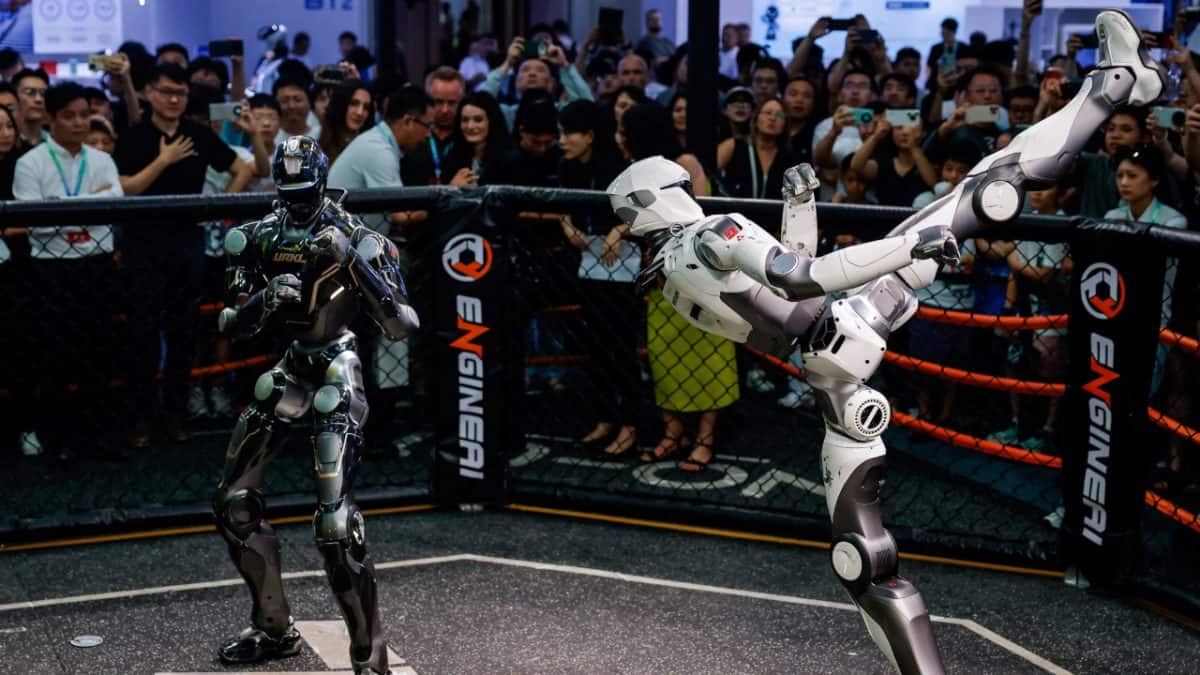
China is building many different kinds of robots very quickly.
Some humanoid robots can dance, run, play games and move objects.
More than 2,000 robots were shown at a major conference.
The industry has received a very large amount of investment and government support.
However, robots can still fail at simple jobs, such as folding a shirt or stopping safely after running.
This means an impressive video does not always prove that a robot can work reliably every day.
Experts say the biggest challenge is teaching robots to understand new places and react without constant human help.
China may have an advantage because it has many companies and strong manufacturing support.
The technology could keep improving, but it is not yet clear when dependable humanoid robots will become common.

More than 2,000 robots were displayed at China’s World Robot Conference, including humanoid, quadruped and experimental machines.
China’s robotics expansion is supported by numerous companies, government policy and an estimated $138 billion investment in embodied AI.
Companies such as UBTECH and Unitree Robotics demonstrated robots handling industrial components, sorting objects, dancing and playing games.
Failures involving shirt-folding, running and balance highlighted the gap between viral demonstrations and dependable autonomous work.
China’s 2026–2030 policy plan gives embodied intelligence a larger role, while United States companies pursue domestic manufacturing and potential security applications.
- Who
- Chinese humanoid-robot companies, including UBTECH and Unitree Robotics, along with United States robotics companies and distributors.
- What
- China’s humanoid-robot industry is expanding rapidly, while demonstrations and failures raise questions about the technology’s reliability and future scale.
- Where
- The demonstrations took place in China; related United States manufacturing and security efforts involve New York, the US border and other locations.
- When
- The discussion centers on the ongoing World Robot Conference, China’s March 2026 policy planning, and targets extending to 2027 and beyond.
- Why
- China is pursuing robotics for manufacturing, digital transformation, elderly care, national security and other sectors, while the United States is responding to concerns about dependence on Chinese-made robots.
Industry Optimists
Reliability Skeptics
China’s competitive position
Industry Optimists
China may have an edge because it has more humanoid-robot companies, substantial government support, manufacturing capacity and large investment.
Reliability Skeptics
The industry’s advantage is not yet proof that its robots can perform unfamiliar tasks reliably or operate independently at scale.
Meaning of demonstrations
Industry Optimists
Robots are increasingly performing practical activities such as moving industrial components, sorting objects, handling parcels and packaging phones, suggesting rapid progress beyond entertainment.
Reliability Skeptics
Viral demonstrations can conceal narrow or controlled capabilities; failures such as an inability to fold a shirt or stop before hitting a wall expose the gap between spectacle and dependable work.
Near-term outlook
Industry Optimists
Policy support and an “AI+” programme could help integrate robotics into factories, public services and other sectors, accelerating improvement.
Reliability Skeptics
The crucial software needed to understand unfamiliar environments and adapt without constant programming remains unresolved, and the timing of a major breakthrough is uncertain.
Key facts
- Conference display
- More than 2,000 robots were showcased at the World Robot Conference.
- Chinese investment
- China’s embodied-AI investment is estimated at $138 billion.
- UBTECH target
- UBTECH has projected deliveries of more than 10,000 humanoid robots by 2027.
- Key limitation
- Robots demonstrated failures in shirt-folding, balance, navigation and stopping safely.
- Policy period
- China’s draft 15th Five-Year Plan covers 2026 to 2030 and gives dedicated attention to embodied intelligence.
- Potential software timeline
- Unitree CEO Wang Xingxing said major software advances could arrive in two or three years in an optimistic scenario, or take five to 10 years on a slower path.
- US manufacturing plan
- RoboStore announced a planned 66,000-square-foot Long Island facility intended to manufacture commercial robots by the first fiscal quarter of 2027.
Quotes
Jeff Burnstein
President of the Association for Advancing Automation
“[The Chinese] have more companies developing humanoids and more government support than anyone else. So, right now, they may have an edge.”
 firstpost.com
“We’ve sold over 1,500 robots and deployed them and worked with customers like Cisco, OpenAI, Nvidia, and over 150 universities”
firstpost.com
Sources
Related news
China Pushes Humanoid Robots From Spectacle Toward Industrial Workforce

China’s Humanoid Robot Industry Chases a ChatGPT Moment
China’s Humanoid Robot Boom Races Ahead of Real-World Readiness
China’s Humanoid Robot Makers Pursue Practical Commercial Uses
Chinese Humanoid Robot Takes Center Stage at Ujjain Shop Opening

China Robot Makers Push Humanoids Toward Everyday Use

Tesla Expands Ahmedabad Network With Body Shop, Model Y Drives
Ather Energy Stock Surges 130%, Outpacing Tesla and BYD

Pakistan’s Remote-Controlled Driverless Car Crashes Into Police Van

SpaceX Plans Texas Foundry to Ease AI Power Bottleneck

Musk Warns Climate Action Alone May Not Save Humanity
