5 hrs ago
Supreme Court Extends Three-Language Relief to Class VI
The CBSE changed its language rules for some middle-school students.
The new rule says that two of the three languages must be Indian languages.
This could have forced some Class VI students to stop studying one of two foreign languages.
The Centre asked the Supreme Court to let the new rule apply this year.
The court rejected that request.
It said Class VI students should receive the same relaxation as Class VII students.
These students can continue with their existing language choices for now.
They will receive appearance certificates instead of pass-or-fail marks under the exemption.

The Supreme Court directed the CBSE to exempt this year’s Class VI students from the new compulsory three-language formula.
Class VI students may continue studying two foreign languages, matching the relaxation already granted to Class VII and VIII students.
The Centre argued that the policy should apply because nearly all CBSE schools had the required textbooks and students had chosen the scheme.
The court ordered that affected students receive appearance certificates, with no pass-or-fail marks under the exemption.
Southern states have alleged that requiring two Indian languages could introduce Hindi in non-Hindi-speaking states.
- Who
- The Supreme Court, the Central Board of Secondary Education, the Centre, and Class VI students are involved.
- What
- The court directed the CBSE to extend the existing language-policy exemption to this year’s Class VI students.
- Where
- The decision applies to CBSE schools across India, including non-Hindi-speaking states.
- When
- The direction was issued on Monday, during the current academic year’s implementation of the new formula.
- Why
- The exemption prevents Class VI students already studying two foreign languages from being forced to switch to a second Indian language this year.
Court and language-policy critics
Centre and CBSE position
Applying the new formula this year
Court and language-policy critics
The Supreme Court said Class VI students should receive the same relaxation as Class VII students, while southern states have criticized the two-Indian-languages requirement as a possible way to introduce Hindi in non-Hindi-speaking states.
Centre and CBSE position
Solicitor-General Tushar Mehta urged the court to allow the new policy for Class VI, arguing that almost all CBSE schools had the required textbooks and that students had opted for the scheme.
Key facts
- Decision
- The Supreme Court ordered the CBSE to extend the Class VII relaxation to Class VI students.
- Language rule
- The new formula requires two of three studied languages to be Indian languages.
- Affected students
- This year’s Class VI students who were studying two foreign languages can continue doing so.
- School network
- The CBSE has 28,819 schools across the country, according to the solicitor-general.
- Textbook readiness
- The Centre said 1.2 per cent of CBSE schools were not yet fully equipped with the new textbooks.
- Assessment
- The court said there would be no pass-or-fail marks and that students would receive appearance certificates.
- Related classes
- Relaxations had already been provided to this year’s Class VII and VIII students; Class IX students in the same situation also received an exemption.
Quotes

Supreme Court bench
The bench comprising Chief Justice Surya Kant, Justice Joymalya Bagchi and Justice V. Mohana
“We direct that the students of 6th standard may be granted the same exemption as granted to class 7 students.”
 telegraphindia.com
“There will be no pass/ failure marks. There will be only appearance certificates…”
telegraphindia.com
Sources
Related news
Supreme Court Extends CBSE Language Exam Exemption To Class 6
Government Reconsiders CBSE Three-Language Rule for Class VI Students
Supreme Court Seeks Class VI Exemption From CBSE Language Policy
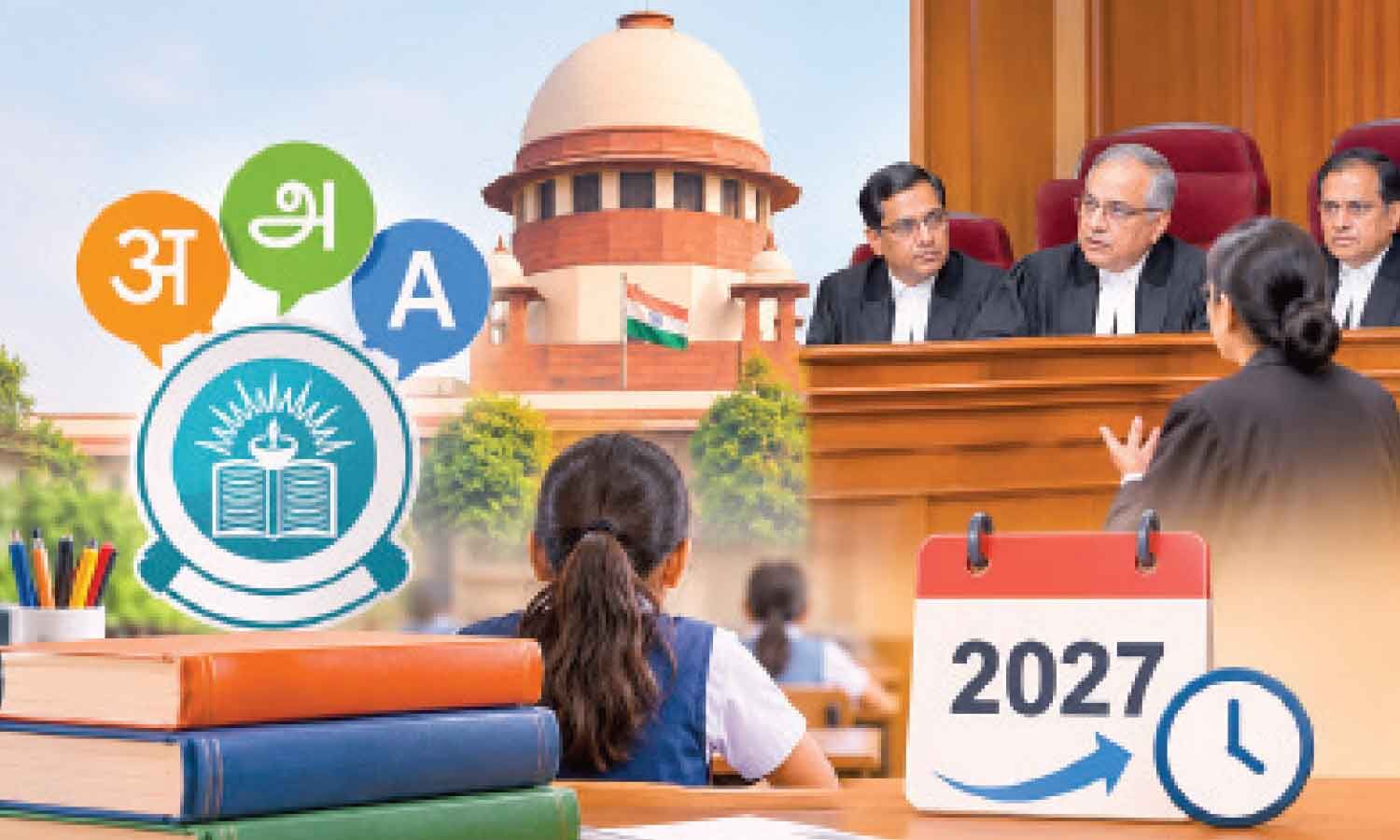
Supreme Court Urges CBSE to Defer Class 6 Language Policy
Centre Develops CBSE Three-Language Policy Implementation Plan

Teacher Raises Pressure Concerns Over Delayed NCERT Books

Delhi Government Forms Panel After Satya Niketan Collapse
Supreme Court Questions Bengaluru Infrastructure Amid Premium FAR Case

Supreme Court Seeks Former High Court Chief Justice Panel