1 hr ago
Report places India among countries with severely restricted academic freedom
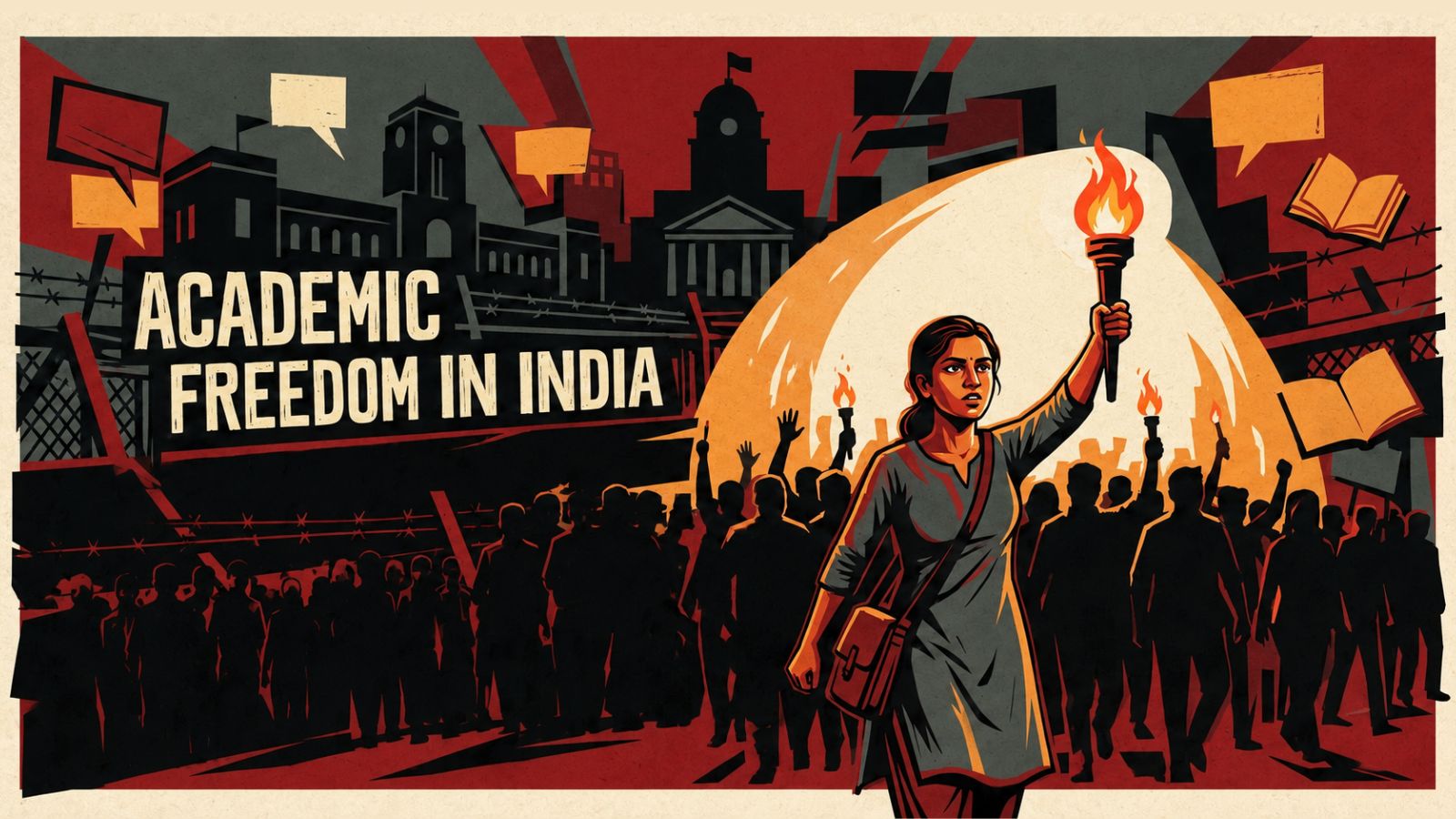
A new report says academic freedom in India is severely restricted.
Academic freedom means teachers and students can research, teach and speak without unfair interference.
The report says the government has become more involved in universities.
It also says some teachers were dismissed and some academic events were cancelled.
Students and professors faced pressure over protests, public statements and campus debates.
The report mentioned cases involving Snehashish Bhattacharya and Lora Santhakumar.
India’s score fell from 0.38 in 2022 to 0.14 in 2025.
India was placed above China in the comparison, but both countries had very low scores.
The report studied attacks and restrictions on higher education around the world.

Scholars at Risk classified India’s academic freedom as “severely restricted” in its 2026 report.
The report attributed the decline to greater government involvement in university governance, appointments and academic priorities.
India’s Academic Freedom Index score fell from 0.38 in 2022 to 0.14 in 2025.
The report cited faculty dismissals, cancelled events, student-expression restrictions and pressure on protesters.
India ranked above China in the comparison, although both countries were placed in different restriction categories.
- Who
- Scholars at Risk, an international higher-education monitoring network, assessed India alongside other countries and territories.
- What
- The organization classified India’s academic freedom as “severely restricted” and reported a major decline in its index score.
- Where
- India, with comparisons involving China, Ukraine, the West Bank and other countries and territories.
- When
- The report covered July 1, 2025, to June 30, 2026; India’s cited score fell between 2022 and 2025.
- Why
- The report linked the classification to increased government involvement, restrictions on campus expression, faculty dismissals, cancelled events and pressure on protesters.
Report’s concerns
Institutional and official explanations
Faculty dismissals
Report’s concerns
The report presented dismissals as examples of pressure on academic freedom, citing Snehashish Bhattacharya and Lora Santhakumar.
Institutional and official explanations
South Asian University described Bhattacharya’s termination as resulting from “misconduct against university interests,” while the report said Santhakumar was dismissed after a social-media post opposing war.
Government role in universities
Report’s concerns
Scholars at Risk said the Central government had expanded its role in university governance, leadership appointments and academic priorities, with the University Grants Commission serving as a vehicle for state influence.
Institutional and official explanations
The report identified policy changes and institutional actions but did not provide a separate government response disputing those conclusions.
Campus protests and expression
Report’s concerns
The report said students and faculty faced restrictions, pressure, online abuse and clashes connected to protests, events and debates about national identity, caste, religion and history.
Institutional and official explanations
The report also said students and police committed acts of violence at protests or campus gatherings, and that opposing student groups sometimes clashed.
Key facts
- Report
- Scholars at Risk’s “Free to Think 2026”
- Global scope
- 382 attacks on higher education communities across 59 countries and territories
- India’s category
- Severely restricted
- India’s index score
- 0.14 in 2025, down from 0.38 in 2022
- Countries in the same category
- Hong Kong, Indonesia, Pakistan, the West Bank and Ukraine
- Lowest category
- “Completely restricted,” including China, Afghanistan, Iran and Russia
- Cited cases
- Faculty members Snehashish Bhattacharya and Lora Santhakumar
- Court-related claim
- The report described a March 11, 2026, Supreme Court order as imposing a “life ban” on three academics from public curriculum-development funding
Quotes
Scholars at Risk report
International higher-education monitoring report
“Both students and police committed acts of violence at protests or other campus gatherings. Academic freedom was ‘severely restricted’ in 2026.”
 indianexpress.com
“Policy shifts, academic decisions and debates about national identity, caste, religion and historical interpretation led to student protests.”
indianexpress.com
Lora Santhakumar
Assistant professor at SRM Institute of Science and Technology
“Say NO to war. And don’t be afraid to say so, even if it is not the popular opinion.”
indianexpress.com
Sources
Related news

BJP Rule and the Erosion of Academic Freedom in India
Higher Education Secretary’s UGC Charge Sparks Autonomy Concerns
Bengal University Transfer Bill Raises Autonomy Concerns
West Bengal University Bill Renews Debate Over Academic Liberty
Bengal Assembly Passes Controversial University Staff Transfer Bill

UGC Invites Nominations for Srinivasan Award in Low Temperature Physics
UGC Orders Disability Compliance, Data Submission By September 2026

AP PGECET 2026 Counselling Schedule Sets September Registration and Allotment