1 hr ago
India’s Drone Industry Turns to Localising Critical UAV Components
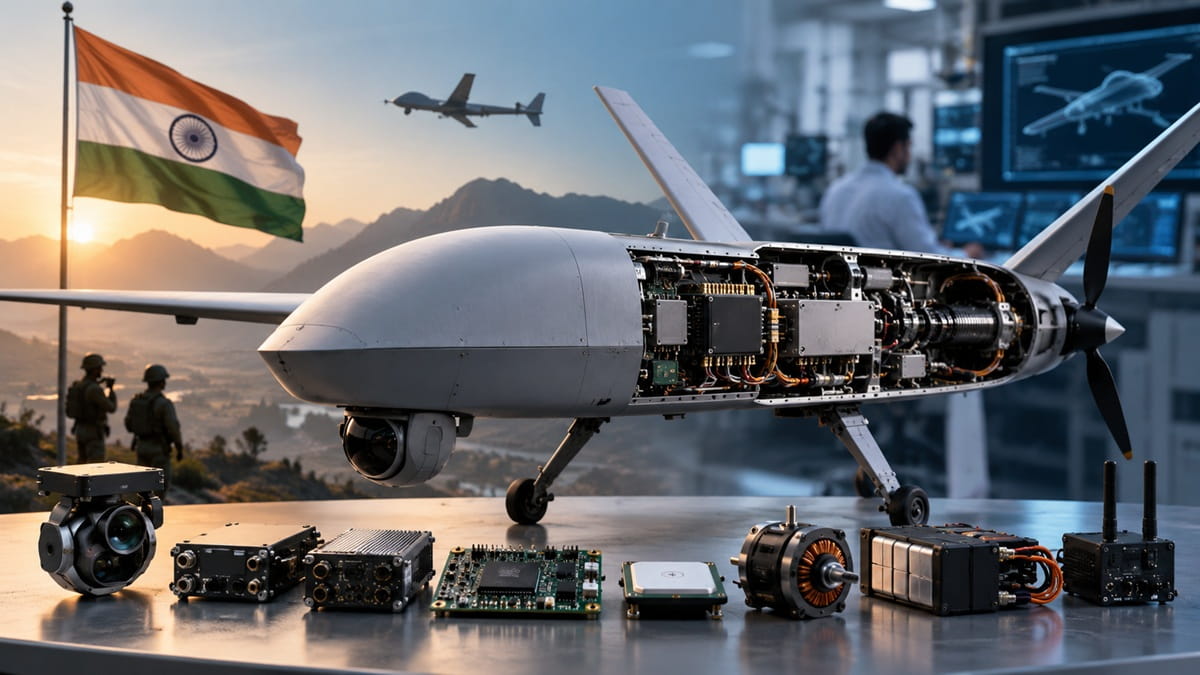
India makes and assembles many drones, but some important parts still come from other countries.
These parts include systems that help drones fly, navigate, communicate and see.
Companies such as Paras Defence and AKSI Aerospace Group say India needs to make more of these important systems itself.
This would give India greater control over upgrades, repairs, cybersecurity and future use of military drones.
Replacing foreign parts can be difficult because domestic companies may produce fewer units and face higher costs.
They also need to pass demanding tests before the military accepts their products.
The article says companies making parts could supply several drone makers instead of selling only complete drones.
Such suppliers may earn repeat business after their systems are approved.
However, the article says India may need to localise the most sensitive technologies first rather than eliminate every import immediately.

India’s drone sector is shifting from assembling airframes toward developing domestic mission-critical subsystems.
Paras Defence and AKSI Aerospace Group identify sensors, avionics, navigation, communications, propulsion and flight-control systems as key localisation priorities.
Imported components can create strategic dependencies involving software, upgrades, cybersecurity, supply and lifecycle support.
Domestic alternatives face challenges involving cost, production scale, testing, certification, raw materials and technological maturity.
Subsystem makers could gain higher-margin, recurring business by supplying multiple UAV platforms after completing defence qualification processes.
- Who
- India’s drone industry, including Paras Defence and Space Technologies, AKSI Aerospace Group and other defence suppliers.
- What
- The industry is moving toward domestic production of critical UAV subsystems rather than focusing mainly on assembling complete drones.
- Where
- India.
- When
- The article describes an ongoing shift; its stock-market reference concerns Friday, September 4, with no year specified.
- Why
- To reduce strategic dependence on foreign-controlled technologies and strengthen control over military UAV performance, upgrades, cybersecurity and lifecycle support.
Prioritise Strategic Localisation
Phase In Localisation Pragmatically
Strategic control
Prioritise Strategic Localisation
India should develop domestic control over mission-critical systems because foreign-controlled electronics can affect navigation, communications, cybersecurity and military reliability.
Phase In Localisation Pragmatically
India does not need to eliminate every import immediately and can continue sourcing some commodity components from trusted global suppliers.
Replacing foreign components
Prioritise Strategic Localisation
Reducing dependence on overseas suppliers, including strategically sensitive supply chains, would strengthen operational sovereignty.
Phase In Localisation Pragmatically
Replacing components can require software changes, hardware integration, testing, reliability validation and possible customer requalification.
Business focus
Prioritise Strategic Localisation
Specialised subsystem suppliers may capture higher-value and recurring revenue by serving multiple UAV manufacturers.
Phase In Localisation Pragmatically
Localisation must first overcome higher initial costs, limited scale, certification demands and supply-chain constraints before becoming commercially competitive.
Key facts
- Localisation priority
- Autonomy, navigation, sensing, communication, control and survivability technologies.
- Key subsystem areas
- Flight controllers, autopilots, sensors, electro-optics, avionics, datalinks, batteries, propulsion and mission systems.
- Main risks of imports
- Dependence on overseas software, firmware, availability, upgrades, supply and maintenance.
- Indicative commercial margins
- AKSI cited 20–30% for assembled commercial and agricultural drones, 30–50% for subsystems and potentially 45–60% for autopilots and flight-control systems at scale.
- Qualification value
- Successful testing and vendor-development processes can lead to multi-year production and lifecycle supply opportunities.
- Immediate policy approach
- Paras Defence said 100% localisation should be a long-term aspiration, with mission-critical technologies prioritised first.
- Paras Defence stock reference
- Shares closed at Rs 1,414.50 on Friday, September 4, after falling 1.72% over the week.
Quotes

Paras Defence and Space Technologies
Indian defence electronics and optical-systems company
“A UAV can be designed and assembled domestically, but genuine technological sovereignty requires control over its mission-critical subsystems”
 financialexpress.com
“100% localisation should be treated as a long-term aspiration rather than an immediate requirement.”
financialexpress.com
Pankaj Akula
Group Managing Director of AKSI Aerospace Group
“A drone assembled in India can still carry significant strategic dependency if its flight controller, propulsion electronics, communications, sensors, batteries or navigation stack originate overseas”
financialexpress.com
Sources
Related news
India’s Defence Indigenisation Targets 405 Components Across Supply Chains
India’s Defence Electronics Shift Opens Rs 3,100-Crore Opportunity
India’s Defence Push Must Advance From Production To Technology

India Urged to Monitor Potential Ukraine-Pakistan Drone Technology Transfer

Modi urges big leap in defence manufacturing for India

Mysuru Dasara Plans Expand With Southern States, Armed Forces
Revanth Reddy Inaugurates Hyderabad’s 3.32-Km Chanchalguda Steel Flyover

DRDO, University of Hyderabad Researchers Patent New Rocket Propellant

Revanth Reddy Invites Rajnath Singh to Telangana Defence Summit