

3 weeks ago
India seeks to turn offshore wind potential into large-scale deployment
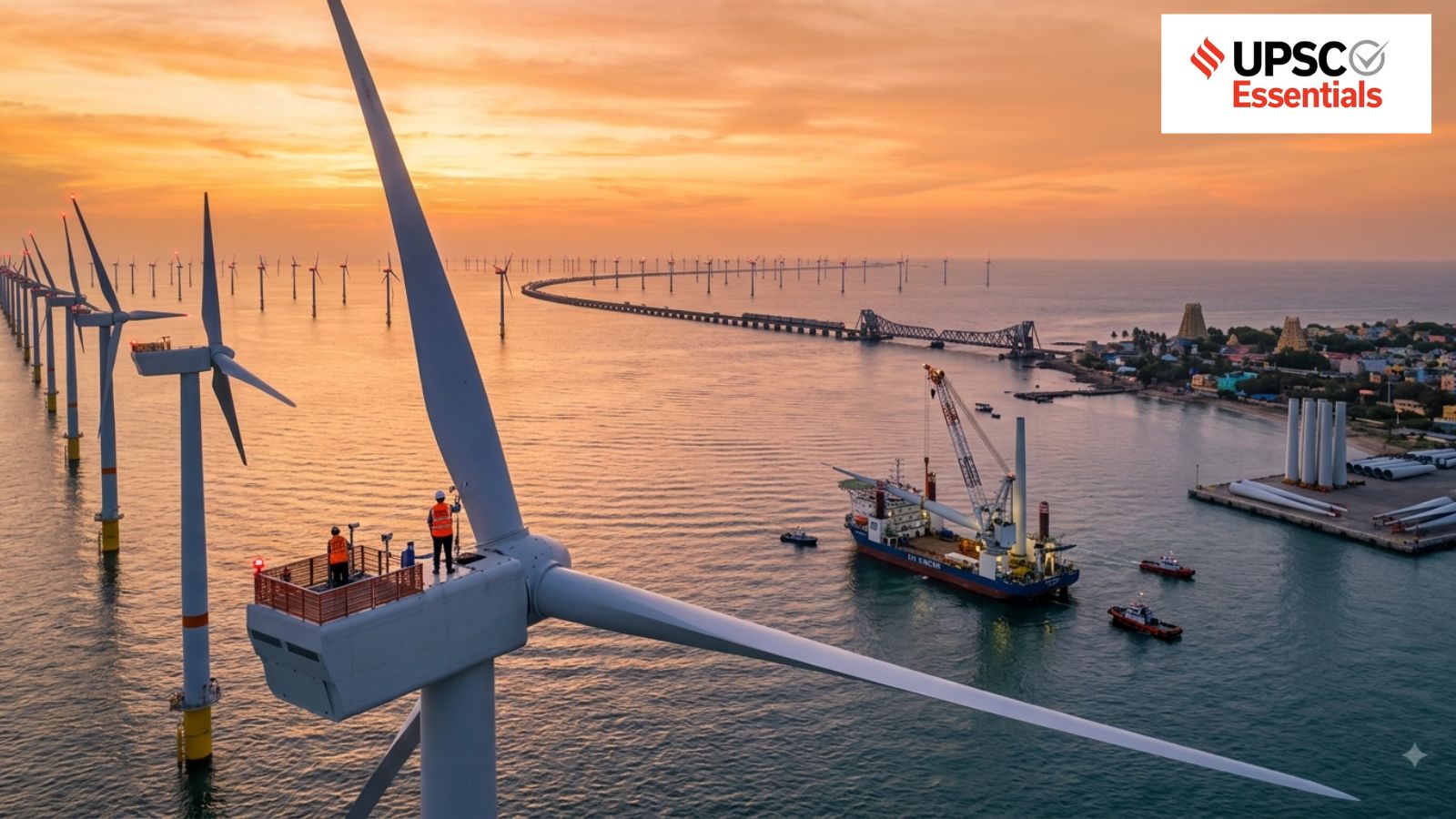
Do you know what wind farms are?
They use big fans, called turbines, that spin in the wind to make electricity.
Some wind farms are built in the ocean, and India wants to build more of those.
The wind over the sea is stronger and blows more steadily than on land, so ocean wind farms can make electricity even in the evening.
India's coastline is very long — about 7,600 kilometres — so there is lots of sea to use.
India hopes to build enough ocean wind farms to power millions of homes by 2030.
But building in the sea is tricky and costs about twice as much as building on land.
You need special boats, strong underwater foundations and cables that carry electricity under the sea.
Some early plans did not attract any companies because the projects were so expensive.
To help, the government is offering money support and improving ports so companies will want to build there.

India has identified more than 70 GW of technical offshore wind potential, mainly off Gujarat and Tamil Nadu, and set a 30 GW deployment target by 2030.
Offshore wind projects cost around Rs 18–20 crore per MW, nearly twice as much as onshore wind or utility-scale solar, and require specialised vessels, seabed foundations and subsea cables.
Initial auctions failed to attract bidders: a 500 MW grid-connected project off Gujarat and a 4 GW seabed lease auction off Tamil Nadu received no bids.
India's policy toolkit includes the 2015 National Offshore Wind Energy Policy, the 2023 Offshore Wind Strategy Paper (37 GW auction roadmap) and Viability Gap Funding.
Globally, 9.3 GW of offshore wind was grid-connected in 2025, lifting cumulative capacity to about 92.5 GW, with the UK, Germany and Netherlands leading additions.
- Who
- The Government of India, through the Ministry of New and Renewable Energy and the National Institute of Wind Energy, along with partners including the UK and Norway.
- What
- India is working to scale up offshore wind energy deployment through policy frameworks, financial support, transmission planning and global partnerships, targeting 30 GW by 2030.
- Where
- India, particularly the coasts of Gujarat and Tamil Nadu, within its 200-nautical-mile Exclusive Economic Zone.
- When
- The push gathered momentum in 2025–2026, including the Samudra Manthan scheme approved on 31 July 2026 and the Global Wind Day Conference on 15 June 2026 in Goa.
- Why
- To strengthen energy security amid global supply disruptions, diversify the renewable energy mix, meet rising electricity demand and benefit from stronger, more stable sea winds.
Government push
Market caution
Offshore wind viability
Government push
Offshore wind offers stronger, steadier winds and capacity factors of 40–50%, contributing to energy security, grid stability and efficient use of land.
Market caution
Projects cost nearly twice as much as onshore wind or solar and carry high capital, construction, transmission and electricity-price risks, making them hard to finance.
Auction and incentive design
Government push
Development models with Viability Gap Funding, port upgrades and transmission planning provide enough support to kick-start deployment.
Market caution
Even with government support, developers found the initial 500 MW Gujarat project and 4 GW Tamil Nadu auction unattractive, showing incentives still do not close the cost gap.
Key facts
- Offshore wind target
- 30 GW by 2030
- Technical potential
- More than 70 GW, mainly off Gujarat and Tamil Nadu
- Coastline length
- About 7,600 km
- Project cost
- Rs 18–20 crore per MW, nearly twice onshore wind or solar
- Auction roadmap
- 37 GW of site leases by 2030 under the 2023 Offshore Wind Strategy Paper
- Global capacity (2025)
- 9.3 GW added; cumulative about 92.5 GW
- First commercial offshore wind farm
- Vindeby, Denmark, commissioned in 1991
- Transmission planning
- Completed for initial 10 GW (5 GW each for Gujarat and Tamil Nadu)
Sources
Related news

PM Modi: 99% 'no-go' coastal waters now open for exploration
India’s Samudra Manthan Funds Deepwater Exploration to Cut Oil Imports
Samudra Manthan: India's Offshore Oil Push Targets Energy Security
BP Evaluates Indian Deepwater Blocks Under Samudra Manthan
MP Pushes Andhra Pradesh for Bigger Share in Samudra Manthan

India's Power Capacity Reaches 552 GW, Non-Fossil Share 54%
India’s Non-Fossil Capacity Crosses 300 GW as Centre Pushes Transition

Karnataka Accelerates Rooftop Solar Projects for Government Buildings
Economy Quiz Covers Solar Projects, Forex Deposits And PPPs
Rajasthan Targets 125 GW Renewable Capacity by 2030
PM Surya Ghar May Tie Support to Solar Performance
