Science & Tech · Space · 4 hrs ago
Solar Orbiter traces a solar wind kink to the Sun’s surface
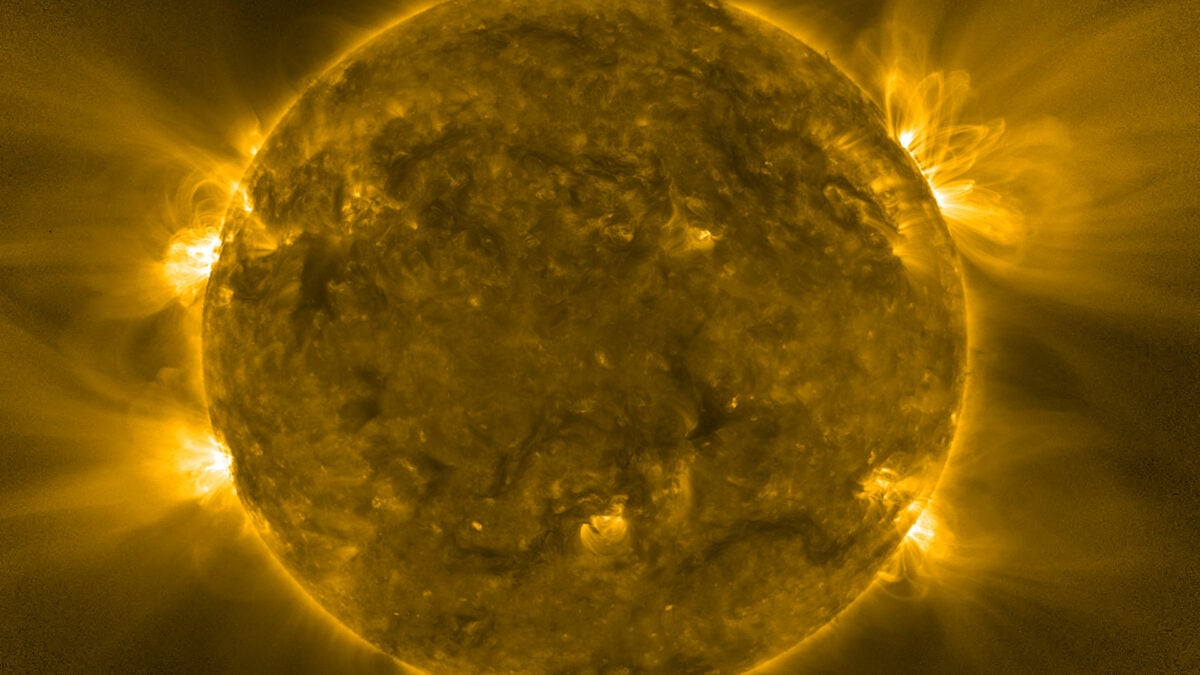
In 2022, the European Space Agency’s Solar Orbiter spacecraft passed through an S-shaped kink in the stream of charged particles flowing from the Sun.
The kink, called a switchback, is a sharp bend in the Sun’s magnetic field.
Researchers examined oxygen and carbon particles inside it and traced them to hot magnetic loops on the Sun’s surface.
Their findings point to a process called interchange reconnection, in which parts of the Sun’s magnetic field interact and release trapped plasma into space.
This offers evidence for how the solar wind forms and how the Sun heats its atmosphere.
The solar wind can influence Earth and is linked to space weather that can affect technology and infrastructure.
The findings could help scientists improve predictions of extreme space weather, though the sources give no specific next steps.

Solar Orbiter traced an S-shaped solar-wind switchback to the Sun’s surface.
The spacecraft observed the switchback in 2022 and sampled its plasma with the Solar Wind Analyser.
The mix of charged oxygen and carbon particles pointed to plasma released from hot magnetic loops through interchange reconnection.
The finding sheds light on how the Sun heats its atmosphere and accelerates solar wind particles.
Researchers say the results could help improve understanding and prediction of extreme space weather.
- Who
- The Solar Orbiter spacecraft and a team of scientists led by Jesse Coburn.
- What
- Scientists traced an S-shaped solar-wind switchback to the Sun’s surface.
- When
- Solar Orbiter observed it in 2022; the study was reported in 2026.
- Where
- The switchback was detected in the solar wind, and its source was traced to the Sun’s surface.
- Why
- To understand how switchbacks and solar wind form, and improve knowledge of extreme space weather.
This story does not have two clearly opposing sides.
Solar Orbiter flew through and observed an S-shaped stream of charged particles.
Scientists used Solar Orbiter’s Solar Wind Analyser to sample the switchback’s plasma.
Researchers identified the switchback’s source on the Sun’s surface and linked its formation to interchange reconnection.
- Spacecraft
- Solar Orbiter
- Observation year
- 2022
- Shape
- S-shaped switchback
- Particles detected
- Charged oxygen and carbon
- Proposed formation process
- Interchange reconnection
- Journal
- Nature Astronomy
What people are saying
The specific mix of particles detected by Solar Orbiter is the smoking gun for a formation process known as ‘interchange reconnection’.
The more we know, the better we can prepare for solar storms to protect our space-based infrastructure and technology.
Sources
Related news

Perseverance sets Mars driving record at 28.10 miles

SpaceX set to send solar arrays and supplies to the space station

All nine Nuriho rideshare satellites establish contact
Valkyrie combat drone completes first flight test in Europe
Anduril develops modular interceptor missile family for US air defenses

SpaceX plans to launch 27 Starlink satellites from California
Red dwarf appears to slowly draw matter from a brown dwarf

French astronaut Sophie Adenot says space brought a full range of emotions

NASA releases nearly 800 GB of Artemis II lunar data
Black hole in NGC 1275 launches radio jets after an X-ray flare

NASA releases more than 800GB of Artemis II mission data