

Science & Tech · Space · 3 hrs ago
New simulations suggest rare process forms Mars's giant Arsia Mons cloud
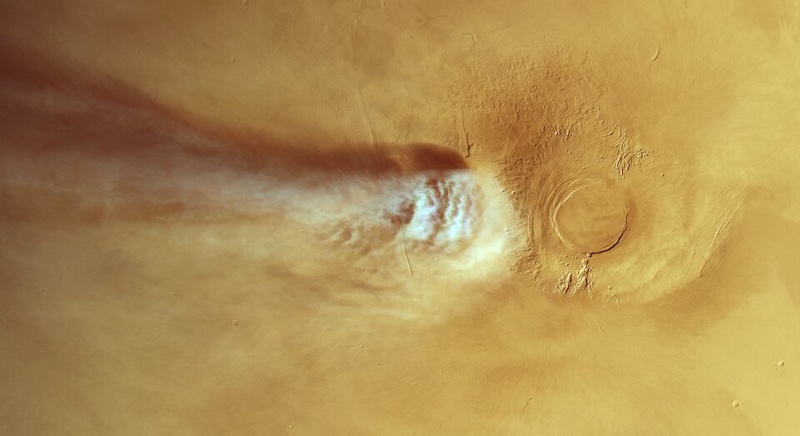
A giant cloud forms each spring and summer downwind of Arsia Mons, a volcano on Mars.
Called the Arsia Mons Elongated Cloud, it can stretch up to 1,500 kilometers and grows and fades each day.
The European Space Agency’s Mars Express spacecraft first observed it in 2018, but its size and daily cycle have been hard to explain.
A team from Sorbonne University in France used new simulations to model the cloud’s formation.
The results suggest water vapor may turn directly into ice particles, without first attaching to dust or other particles.
This process, called homogeneous nucleation, is theoretical and has not been observed in a planetary atmosphere.
The findings could help explain how this unusual Martian cloud forms, but the supplied information does not say what researchers plan to do next.

New simulations suggest that the Arsia Mons Elongated Cloud forms through a rare process called homogeneous nucleation.
The process involves water vapor turning directly into icy cloud particles without first condensing on seed particles.
The cloud forms downwind of the Arsia Mons volcano on Mars every spring and summer.
It can stretch up to 920 miles (1,500 km) and grows and fades each day.
Researchers from Sorbonne University reported the simulations in a peer-reviewed paper published in Nature Geoscience on October 7, 2026.
- Who
- Researchers from Sorbonne University in Paris, France, led by Jorge Hernández-Bernal.
- What
- New simulations suggest a rare process called homogeneous nucleation forms the Arsia Mons Elongated Cloud.
- When
- It forms each spring and summer on Mars. The study was published on October 7, 2026.
- Where
- Downwind of Arsia Mons, a volcano on Mars.
- Why
- The simulations suggest water vapor forms icy particles directly, without needing seed particles.
This story does not have two clearly opposing sides.
The European Space Agency’s Mars Express orbiter first saw the cloud.
Mars Express took an image of the cloud.
Researchers reported the simulations and published their peer-reviewed paper in Nature Geoscience.
- Cloud name
- Arsia Mons Elongated Cloud (AMEC)
- Location
- Downwind of Arsia Mons on Mars
- Maximum length
- 920 miles (1,500 km)
- First observed
- 2018 by the European Space Agency’s Mars Express orbiter
- Study date
- October 7, 2026
What people are saying
To create the AMEC in our modeling, we found that we needed to include some exotic physics … physics that, while included in textbooks, is treated as theoretical and usually thought not to happen in nature.
For the AMEC, it seems that cloud formation takes place without needing any of this ‘stuff.’
Sources
Related news
NASA’s Perseverance rover sets record with 45.2km driven on Mars

SpaceX rocket plume creates a glowing ‘jellyfish’ in the dawn sky

Hubble data point to a possible second-generation planet around a white dwarf

ORBES plans to send robots to the ISS and capture exterior footage

Vast engineer Brianna Clark works on technology for future space living

FAA analyst Kayla Bigham works to keep commercial spaceflight safe

Gold nanogap sensor distinguishes amino acid handedness
Halley's Comet disappointed many viewers in 1986 but advanced astronomy
Aquarius is best seen on autumn evenings in the Northern Hemisphere

NASA predicts two solar eclipses in 2027
Landsat 9 captures a mosaic of farms around Taiwan’s longest river
