

Science & Tech · Space · 2 hrs ago
JWST observations reveal two main drivers of weather on SIMP 0136
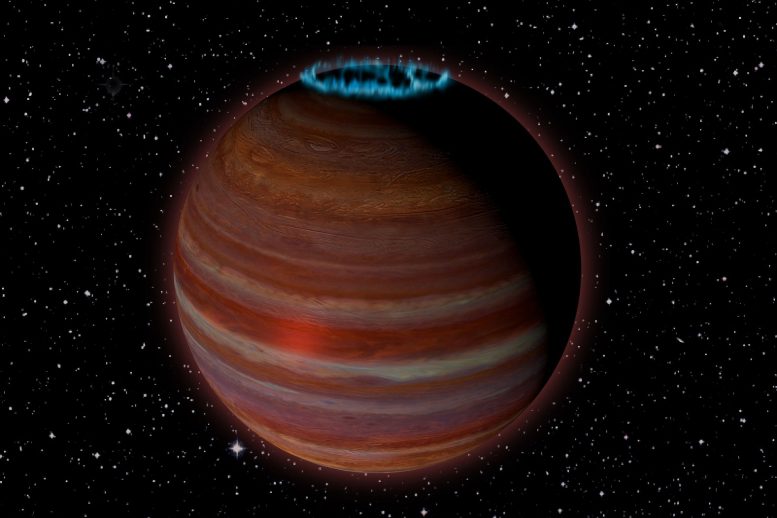
SIMP 0136 is a brown dwarf about 20 light-years from Earth, larger and hotter than a gas giant but too small to sustain the hydrogen fusion that powers a star.
Its atmosphere has fast-changing clouds, and its rotation brings different regions into view.
Using observations from NASA’s James Webb Space Telescope, scientists at Trinity College Dublin found that two main processes explain much of the changing light: temperature shifts and changes in the clouds’ vertical structure.
These processes appear in three recurring weather states, including hotter regions with thinner clouds and cooler regions with thicker clouds.
The broad patterns persisted through more than a dozen rotations, even as the atmosphere’s detailed appearance changed.
The researchers used a statistical method to find patterns in the data, rather than starting with a detailed model of the atmosphere.
This approach could help scientists study other brown dwarfs and better understand the atmospheres of distant worlds.

JWST observations indicate that two main processes drive much of the weather variability on brown dwarf SIMP 0136: temperature changes and changes in the vertical structure of its clouds.
Researchers identified three recurring atmospheric states, including regions that are hotter with thinner clouds and cooler with thicker clouds.
The patterns persisted across more than a dozen rotations, even as the atmosphere’s detailed appearance changed.
The study used Principal Component Analysis to identify the strongest patterns in the observations.
The findings were published in Astronomy & Astrophysics.
- Who
- Scientists at Trinity College Dublin studied SIMP 0136. First author Merle Schrader is a PhD candidate in Trinity’s School of Physics.
- What
- JWST observations revealed that temperature and cloud-structure changes are the main drivers of much of the brown dwarf’s atmospheric variability.
- When
- The study was published on 2026-10-12.
- Where
- SIMP 0136 is about 20 light-years from Earth.
- Why
- The researchers used the observations to identify the main sources of atmospheric variability and to better understand weather patterns on the brown dwarf.
This story does not have two clearly opposing sides.
We also discovered that these drivers of the weather patterns on SIMP-0136 persist over time, even as the detailed appearance of the atmosphere evolves over more than a dozen rotations.
The main weather drivers persisted while the detailed appearance of the atmosphere evolved.
The study was published in Astronomy & Astrophysics.
- Distance from Earth
- About 20 light-years
- Main atmospheric drivers
- Temperature changes and changes in cloud vertical structure
- Recurring weather states
- Three
- Observing instrument
- NASA’s James Webb Space Telescope
- Analysis method
- Principal Component Analysis (PCA)
- Publication
- Astronomy & Astrophysics, 2026-10-12
Sources
Related news

US and China face major challenges in building bases on the moon
Scientists believe a small asteroid caused Siberia’s 1908 Tunguska blast
Distant Radio Burst Traced to a Small, Actively Forming Galaxy
Experiment tests how water behaves in simulated lunar gravity

Promising Mars rock sample awaits a plan to return it to Earth
UAE unveils lander for seven-asteroid mission planned for 2028

NASA releases more than 800GB of Artemis II mission data
SpaceX plans to expand Starlink into a major US mobile carrier

Distant radio burst points to a possible young-star origin
NASA and China plan long-term lunar bases as a new space race gathers pace

French astronaut Sophie Adenot says space brought a full range of emotions
