

7 hrs ago
AfD Victory Highlights Europe’s Resurgent, Adaptable Far-Right Challenge
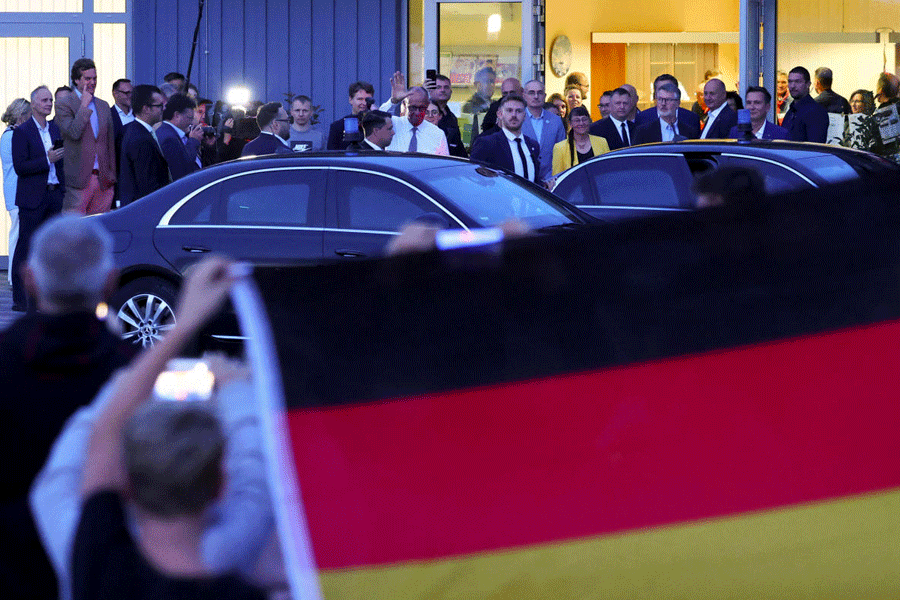
The Alternative for Germany, or AfD, performed very well in a German state called Saxony-Anhalt.
This surprised and worried Chancellor Friedrich Merz’s political party.
The AfD has gained support by speaking about immigration, economic problems, rising prices and inequality.
It has also promoted a controversial idea called “remigration.”
That idea would remove non-ethnic Germans, especially people from Islamic countries.
Some people fear the AfD’s success could encourage similar groups elsewhere in Europe.
However, right-wing parties have not succeeded everywhere.
The editorial says today’s far-right is more flexible and can attract more kinds of voters than earlier extremist movements.

The Alternative for Germany’s victory in Saxony-Anhalt has shaken Chancellor Friedrich Merz’s Christian Democratic Union.
The AfD has expanded by exploiting opposition to austerity, immigration, economic hardship, rising prices and inequality.
Its controversial “remigration” proposal calls for removing non-ethnic Germans, particularly people from Islamic countries.
The result has raised concerns that far-right parties could gain strength in France, Spain and Italy.
The far-right’s progress remains uneven, with setbacks or limits for parties and leaders in the Netherlands, Britain, Hungary and Germany.
- Who
- The Alternative for Germany, Chancellor Friedrich Merz, and his Christian Democratic Union are the main actors; other European far-right parties are also discussed.
- What
- The AfD achieved a major electoral success in Saxony-Anhalt, prompting concern about the broader resurgence of Europe’s far right.
- Where
- Saxony-Anhalt in eastern Germany, with possible implications for other European countries.
- When
- In recent polls in Saxony-Anhalt; the articles do not provide a specific date.
- Why
- The AfD has drawn on public dissatisfaction over immigration, economic hardship, austerity, rising prices and inequality.
Concerns About Far-Right Expansion
Evidence of Resistance and Limits
Meaning of the AfD’s victory
Concerns About Far-Right Expansion
The result has shaken Germany’s mainstream conservatives and could encourage extremist forces in other European countries.
Evidence of Resistance and Limits
The AfD did not win a majority, and the far right’s electoral and ideological success has been uneven across Europe.
Reasons for growing support
Concerns About Far-Right Expansion
The AfD has successfully channelled anger over immigration, economic problems, rising prices, inequality and earlier austerity policies.
Evidence of Resistance and Limits
Other European examples suggest that far-right parties can lose support or moderate their rhetoric when faced with governing constraints.
Nature of the current far right
Concerns About Far-Right Expansion
The editorial argues that today’s far right is more adaptable, populist and capable of reaching broader groups of voters than traditional extremist movements.
Evidence of Resistance and Limits
Political resistance remains possible, as shown by setbacks involving Reform UK, Geert Wilders’s coalition and Viktor Orbán.
Key facts
- Main party
- Alternative for Germany (AfD)
- German state
- Saxony-Anhalt
- German chancellor
- Friedrich Merz
- Political reaction
- Merz said the result had left his Christian Democratic Union “shaken.”
- Controversial proposal
- The AfD’s “remigration” concept advocates the ouster of non-ethnic Germans, especially those from Islamic countries.
- Potential spillover
- The editorial says the result could strengthen extremist constituencies in France, Spain and Italy.
- Limits to far-right gains
- The AfD fell short of a majority, while Reform UK suffered setbacks, Geert Wilders’s coalition collapsed and Viktor Orbán was defeated in Hungary.
Sources
Related news

AfD Victory in Saxony-Anhalt Raises Questions for Europe
Europe’s Rightward Shift Puts Political Establishment Under Pressure

AfD Wins Historic Saxony-Anhalt Vote, Falls Short Majority

AfD Victory in Saxony-Anhalt Signals Major Shift for Germany

Germany Struggles to Counter AfD as Party Reaches New High
AfD Wins Historic Saxony-Anhalt Election, Challenging Germany’s Political Firewall

August 2026 Tied July 2023 as Hottest Month Ever

World Records Warmest August Ever, European Climate Agency Says
