

2 hrs ago
Chemistry Nobel Recognizes Breakthroughs in Molecular Handedness

Some molecules come in two forms that are like left and right hands: they look similar but are mirror images.
Living things often use only one of those forms for certain important molecules.
Henri Kagan found a way for a catalyst to help make more of one form than the other.
Kenso Soai later showed that a molecule could help make more copies of its own form.
This kind of control can help researchers make medicines more carefully.
The two forms can behave differently in the body, so choosing the right one matters.
The article says Kagan's work helped with the synthesis of the anti-HIV drug Efavirenz.
Molecular handedness also affects scents, and the article says it is part of the larger mystery of how life developed.

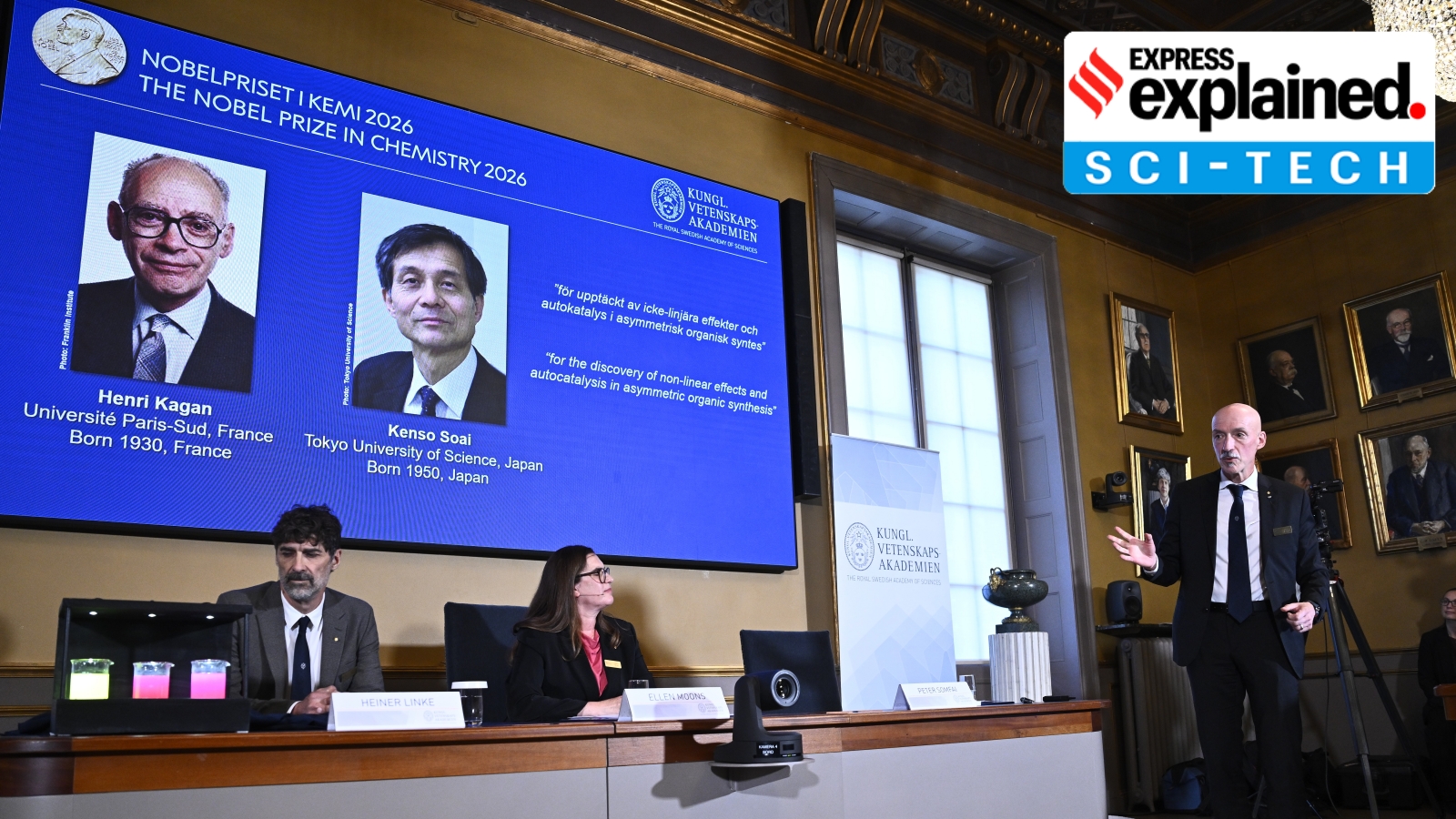
The article says Henri Kagan and Kenso Soai received this year's Nobel Prize in Chemistry for work on asymmetric synthesis.
Kagan showed in 1986 that a chiral catalyst could produce more of one mirror-image form of a molecule.
Soai later demonstrated autocatalysis, in which a molecule acts as a catalyst for producing more of itself.
The work matters in drug development because the two mirror-image forms of a molecule can affect the body differently.
The article links Kagan's research to the synthesis of the anti-HIV drug Efavirenz and discusses chirality in life and perfumery.
- Who
- Henri Kagan and Kenso Soai, named in the article as this year's Nobel Prize in Chemistry laureates.
- What
- They were recognized for advances in asymmetric synthesis and the study of molecular chirality.
- Where
- The article identifies Kagan with the University of Paris-Sud and Soai with the Tokyo University of Science.
- When
- Kagan's cited catalyst research was published in 1986; Soai's autocatalysis work followed nearly two decades later. The article describes the Nobel as awarded this year.
- Why
- Their work helps produce useful amounts of a chosen mirror-image form of a molecule, an important consideration in drug development.
Key facts
- Researchers named
- Henri Kagan and Kenso Soai
- Kagan's cited advance
- In 1986, he showed that manipulating a chiral catalyst could produce an excess of one mirror-image form.
- Soai's contribution
- He demonstrated autocatalysis, where a molecule acts as a catalyst for producing more of itself.
- Drug example
- The article credits Kagan's amplification of a molecular mirror form with effective synthesis of the anti-HIV drug Efavirenz.
- Other medicine mentioned
- Levodopa is cited as containing one effective chiral form.
- Life's molecular orientation
- The article says amino acids are L-configured, while sugars in DNA and RNA are D-configured.
- Safety context
- The article discusses the Thalidomide crisis as an example of the importance of testing drug molecules and their orientation.
Sources
Related news
Kagan and Soai Win 2026 Chemistry Nobel for Asymmetry

Three Scientists Win 2026 Nobel Medicine Prize for Optogenetics
Anthropic Defends Claude’s Claimed Discovery of a Novel Enzyme

Four Pharma Stocks in Focus After Company Updates
JNU Professor’s Research Linked to Nobel-Winning Optogenetics Discovery
