1 hr ago
IIM Calcutta Startup Develops Bengal-Specific Snake Antivenom Treatment
Snake venom can be different in different parts of India.
Most antivenom makers use venom collected in two Tamil Nadu districts.
Some experts worry that this may make treatment less effective for snakebites in Bengal.
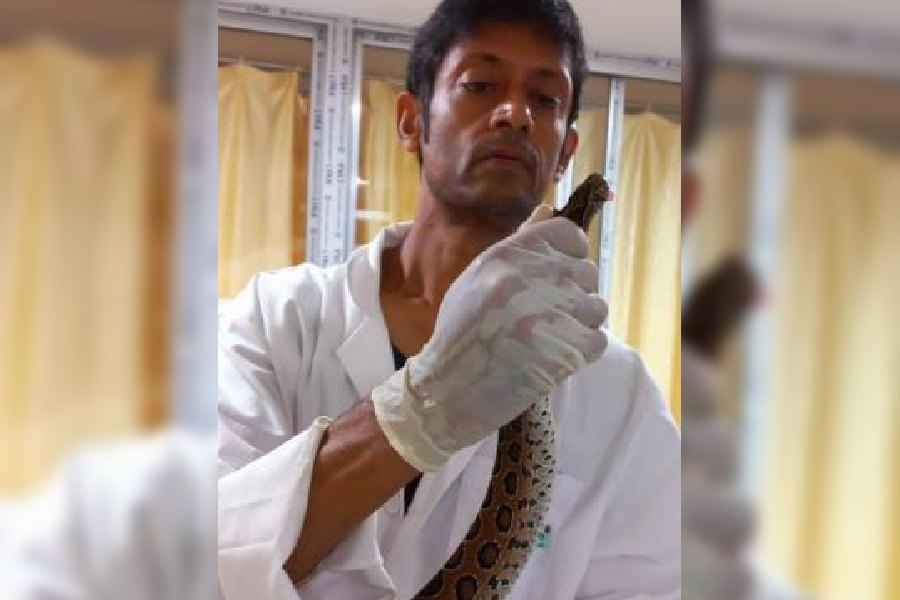
Monosha Biotech is collecting venom from snakes found in Bengal.
It operates a venom laboratory in Baruipur with government cooperation.
The venom will be given to pharmaceutical companies to help make a regional antivenom.
A Bengal health expert said many snakebite deaths involve Russell’s vipers.
The company hopes its first commercial product will be available by 2028.

Monosha Biotech is developing a Bengal-specific antivenom using venom collected from snakes in the state.
Most Indian antivenom manufacturers obtain venom from Chengalpattu and Kanchipuram in Tamil Nadu.
Experts say regional differences in snake venom may create gaps in the effectiveness of standard antivenoms.
The startup received permission to collect snakes and extract venom in 2020, working with Bengal’s forest and health departments.
Monosha’s co-founder Saurabh Ray said the first commercial batch could reach the market by 2028.
- Who
- Monosha Biotech, co-founded by Saurabh Ray and Neha Garodia, with support from IIM Calcutta’s innovation park.
- What
- The startup is developing a Bengal-specific antivenom from venom collected from snakes in Bengal.
- Where
- Venom is extracted at a laboratory in Baruipur, South 24-Parganas, West Bengal, from snakes collected across Bengal.
- When
- Monosha was founded in March 2017, received forest-department permission in 2020, and expects its first commercial batch by 2028.
- Why
- Experts say venom varies by region and that standard antivenoms sourced mainly from Tamil Nadu may not work equally well against snakes in Bengal.
Regional Antivenom Advocates
Existing Antivenom System
Treatment effectiveness
Regional Antivenom Advocates
Monosha Biotech and Bengal experts argue that venom differs by region and that a Bengal-specific antivenom could address treatment gaps.
Existing Antivenom System
The existing system uses polyvalent antivenom made from venom of four medically significant snake species and is administered under national and state protocols.
Evidence for change
Regional Antivenom Advocates
Somnath Das said some patients die despite following guidelines and that there is a strong case for a regional antivenom, particularly because Russell’s vipers cause many Bengal bites.
Existing Antivenom System
The state health department continues to source antivenom from pharmaceutical companies and has sought market interest in region-specific products without yet identifying a final supplier.
Key facts
- Startup
- Monosha Biotech
- Founders
- Saurabh Ray and Neha Garodia
- Incubation support
- IIM Calcutta Innovation Park
- Laboratory location
- Baruipur, South 24-Parganas, West Bengal
- Reported Bengal snakebite deaths
- Around 500 annually
- Expected commercial launch
- 2028
- Main venom sources for Indian manufacturers
- Chengalpattu and Kanchipuram districts in Tamil Nadu
Quotes
Saurabh Ray
Co-founder of Monosha Biotech
“Its work brings together public health, ecology and traditional knowledge, while addressing a critical challenge such as snakebite mortality”
 telegraphindia.com
“Around 500 snakebite deaths are reported in Bengal every year. Some of the deaths happen despite adherence to all the guidelines.”
telegraphindia.com
Sources
Related news
Nanobody Antivenom Shows Promise Against Indian Cobra Venoms

Kolkata’s Monsoon Reveals Snakes Living Alongside Expanding Urban Neighborhoods
India's Snakebite Crisis Reflects Rural Life, Myths, and Medical Gaps
Mitra Institution Student Remains Under Observation After Suspected Snakebite
NHRC Orders States to Improve Snakebite Treatment and Safety
Madhya Pradesh Maps Snake Diversity Amid Rising Bite Concerns

A Book Traces Climate Refugees’ Journey from Bangladesh to Kolkata
Gold and Silver Prices Across Indian Cities on September 21
Petrol and Diesel Prices Hold Steady Across Major Indian Cities
Kolkata Markets and Malls See Puja Shopping Rush