5 hrs ago
Delhi High Court Seeks NTA Reply Over UGC-NET English Retest
A student named Parul Sheoran asked the Delhi High Court to stop a new UGC-NET English exam.
She said the decision to repeat the exam was unfair and was not properly explained.
She also asked officials to process the results from the first English exam.
If the retest continues, she wants the fee from the first exam returned.
The National Testing Agency said three exam papers contained many problems.
These problems included spelling, translation, grammar, punctuation, and repeated-question errors.
The court has asked the agency and the Centre to respond.
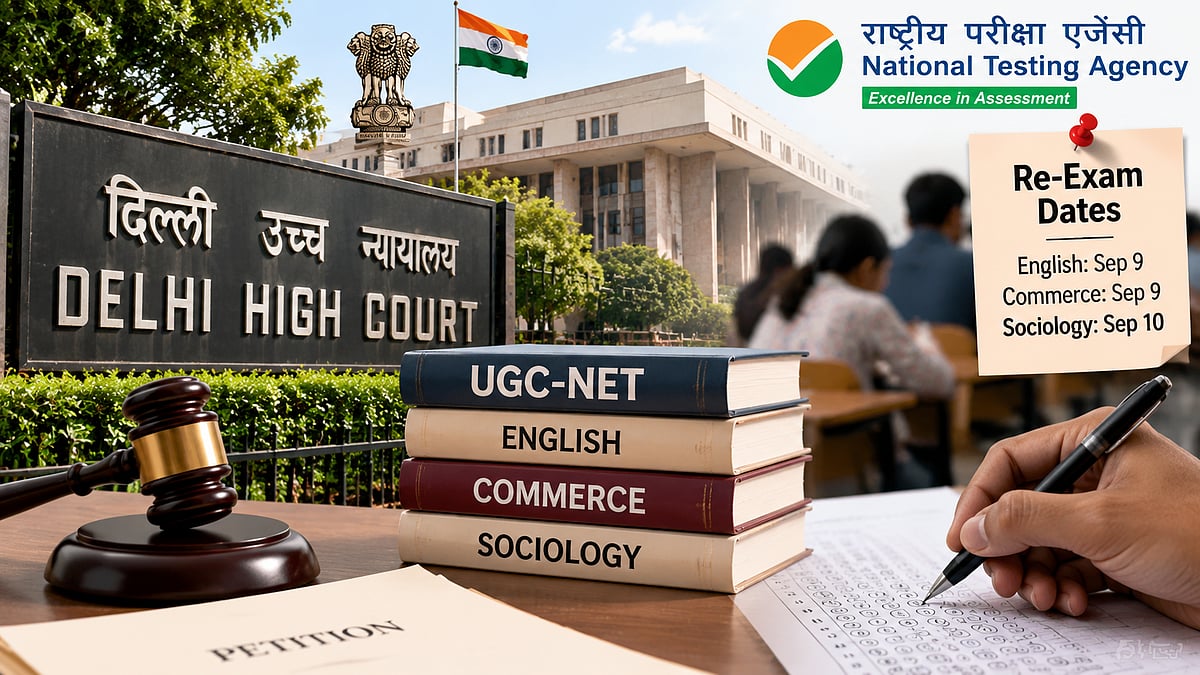
English and Commerce are planned for September 9, while Sociology is planned for September 10.
The court will hear the case again on October 6.

The Delhi High Court sought responses from the National Testing Agency and Centre over a challenge to the UGC-NET English retest.
Petitioner Parul Sheoran asked the court to quash the NTA’s August 16 notice ordering the English paper to be re-conducted.
The petition alleges the retest decision was arbitrary, procedurally unfair, and made without disclosing its supporting material.
The NTA said complaints about factual, typographical, translation, grammatical, punctuation, and repeated-question errors prompted a committee review of three papers.
English and Commerce are scheduled for September 9, Sociology for September 10, and the case will next be heard on October 6.
- Who
- The Delhi High Court, Justice Jasmeet Singh, the National Testing Agency, the Centre, and petitioner Parul Sheoran.
- What
- A petition challenges the re-conduct of the UGC-NET June 2026 English examination and seeks processing of the original results.
- Where
- The case is before the Delhi High Court in New Delhi.
- When
- The NTA issued the retest notice on August 16; the High Court acted on August 31, and the matter is listed for October 6. The retests are scheduled for September 9 and 10.
- Why
- The petitioner disputes the retest decision, while the NTA cited multiple errors and repeated questions in papers for three subjects.
Petitioner’s Position
Authorities’ Position
Whether the English paper should be repeated
Petitioner’s Position
Parul Sheoran argues that the retest decision was arbitrary, unreasonable, and procedurally unfair, and asks authorities to process the original English examination results.
Authorities’ Position
The National Testing Agency said complaints about significant errors in three papers led to a committee review and the decision to conduct retests.
Disclosure and procedure
Petitioner’s Position
The petition claims the basis for the retest was not disclosed and that the procedure in the UGC-NET June 2026 Information Bulletin was not followed.
Authorities’ Position
The NTA publicly cited a committee report identifying multiple factual, typographical, translation, grammatical, punctuation, and question-repetition errors; the court has not yet ruled on the procedure’s legality.
Examination fee
Petitioner’s Position
The petitioner seeks a refund of the original fee if the English retest is upheld, while retaining the right to take the new paper without an additional charge.
Authorities’ Position
The High Court directed authorities to take a decision on refunding the examination fee; no final refund decision was reported.
Key facts
- Petitioner
- Parul Sheoran
- Respondents
- The National Testing Agency and the Centre
- Original examination
- Held from June 22 to 30 across 87 subjects
- Retest schedule
- English and Commerce on September 9; Sociology on September 10
- Reported paper problems
- Factual, typographical, translation, grammatical, gender-and-number agreement, punctuation, and repeated-question errors
- Next hearing
- October 6
- Court direction
- Authorities were directed to decide on refunding the examination fee
Quotes
Committee examining the UGC-NET question papers
Committee whose report reviewed complaints about errors in the UGC-NET question papers
“the three papers had many factual, typographical, and translation errors, including mis-spelt names of prominent scholars, garbled book titles, errors in the stem wording of questions, grammatical errors, gender and number agreement errors, punctuation mistakes, and non-standard coined terms for established concepts, as well as repetition of a significant number of questions previously administered.”
 deccanchronicle.com
 freepressjournal.in
Sources

Related news

Delhi High Court Seeks Decision on UGC-NET Fee Refund
Centre Announces September Retests for Three UGC-NET Papers

NTA to Re-conduct UGC-NET Papers After Multiple Errors Found

NTA Orders UGC-NET Retests After Errors in Three Papers

NTA Announces UGC-NET Re-exam for English, Commerce, Sociology in September

NTA Advises Exam Candidates on Faster Grievance Resolution

UGC NET Re-Exam Admit Cards Expected Before September Tests

UGC NET June 2026 Certificates: What Candidates Should Expect