2 hrs ago
India’s Soil Degradation Threatens Farming and Food Security
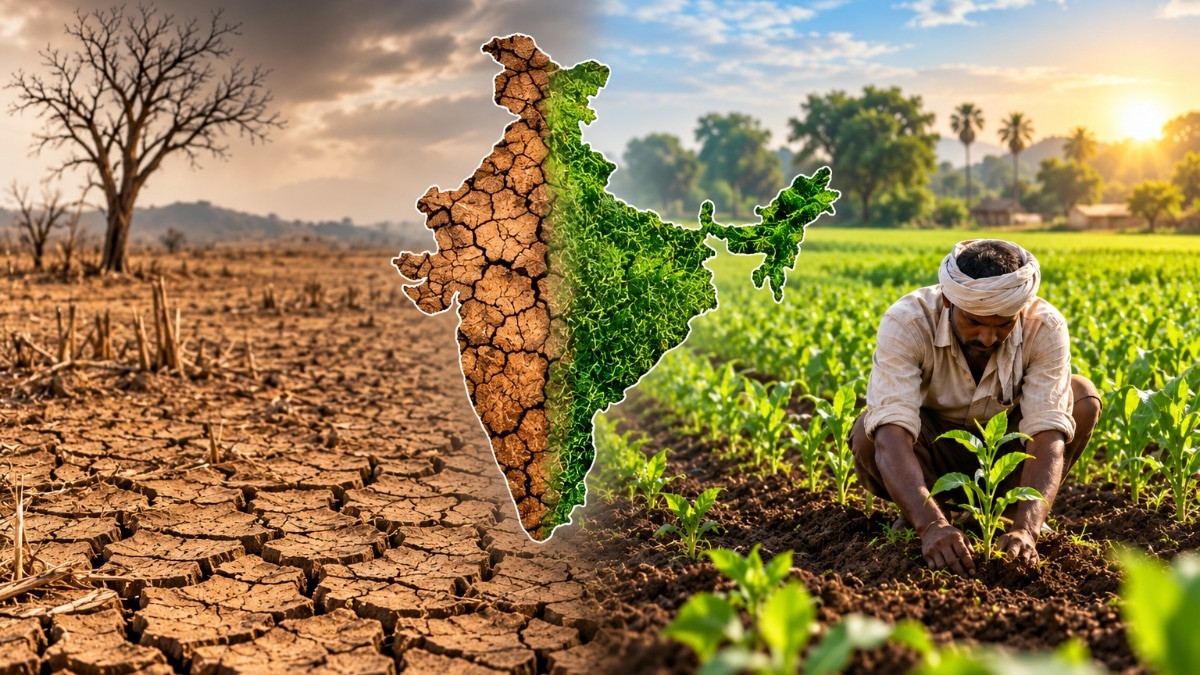
A report says about one-third of India’s land has damaged or weakened soil.
Healthy soil helps farmers grow food and earn a living.
When soil quality falls, crops may become harder to grow reliably.
Changing weather and falling groundwater supplies add to the problem.
Regenerative farming tries to repair soil instead of only using it.
Farmers can do this through crop rotation, cover crops, fewer ploughing operations and planting trees with crops.
These methods can take time and money to adopt.
The report says India should reward farmers for measurable improvements in soil, water use, biodiversity and stable incomes.

A report says 33% of India’s land is degraded, increasing risks to agriculture and food security.
Soil degradation, climate variability and groundwater depletion could reduce farm productivity and threaten farmer livelihoods.
Regenerative agriculture aims to rebuild soil health, biodiversity, water resources and ecosystem functions.
Practices include reduced tillage, cover cropping, crop rotation, agroforestry and livestock integration.
The report recommends outcome-based incentives, citing barriers including transition costs, limited finance and weak monitoring systems.
- Who
- Indian farmers, policymakers and agricultural programmes are central to the issue.
- What
- A report warns that land degradation is threatening soil health, agricultural productivity, farmer livelihoods and food security.
- Where
- Across India.
- When
- The article does not specify a publication date; it discusses current programmes and ongoing risks.
- Why
- Soil degradation is being intensified by climate variability and groundwater depletion, while restoring land is difficult because of financial, market and monitoring barriers.
Key facts
- Land degradation
- The report says 33% of India’s land is degraded.
- National Mission on Natural Farming
- It has received ₹2,481 crore and targets training and adoption among one crore farmers.
- AgriSURE Fund
- The fund has a corpus of ₹750 crore.
- Paramparagat Krishi Vikas Yojana
- The programme provides ₹31,500 per hectare for three years for organic clusters.
- Recommended approach
- The report advocates regenerative agriculture to rebuild soil health, biodiversity, water resources and ecosystem functions.
- Policy gap
- India lacks a nationally accepted definition and unified framework for regenerative agriculture.
- Suggested incentives
- Government support should be linked to outcomes such as soil organic carbon, water productivity, lower input intensity, biodiversity and farmer income stability.
Sources
Related news
India's Regenerative Agriculture Gains Momentum to Restore Soil, Build Resilience

Land Restoration Called Investment in Food, Water and Livelihoods
Google DeepMind Builds India-First AI Models for Agriculture

India urges community-led rangeland restoration at UNCCD CoP17

India Moves to Harness Ecological and Economic Benefits of Bamboo

India Launches First Grasslands Guide, Highlights Open Ecosystems