

1 hr ago
AI May Change Human Work More Than Replace It
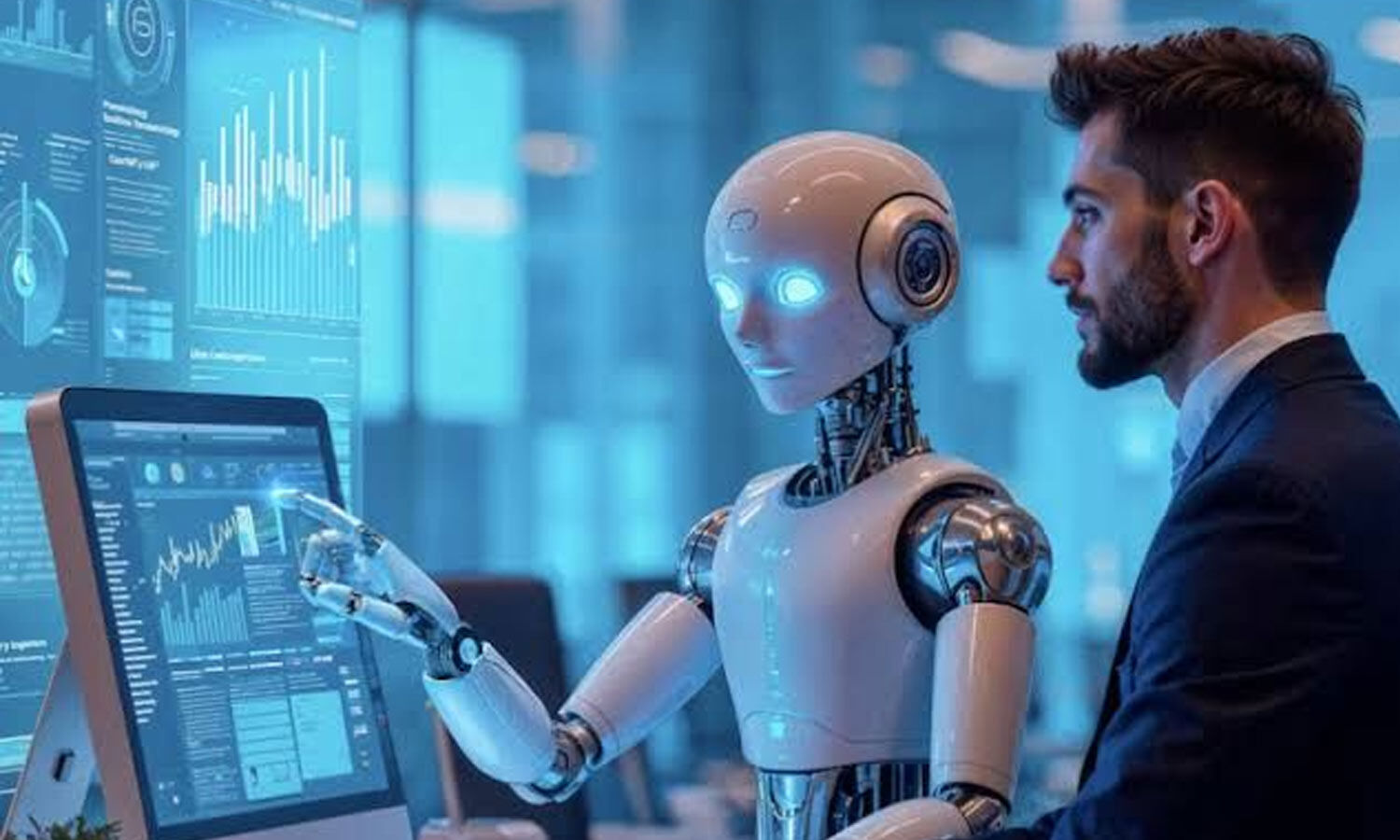
AI can now do many tasks that people used to do at work.
This makes some people worry that machines will take their jobs.
The article says technology has changed jobs before without eliminating every profession.
When AI gives people quick answers, simply knowing facts or making basic plans may matter less.
People may become more valuable by asking better questions and checking whether answers make sense.
They also need judgment, creativity, empathy and courage.
Two people using the same AI can still make different choices because one may notice problems the other misses.
The article says the future may be about people and machines working together, not competing completely.

AI can now write, analyse financial statements, create presentations, generate code and process large amounts of information quickly.
The article argues that AI may reduce the value of routine analysis, summarisation and option generation.
Human judgment becomes more important when deciding which recommendations to follow and identifying missing questions or data.
Curiosity, imagination, context, values, empathy and courage may become more valuable as AI capabilities grow.
The article suggests asking what people can become capable of with AI, rather than only whether AI will replace them.
- Who
- Workers, professionals and artificial intelligence systems are at the center of the discussion.
- What
- The article examines whether AI will replace people and argues that it may instead change which human abilities are valuable.
- Where
- The writer is Singapore-based, but no specific setting for the developments is given.
- When
- The article does not specify a particular date or period.
- Why
- AI can increasingly perform tasks involving writing, analysis, presentations, coding and information processing, challenging traditional measures of professional value.
AI Replacement Concern
Human-AI Adaptation
Impact on professional work
AI Replacement Concern
Because AI can perform tasks that once required education and experience, it may replace or reduce the need for some human work.
Human-AI Adaptation
AI may mainly change expectations and shift value toward work requiring judgment, context and human responsibility.
What creates professional advantage
AI Replacement Concern
Traditional advantages such as knowing more, remembering more and analysing faster are increasingly challenged by widely available AI tools.
Human-AI Adaptation
People can still distinguish themselves by questioning assumptions, spotting omissions, understanding affected people and asking new questions.
Human versus machine future
AI Replacement Concern
The growing speed and scale of AI make competition between people and machines a serious possibility.
Human-AI Adaptation
The more promising possibility is cooperation, with machines handling abundant information while humans apply values, creativity, empathy and courage.
Key facts
- Central question
- Whether artificial intelligence will replace human workers
- AI capabilities mentioned
- Writing, financial-statement analysis, presentation creation, computer-code generation and large-scale information processing
- Skills potentially less scarce
- Summarising information, producing options and performing routine analysis
- Skills emphasized
- Judgment, curiosity, imagination, context, values, empathy and courage
- Comparison with earlier technology
- Calculators, spreadsheets and search engines changed work without making mathematicians, accountants or knowledge irrelevant
- Suggested reframing
- Ask what people can become more capable of as AI improves
Sources
Related news
AI Reskilling May Become Essential as White-Collar Work Changes

How Artificial Intelligence Is Redefining Executive Education for Professionals
Chalkboards, AI Professors, and the Future of Human Teaching

Former Google Executive Warns AI Could End Traditional College Education
Why AI-Native Workflows Must Replace Old Incremental Automation
Editorial criticizes Zuckerberg's AI manifesto for reductive vision of freedom

Universities Urged to Prepare Students for an Evolving World

AI and Health Informatics Create Fast-Growing Healthcare Careers

How Smartphone AI Spots Crop Disease From Leaf Photos
Trump Warns U.S. Risks AI Race Loss, Rejects Extinction Concern
