

1 week ago
Why AI-Native Workflows Must Replace Old Incremental Automation
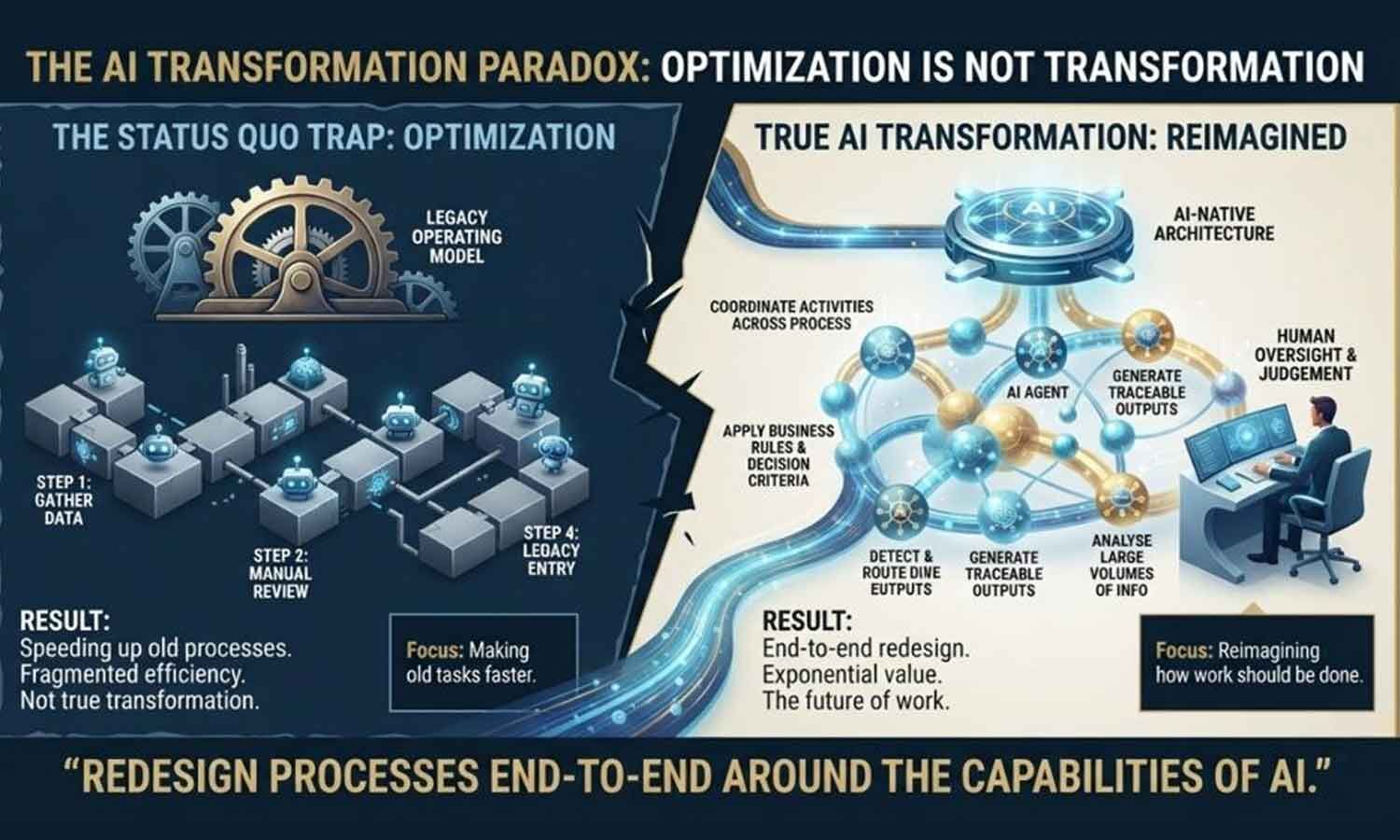
The article says companies often use AI to speed up old tasks instead of changing how work is organized.
It compares this to early cars being designed like carriages.
Small improvements can help, but they may not fix a broken process.
AI agents can handle many connected steps at once, such as gathering information and checking rules.
They can also notice unusual cases and send difficult decisions to people.
This could remove repetitive administrative work.
People would then have more time for creative thinking, problem-solving, and important relationships.
The article says businesses should redesign work from the beginning while keeping humans responsible for major decisions.

Many companies add AI to existing workflows instead of redesigning work around AI’s capabilities.
The article attributes this tendency to status quo bias and organizational preference for predictable, modest efficiency gains.
Boston Consulting Group research cited in the article says 60% of organizations have not yet captured material value from AI at scale.
AI agents can analyze information, coordinate systems, apply rules, route exceptions, create audit trails, and escalate difficult decisions.
The proposed model removes administrative friction while keeping humans responsible for context, ethics, accountability, and high-stakes judgment.
- Who
- Business leaders, employees, and AI agents are the main actors discussed.
- What
- The article argues that companies should redesign workflows around AI rather than simply adding AI to existing processes.
- Where
- The proposed changes apply within enterprise operating models and business workflows.
- When
- The discussion concerns current AI adoption and cites Boston Consulting Group research from 2026.
- Why
- To capture more meaningful value from AI, eliminate legacy inefficiencies, and focus human effort on judgment, creativity, and strategy.
Incremental Automation
AI-Native Redesign
How to adopt AI
Incremental Automation
Organizations can layer assistants, chatbots, and automation onto familiar workflows to achieve measurable short-term efficiencies.
AI-Native Redesign
Organizations should redesign processes from the ground up around AI’s ability to manage connected, parallel workflows.
Approach to legacy processes
Incremental Automation
Existing procedures provide a safe, predictable baseline and can be improved without disrupting the operating model.
AI-Native Redesign
Meetings, approvals, reformatting, and handoffs created by older system limitations should be removed, combined, or redesigned.
Role of people
Incremental Automation
Employees continue performing much of the established process, with AI helping them complete tasks faster.
AI-Native Redesign
AI should handle cognitive administrative work while people remain in the loop as accountable decision-makers and strategic contributors.
Key facts
- Central argument
- Optimization makes existing work faster, while transformation changes the nature of the work.
- Cited research
- Boston Consulting Group research cited in the article says 60% of organizations have not captured material value from AI at scale.
- AI agent role
- AI agents are described as orchestrators of complex, multi-step workflows rather than single-task assistants.
- Core capabilities
- Agents can analyze data, coordinate systems, apply rules, route exceptions, generate traceable outputs, and escalate decisions.
- Human role
- Humans remain responsible for context, critical thinking, moral accountability, and high-stakes judgment.
- Recommended approach
- Leaders should question legacy steps, remove unnecessary handoffs, and identify where human oversight is essential.
Sources
Related news

Enterprises Move Beyond Digital Transformation to AI-First Operations

Why Indian Enterprises Struggle to Scale AI Beyond Pilots

How AI is transforming the future of enterprise innovation
India’s GCCs Evolve Into Testing Grounds for AI-Native Businesses

Indian Banks Urged to Rethink Operations as Agentic AI Advances

Mastek Shifts From Coding Toward Context-Driven AI Transformation

India’s Insolvency Framework Faces New Questions From AI Transactions

AI, Networking Debate Intensifies Over Future of Tech Careers

Bessent Says AI Could Fuel U.S. Startup Boom

Readers Debate AI Content Rights and National Identity

Musk Predicts AI Will Surpass Humans Digitally By 2027
