2 weeks ago
Ahmedabad study links starling murmuration shapes to predator threat
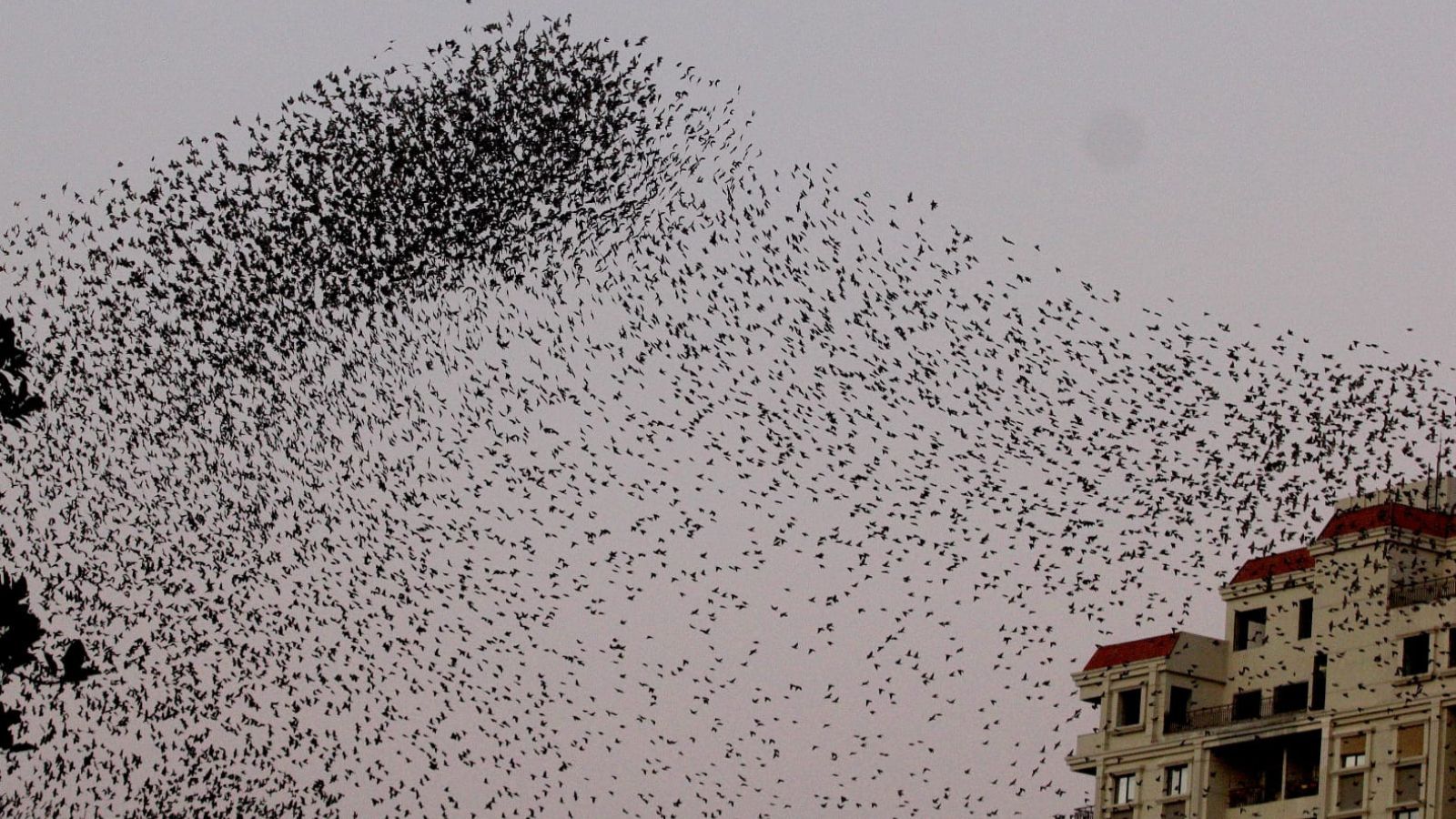
Rosy starlings are birds that fly together in huge groups.
When they fly in swirling, changing patterns, it is called a murmuration.
Scientists at Ahmedabad University in India watched these birds for 28 days.
They wanted to learn why the flocks change shape.
They found that when a predator bird, like a black kite, comes close, the flock changes shape.
The birds form a long, pointy shape called 'Small Road' that may help them fly faster to escape.
When no predator is near, the birds mostly make small oval shapes.
The scientists watched 3,023 flocks and recorded 181 times when a predator was nearby.
This study helps us understand how birds work together as a group.

Ahmedabad University researchers found a correlation between rosy starling murmuration shape and predator presence.
The study, published in Integrative and Comparative Biology, is the first of its kind in India.
When a predator was within 10 metres, the 'Small Road' shape dominated, accounting for 71.3% of observed formations.
Without predators, 'Small Oval' (27.9%) and 'Mini Flock' (27.7%) shapes were most frequent.
Predator presence alone did not consistently trigger murmuration displays, contrasting with common assumptions.
- Who
- Researchers Venu Divin and Jitesh Jhawar of Ahmedabad University's School of Arts and Sciences.
- What
- A study establishing a correlation between the size and shape of rosy starling murmurations and the threat and proximity of predators.
- Where
- Ahmedabad University campus, Ahmedabad, Gujarat, India.
- When
- Data collected from January 2 to February 13, 2025; published in the April issue of Integrative and Comparative Biology.
- Why
- To understand how predator presence influences the geometry of bird murmurations and to advance field-based group living research.
Key facts
- Species studied
- Rosy starling (Pastor roseus)
- Researchers
- Venu Divin and Jitesh Jhawar, Ahmedabad University
- Publication
- Integrative and Comparative Biology (April issue)
- Study period
- January 2 - February 13, 2025
- Flocks recorded
- 3,023
- Predator encounters
- 181 instances of black kite within 10 metres
- Dominant shape with predator
- Small Road (71.3%)
- Dominant shapes without predator
- Small Oval (27.9%) and Mini Flock (27.7%)
Quotes
Jitesh Jhawar
Researcher, School of Arts and Sciences, Ahmedabad University
“There are very few such studies, especially in the wild. If their behaviour is to be predicted in future, these types of studies are needed. Until we understand these dynamics, we will not be able to predict their responses in their natural environment. The collective response is important because often species do not respond individually.”
 indianexpress.com
“From the perspective of group living [of birds], this study has broad implications. So far, group living studies have been done in labs; there are very few group living studies directly from the field. This study is one of its kind in that sense. We have shown that group living can be studied in this way [as well].”
indianexpress.com
Sources
Related news
Black kites remain biggest challenge to Pune Airfield flying operations
600 flamingo chicks ringed in Spain for migration to India
Khijadiya Sanctuary Confirmed as Key Black-Necked Stork Breeding Site

Birds Fly Into Delhi Offices to Escape Heat, Rescuers Warn

Mausi the Hornbill Reveals How Delhi Birds Adapt

Vulture Release Revives Calls To Restore Mumbai's Tower Of Silence

JNU Professor Advocates Emission Taxes for India
Sankdi Sheri's Heritage Makeover Pilot Project

NITI Aayog highlights health insurance challenges for middle class