1 hr ago
RBI Plans ₹7 Lakh Crore Liquidity Absorption Amid Cash Glut
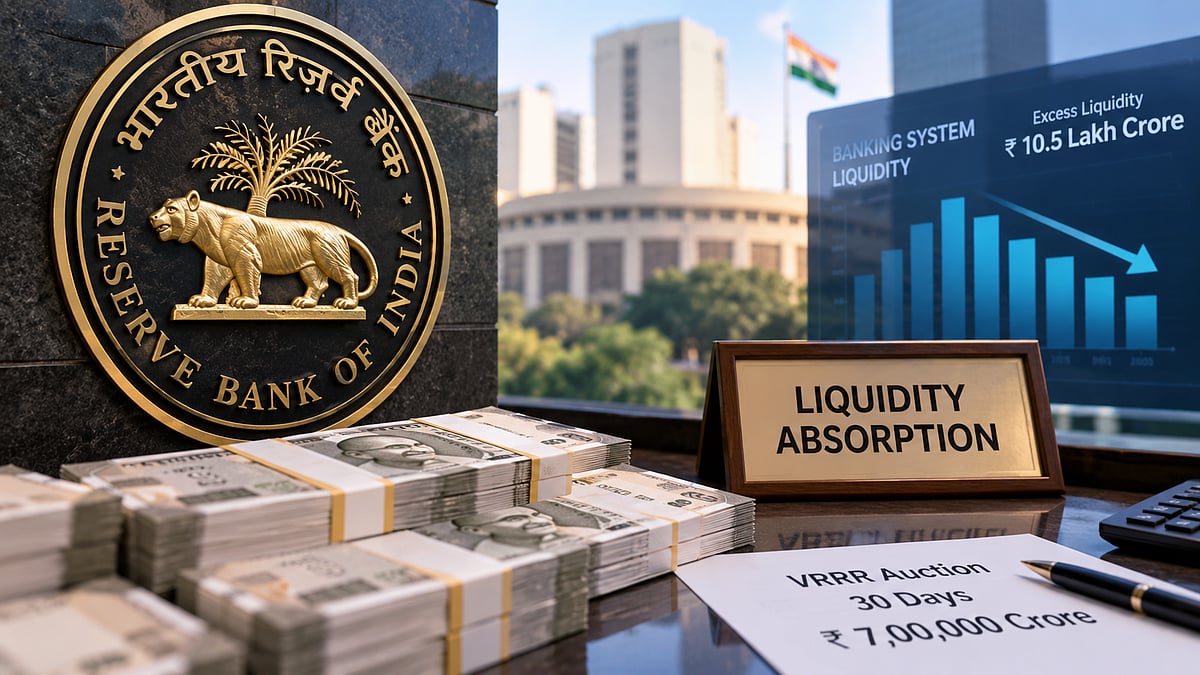
Banks in India currently have much more cash than they need.
The Reserve Bank of India wants to temporarily take some of that extra money out of circulation.
It plans to ask banks to park up to ₹7 lakh crore with it for 30 days.
This is called a variable-rate reverse repo auction.
The operation is longer than the RBI’s recent auctions, which lasted up to 15 days.
A large amount of foreign money came into India through deposits from overseas Indians and overseas borrowing.
When that foreign money was changed into rupees, banks received more cash.
The RBI hopes to control money-market conditions and help manage inflation, although banks can choose how much money to deposit.

The Reserve Bank of India will conduct a 30-day VRRR auction worth ₹7 lakh crore on Monday.
The operation is longer than recent VRRR auctions, which generally lasted up to 15 days.
India’s banking-system liquidity surplus is estimated at around ₹10.5 lakh crore.
Foreign-currency inflows included a record $127 billion raised through deposits from overseas Indians and about $136.4 billion including subsidised overseas borrowing.
The surplus has pushed the weighted average call rate below the RBI’s policy rate, increasing the need to manage short-term liquidity.
- Who
- The Reserve Bank of India and India’s banks.
- What
- The RBI plans a 30-day variable-rate reverse repo auction to absorb up to ₹7 lakh crore of surplus liquidity.
- Where
- India’s banking and money markets, with the auction conducted by the Reserve Bank of India.
- When
- The auction is scheduled for Monday; the deposit scheme was closed in August, one month ahead of schedule.
- Why
- To manage a record liquidity surplus, regain control over short-term borrowing conditions, and support efforts to contain inflation.
RBI’s Liquidity-Management View
Banking-System Flexibility View
Longer liquidity absorption
RBI’s Liquidity-Management View
The RBI is using a 30-day operation to keep surplus funds out of the banking system for longer and exert greater control over short-term money-market conditions.
Banking-System Flexibility View
The VRRR mechanism is less forceful than some other tools because banks decide how much money they want to park with the central bank.
Managing the cash surplus
RBI’s Liquidity-Management View
The operation can help absorb excess rupee liquidity created by foreign-currency inflows while policymakers focus on inflation.
Banking-System Flexibility View
The foreign inflows strengthened India’s external financing position, even though they also created a significant liquidity-management challenge.
Key facts
- Planned operation
- 30-day variable-rate reverse repo auction
- Auction amount
- ₹7 lakh crore, or $74.1 billion
- Estimated banking liquidity surplus
- Around ₹10.5 lakh crore
- Overseas Indian deposit inflows
- A record $127 billion
- Total reported inflows
- About $136.4 billion, including subsidised overseas borrowing by banks and state-owned companies
- Money-market impact
- The weighted average call rate has fallen below the RBI’s policy rate
- Bank participation
- Banks can decide how much money to park with the RBI
Sources
Related news
RBI Absorbs ₹6.02 Lakh Crore as Record Liquidity Surges
RBI Meets Banks as Liquidity Surplus Nears ₹10 Lakh Crore

India's Banking Liquidity Surges, Prompting RBI Absorption Measures

FCNR Deposit Surge Puts India’s Liquidity Management Under Focus
India Banking System Surplus Liquidity Nears Rs 5 Lakh Crore

Why Dubai Is Emerging as a Study Abroad Destination

Mirzapur: The Movie Opens Strongly, Beats Recent Bollywood Hits

Iran War Redraws Global Energy Markets, Boosting Renewables

Rohit Sharma Set for Television Debut With Family Show

Rohit Sharma Retirement Speculation Puts Ajit Agarkar Under Scrutiny