1 hr ago
Earth’s Deep Mantle May Store Two Pacific Oceans’ Water
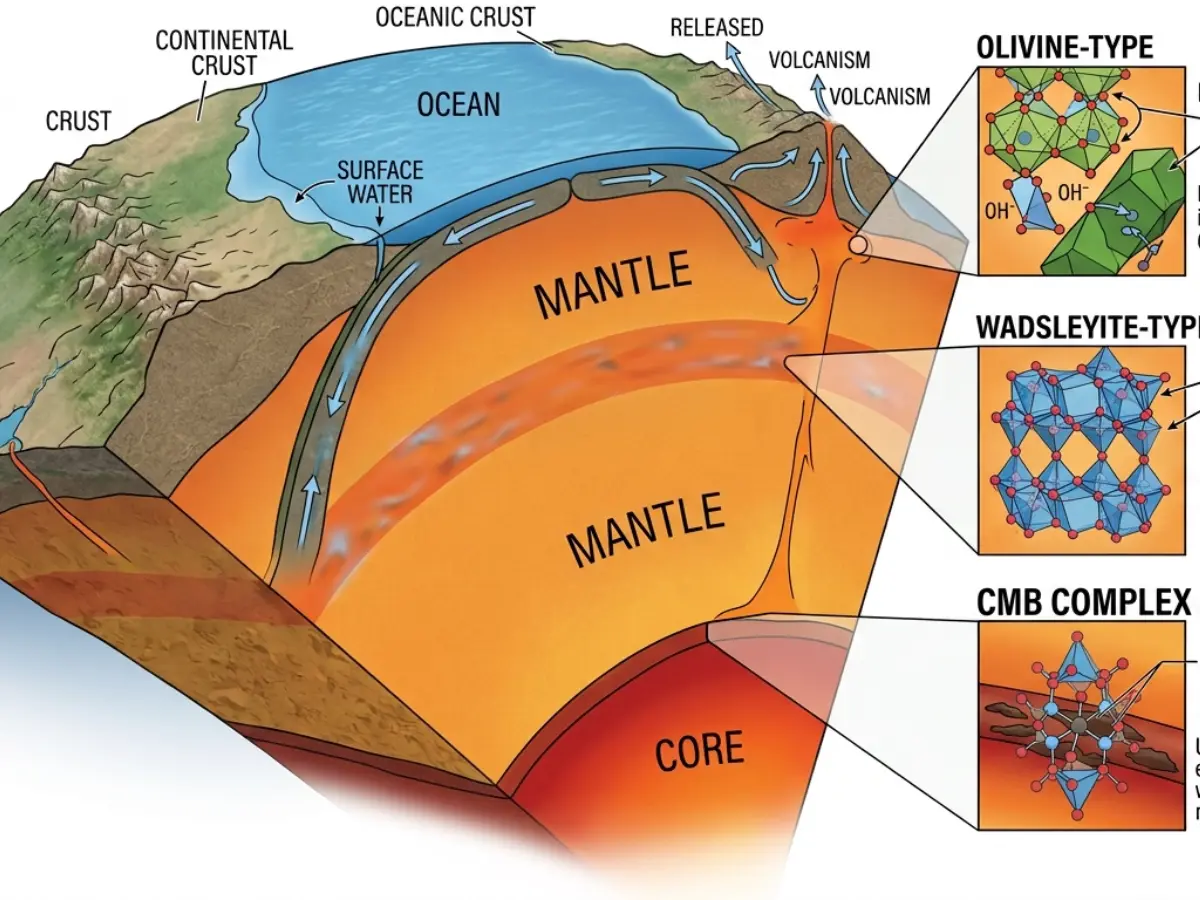
Scientists think a huge amount of Earth’s water may be hidden deep inside the planet.
It could equal the water in about two Pacific Oceans.
The water would not form a giant underground sea.
Instead, it would be stored inside special minerals.
Researchers made two possible minerals in a laboratory using very high heat and pressure.
These conditions may be similar to those near Earth’s core.
The minerals could have formed when early Earth’s molten interior cooled.
However, scientists have not yet proved that these minerals exist inside Earth today.
The discovery may help explain how Earth kept its water over time.

A study suggests water equivalent to two Pacific Oceans could be stored about 2,900 kilometres beneath Earth’s surface.
Researchers identified two previously unknown iron oxyhydroxides, Fe5O12Hx and Fe7O12Hx, that can retain substantial water.
The minerals were produced in laboratory experiments using extreme pressures and temperatures created with diamond tips and lasers.
The proposed water would be chemically held inside minerals near the mantle–outer-core boundary, not present as underground oceans.
Scientists caution that there is no direct evidence these mineral phases currently exist inside Earth.
- Who
- Researchers studying Earth’s deep interior, with commentary from geoscientist Alfred Wilson of the University of Leeds.
- What
- A study identified two iron oxyhydroxides that could store water deep within Earth’s mantle.
- Where
- About 2,900 kilometres beneath the surface, near the boundary between the mantle and the liquid outer core.
- When
- The minerals may have formed early in Earth’s history as a molten basal magma ocean cooled and crystallised.
- Why
- The research aims to explain where Earth’s water may be stored and how the planet obtained and retained it.
Key facts
- Estimated water volume
- Equivalent to about two Pacific Oceans
- Proposed depth
- Approximately 2,900 kilometres below Earth’s surface
- Location
- Near the mantle–liquid outer-core boundary
- Candidate minerals
- Iron oxyhydroxides Fe5O12Hx and Fe7O12Hx
- Research method
- High-pressure, high-temperature experiments using diamond tips and lasers
- Publication
- Nature Geoscience
- Key limitation
- There is no proof that the mineral phases are present inside Earth
Quotes
Alfred Wilson
Geoscientist from the University of Leeds who wrote a commentary on the study
“Identifying these iron oxyhydroxides is important because they are seemingly stable, dense phases that capture and retain water across a wide range of lower-mantle conditions.”
 wionews.com
Sources
Related news
Scientists Say Young Sun May Have Swallowed Super-Earth
Indian Geologists Link Jharkhand Rocks to 3.5-Billion-Year-Old Life
Ancient Supervolcano Beneath England's East Coast Predates Dinosaurs
IISc Bengaluru Develops More Effective Uranium Extraction Method
New Simulations Suggest Moon Formed Within Five Hours

AI is flooding online book market with poor translations

IIT Kharagpur and Leeds University sign MoU

Elpro International School Achieves Perfect CBSE Scores

Heartstopper Forever Soundtrack Features Diverse Artists