5 days ago
Anthropic’s Destructive Book Scanning Raises Copyright and Preservation Fears
Anthropic reportedly bought many books and cut off their spines so machines could scan the pages quickly.
The scans are intended to help train Claude, its artificial-intelligence model.
Cutting the spines makes the pages flat and easier for scanners to read.
However, it destroys the physical books.
Readers say books are more than words because they carry memories, marks, and history.
Writers are also worried that their work may be used without permission or payment.
Some people fear that books could move from public shelves into private company databases.
Experts say rare books should be handled carefully, while common copies might be scanned in faster ways.
The debate is about balancing technology’s speed with people’s rights and the value of physical books.

Anthropic reportedly acquired books in bulk through Project Panama and removed their spines to scan pages for Claude’s training.
Destructive scanning makes books easier to process with high-speed scanners, but it permanently damages or destroys the physical copies.
Indian readers and writers fear that second-hand and regional-language books could eventually be absorbed into private AI databases.
Critics question whether authors receive ownership, credit, or copyright protections when their work is used for AI training.
Experts say rare and culturally significant books should be scanned non-destructively, while widely available copies may be suitable for faster methods.
- Who
- Anthropic, authors, readers, and experts discussing book scanning for AI training.
- What
- Anthropic’s Project Panama reportedly involved buying books in bulk, removing their spines, and scanning the pages to train Claude.
- Where
- The reported practice concerns Anthropic, while the article focuses on possible effects on India’s second-hand and regional-language book culture.
- When
- The article describes Project Panama as recent but gives no specific date; it says there are currently no official reports of the practice reaching India.
- Why
- Books provide long-form, professionally edited text for AI training, and removing their spines allows faster, more automated scanning.
Industrial Efficiency and AI Training
Preservation, Access, and Author Rights
Why dismantle books?
Industrial Efficiency and AI Training
Removing a spine turns a book into loose sheets that can pass through automated duplex scanners, improving speed, page flatness, lighting consistency, and optical character recognition.
Preservation, Access, and Author Rights
The article’s critics argue that efficiency does not justify destroying books, particularly when physical copies may have cultural, historical, or personal value.
Which books should be scanned destructively?
Industrial Efficiency and AI Training
Akash Anant Saxena says widely available and replaceable copies could be processed this way when it substantially improves throughput.
Preservation, Access, and Author Rights
Saxena and other commentators say scarce, historically significant, unusual, or culturally valuable books should use non-destructive scanning instead.
Who should control the knowledge?
Industrial Efficiency and AI Training
AI companies can place scanned text in private databases to train models and improve access to machine-readable material.
Preservation, Access, and Author Rights
Authors and readers worry that private databases concentrate control over knowledge, may use writing without permission, and do not provide the same public access as books on shelves.
Key facts
- Company
- Anthropic
- AI model
- Claude
- Project
- Project Panama
- Scanning method
- Books are reportedly purchased, their spines removed, and pages processed through high-speed scanners.
- Indian locations mentioned
- Mumbai’s Flora Fountain, Bengaluru’s Church Street, and Delhi’s Sunday Book Market in Daryaganj.
- Main concerns
- Copyright, author ownership and credit, public access, cultural preservation, and the destruction of physical books.
- Alternative method
- V-shaped cradles, controlled lighting, cameras, and automated page-turning can scan books without dismantling them, but more slowly.
Quotes
Akash Anant Saxena
Director at Team Geek Solutions explaining the technical rationale for destructive scanning.
“The primary reason is throughput. Once the spine is removed, a book effectively becomes a stack of loose sheets. Those pages can be passed through high-speed duplex scanners in a largely automated workflow, very similar to industrial document processing. The pages remain flat, lighting is uniform, there is no gutter distortion, and OCR accuracy is generally easier to maintain”
 deccanchronicle.com
“Using an author’s original ideas, writing, and story to train a model to write better is horrifying. I feel only anger and rage. I would never give an AI company my book to use for whatever purpose, though I do fear that they already have access to a lot of material related to my work and writing, because a lot of it is available online.”
deccanchronicle.com
Sources
Related news

AI firms buy second-hand books for destructive scanning surge

Amazon Reportedly Scanning Books for AI Training Data

Anthropic destroying books to make AI data: an existential challenge

When AI destroys books, Kolkata finds comfort in second-hand pages
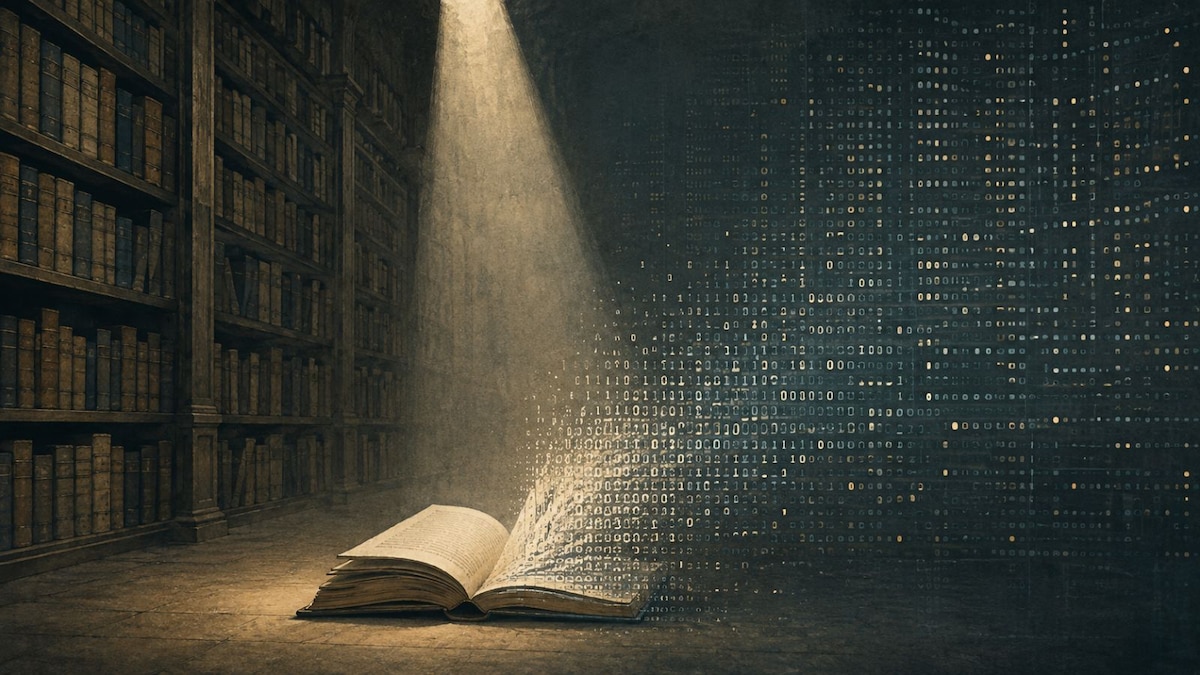
Great Book Grab: Who Owns Knowledge in the AI Age?

Court defers approver Pradosh’s statement in Renukaswamy murder case

Shivakumar Seeks NITI Aayog Funds, Backs Second Bengaluru Plan

Viswanathan Anand Says AI Has Transformed Modern Chess

Science Quiz Covers Vehicle Communication, Space, Medicine, Missiles and Time

Syrma SGS, Elemaster Launch High-Reliability Electronics Facility in Bengaluru