3 days ago
RBI Struggles to Drain Surging Liquidity From Banks
Banks in India currently have much more money than they can easily lend or invest.
This happened partly because foreign dollars entering through an RBI swap program were converted into rupees.
The extra rupees increased the amount of money available in the banking system.
When there is too much money, short-term interest rates can fall below the RBI’s target rate.
Very easy money can also add to inflation.
The RBI wants to remove some of the excess money, but it must avoid suddenly raising interest rates or disturbing the bond market.
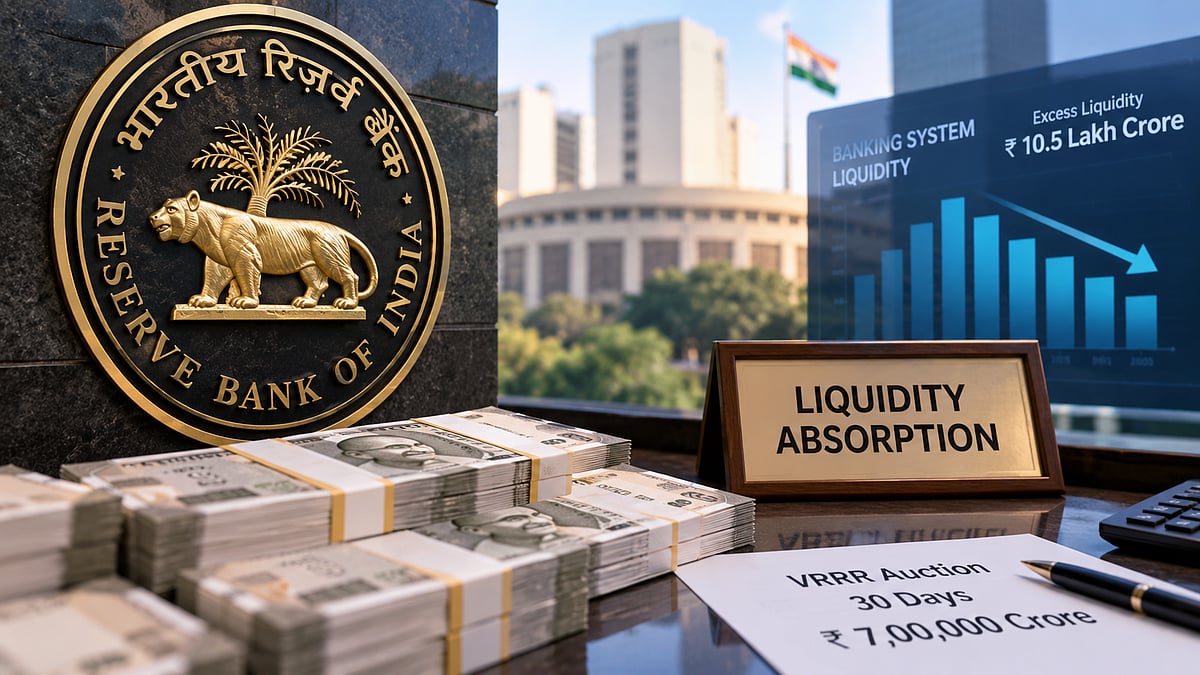
It is already using auctions to temporarily absorb money from banks.
It may also use tools such as higher reserve requirements or bond sales if the surplus continues.

Banking-system liquidity reached about Rs 9.7 lakh crore on September 2, its highest level since May 2022.
Foreign-exchange inflows from the RBI’s swap facility released substantial rupee funds into banks.
The average daily surplus rose to Rs 3.67 lakh crore in August from Rs 1.07 lakh crore in July.
Excess liquidity can push overnight rates below the repo rate and increase inflationary pressure.
The RBI is using VRRR auctions and may consider CRR increases, OMO sales, or other measures to absorb the surplus.
- Who
- The Reserve Bank of India, commercial banks, market economists, and ratings analysts.
- What
- The RBI is managing an unusually large surplus of liquidity in India’s banking system.
- Where
- India’s banking and financial markets.
- When
- Liquidity reached a four-year high on September 2; analysts also discussed possible conditions through December-end and FY27.
- Why
- Large foreign-exchange inflows and the RBI’s foreign-exchange operations released substantial rupee funds, creating more liquidity than banks currently need.
Faster, Durable Liquidity Drainage
Gradual, Market-Based Absorption
Preferred tools
Faster, Durable Liquidity Drainage
A temporary CRR or Incremental CRR increase could immediately and durably remove a large amount of liquidity from banks.
Gradual, Market-Based Absorption
Longer-tenor VRRR operations and OMO sales could absorb surplus liquidity more gradually and with greater calibration.
Market impact
Faster, Durable Liquidity Drainage
A CRR increase is described as the cleanest way to extract lasting liquidity, but it could effectively reverse the earlier exemption of some deposits from CRR and SLR requirements.
Gradual, Market-Based Absorption
OMO sales are market-priced and reversible in principle, while VRRR operations can steer short-term rates without an abrupt policy shift.
Longer-term adjustment
Faster, Durable Liquidity Drainage
Allowing forward positions to mature and selling dollars in the spot market could help reduce excess liquidity over time.
Gradual, Market-Based Absorption
The pace of these operations must be managed carefully to avoid a sharp rise in interest rates or disruption in the government-securities market.
Key facts
- Liquidity level
- About Rs 9.7 lakh crore on September 2, the highest since May 2022.
- Average August surplus
- Rs 3.67 lakh crore, compared with Rs 1.07 lakh crore in July.
- Swap-facility inflows
- The RBI’s US dollar-rupee swap facility attracted $136.377 billion through August 31.
- FCNR(B) share
- FCNR(B) deposits accounted for $127.226 billion of the swap-facility mobilisation.
- Potential core liquidity
- CareEdge Ratings estimated core liquidity could approach Rs 13-14 lakh crore by December-end without further RBI operations.
- Currency demand offset
- Currency in circulation could rise by around Rs 1.1 lakh crore by December because of festive-season demand.
- Possible forward-book effect
- Maturing RBI short-forward positions could drain around Rs 3 lakh crore, with about $22 billion maturing within three months.
Quotes
Sneha Pandey
Fund manager for Equity at Quantum AMC
“Near-term options include a temporary Cash Reserve Ratio (CRR) hike or an Incremental CRR, as introduced in 2023. While this will have an immediate impact, such a move could be viewed as effectively unwinding the RBI’s earlier decision to exclude these deposits from CRR and SLR requirements”
 indianexpress.com
“The RBI has been running back-to-back Variable Rate Reverse Repo (VRRR) auctions, including a 7-day Rs 6 lakh crore operation and an overnight Rs 4 lakh crore operation on the same day, followed by Rs 5 lakh crore and Rs 6 lakh crore overnight operations on successive days”
indianexpress.com
CareEdge Ratings
Ratings agency assessing India’s liquidity conditions
“Even after adjusting for the increase in currency in circulation during the upcoming festive season and the maturity of the RBI’s short dollar positions in the forward markets, we expect core liquidity to rise from Rs 8.1 lakh crore as of mid-August to potentially closer to Rs 13-14 lakh crore by December-end in the absence of any liquidity management operations by the RBI”
indianexpress.com
Sources
Related news
RBI Meets Banks as Liquidity Surplus Nears ₹10 Lakh Crore
FCNR Deposit Surge Puts India’s Liquidity Management Under Focus
RBI Weighs Tools to Manage ₹11.16 Lakh Crore Liquidity Surplus
RBI Plans ₹7 Lakh Crore Liquidity Absorption Amid Cash Glut
India's Banking Liquidity Surges, Prompting RBI Absorption Measures

Rupee Reaches Two-Month High as FCNR-B Inflows Surge

YuVerse Unveils Four Enterprise AI Platforms at Yunite

RBI Intensifies Rupee Support as Reserves Cushion Currency Pressure