3 hrs ago
India Should Innovate on UPI Merchant Fees, Writer Argues

UPI is a system that lets people move money directly between bank accounts.
It was created in India instead of relying mainly on international card networks.
The writer says UPI should also create its own way of charging merchants.
Traditional bank transfer systems often use small fixed fees or fee limits.
The article questions whether UPI should use a percentage fee like card payments.
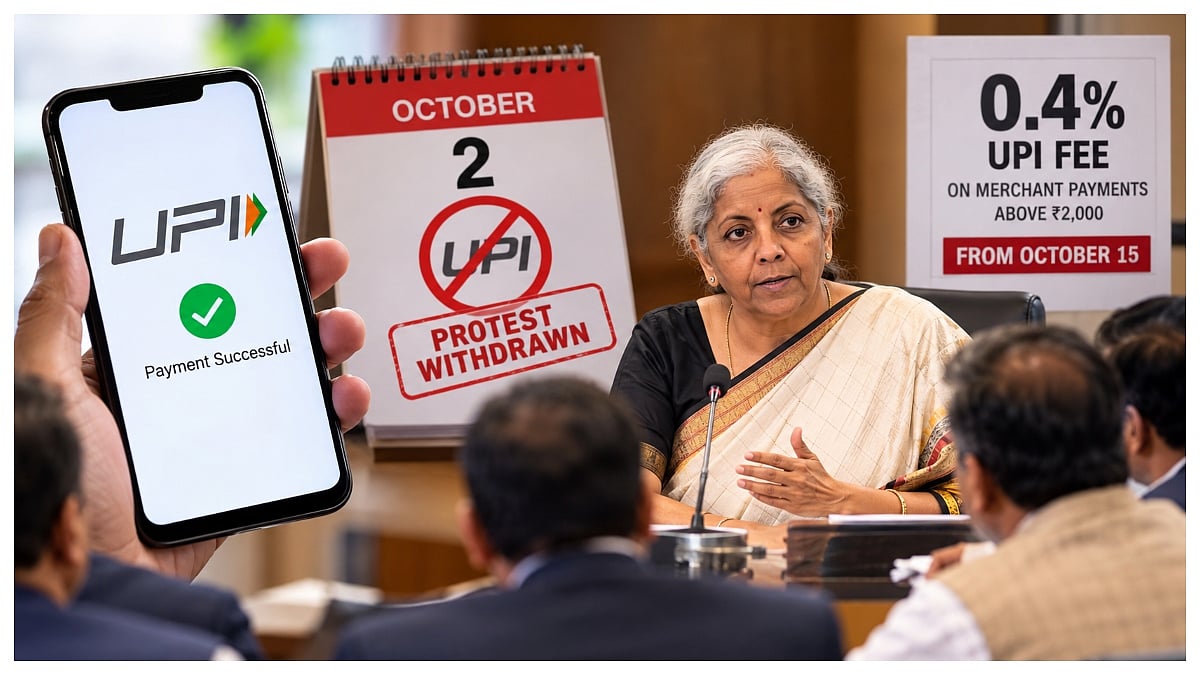
One proposal mentioned is a 0.40% merchant fee, with a maximum charge of Rs 300.
The writer says UPI must earn enough to pay for its costs and remain reliable.
But the writer also warns that high fees could hurt small merchants and UPI’s goal of expanding participation in the formal economy.

Balakrishnan Mahadevan argues that UPI should have its own pricing model rather than copy card-network economics.
The article contrasts UPI’s account-to-account credit transfers with cards’ merchant-initiated pull transactions.
India’s NEFT, RTGS and IMPS systems traditionally used fixed or slab-based charges with maximum limits.
The proposed UPI pricing cited in the article is a 0.40% merchant discount rate, capped at Rs 300.
An IIM Bangalore analysis estimated NPCI-wide expenses at about 9.8 paise per transaction in 2024–25.
- Who
- Balakrishnan Mahadevan, a former chief operating officer of NPCI and former World Bank payments specialist, makes the argument.
- What
- The article calls for a new, potentially fixed or slab-based pricing model for UPI merchant fees instead of automatically using percentage-based MDR.
- Where
- The debate concerns India’s UPI and wider digital public infrastructure.
- When
- The article cites NPCI’s 2024–25 financials and refers to an editorial published on September 17.
- Why
- The writer argues that UPI needs sustainable economics but should preserve its goals of affordability, inclusion and reduced dependence on card networks.
Fixed or Slab-Based Pricing
Percentage-Based Merchant Fees
How UPI should be priced
Fixed or Slab-Based Pricing
UPI is a credit-transfer system and should use simple, low, fixed or slab-based charges with maximum limits, following the approach used by NEFT, RTGS and IMPS.
Percentage-Based Merchant Fees
A merchant fee can provide a sustainable economic model for UPI and help support banks, acquirers, fraud management, security and customer support.
Relationship to card networks
Fixed or Slab-Based Pricing
Because UPI was designed as an alternative to card networks, it should not automatically adopt the percentage-based pricing logic developed for cards.
Percentage-Based Merchant Fees
The article refers to an editorial supporting the introduction of a fee, suggesting that UPI’s scale and role do not eliminate the need for revenue.
Impact on inclusion
Fixed or Slab-Based Pricing
Keeping charges low and predictable would better protect small merchants, low-value payments and UPI’s broader inclusion purpose.
Percentage-Based Merchant Fees
Charging merchants could help maintain the infrastructure and ensure long-term reliability, provided the model remains economically sustainable.
Key facts
- Proposed UPI fee
- 0.40% merchant discount rate, with a maximum of Rs 300, as cited in the article.
- UPI structure
- An open, interoperable, account-to-account payment infrastructure.
- NPCI expenses
- Rs 2,270 crore against 230.2 billion transactions in 2024–25.
- Estimated cost per transaction
- Approximately 9.8 paise across NPCI’s payment systems; about 5 paise on the narrower operational-cost basis discussed.
- Earlier transfer pricing
- NEFT, RTGS and IMPS traditionally used fixed or slab-based charges with maximum limits.
- Author
- Balakrishnan Mahadevan, former chief operating officer of NPCI.
Sources
Related news

UPI Charges Debate Balances Sustainability With Affordable Payments

India Debates MDR Charges to Sustain UPI Payment Revolution

India Introduces Limited UPI Fees, Sparking Debate Over Public Payments

India Weighs Selective UPI Fees to Sustain Digital Payments Growth

UPI’s Rapid Growth Raises Sustainability Questions for GetePay

India's UPI Fee Proposal Draws Concerns Amid US Pressure

Apple Pay Launches in India With Limited Card Support
Traders Withdraw No UPI Day Protest as Fee Deadline Remains

Apple Pay Launches in India With Limited Bank Support

India's October 2026 Financial Rule Changes Affect ATMs, LPG, Deposits