5 days ago
UPSC Key Highlights Nepal Floods, Rights, Defence, Nuclear Energy
This UPSC study key explains several important events and concepts for the civil services examination.
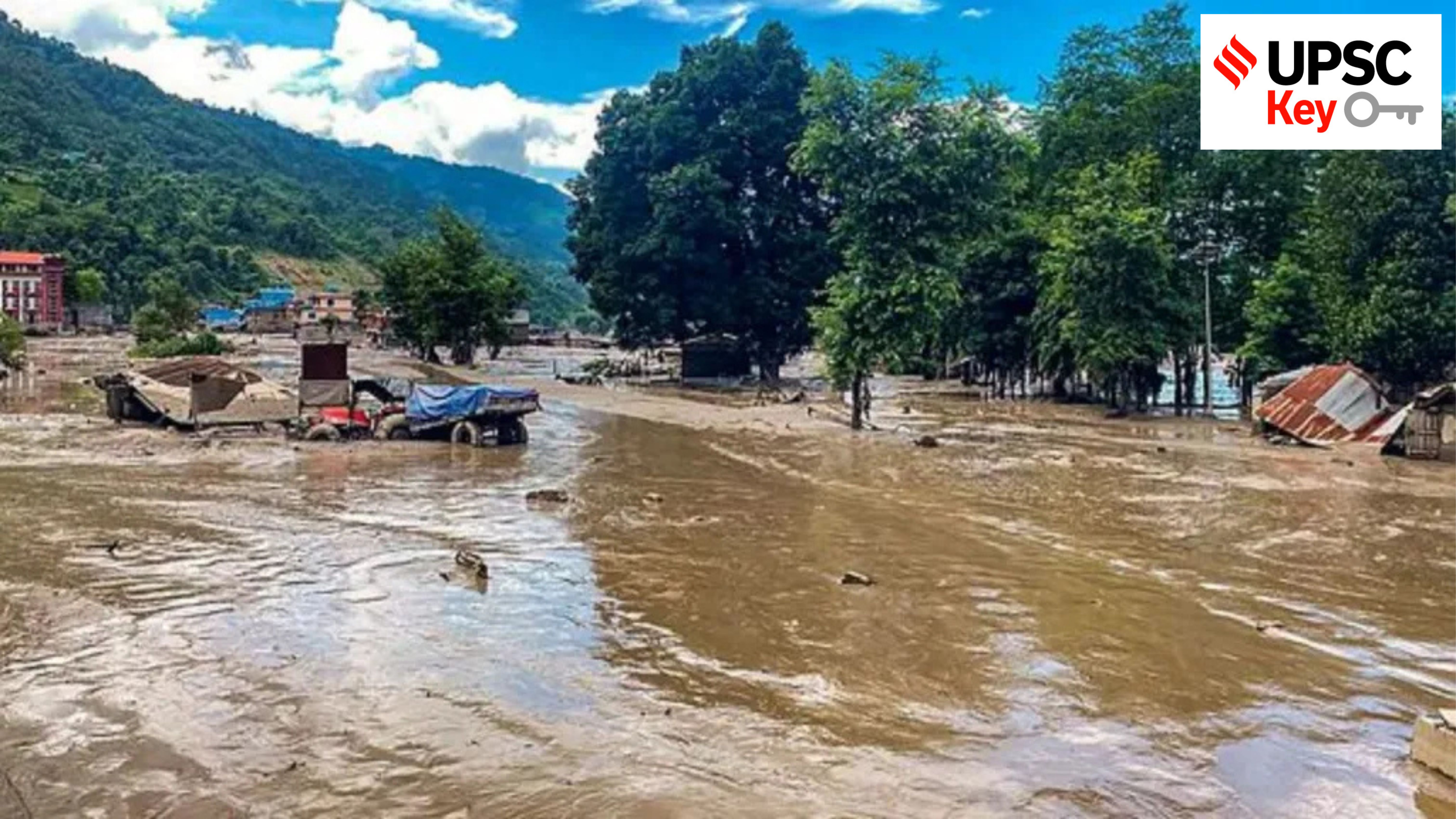
A sudden flood near Nepal’s border with Tibet caused deaths, disappearances and major damage to roads and hydropower projects.
Experts think a glacier-related ice-and-rock avalanche may have blocked a river before releasing a powerful flood.
India rejected a UN committee’s criticism about the treatment of some disadvantaged groups and refugees.
India and the United Kingdom are planning to cooperate on electric systems for large naval ships.
India’s nuclear power company is also planning a unit to help other organisations use Indian reactor technology.
The United States is trying to pressure Iran through wider economic sanctions.
It has also proposed a very large fee for some H-1B visa applications, which could particularly affect Indian workers.
These subjects are relevant to geography, disaster management, international relations, science and technology, and India’s diaspora.

Flash floods along the Nepal-Tibet border killed over 150 people and left at least 484 missing, including 105 Indians and 37 NRIs.
The UN Committee on the Elimination of Racial Discrimination raised concerns about alleged abuses against marginalised communities, Rohingya refugees and Bengali-speaking Muslims in India.
India and the United Kingdom are preparing agreements on electric propulsion systems for four Indian Navy Landing Platform Docks and on Lightweight Multirole Missiles.
Nuclear Power Corporation of India Limited plans a design vertical to support public and private entities adopting indigenous pressurised heavy-water reactor technology.
The United States proposed a $103,265 fee on cap-subject H-1B petitions and announced further sanctions targeting entities maintaining economic ties with Iran.
- Who
- The Indian government, UN human-rights officials, Nepalese authorities, India-UK defence officials, India’s nuclear power sector, the United States and affected Indian workers are central to the topics.
- What
- The UPSC key examines a Nepal flash flood, UN criticism of India, India-UK defence cooperation, nuclear-sector expansion, US sanctions on Iran and a proposed H-1B fee.
- Where
- The events concern Nepal’s districts bordering Tibet, India, the United Kingdom, Iran and the United States.
- When
- The topics were published for UPSC preparation on August 27, 2026; the Nepal disaster occurred on Wednesday, and the US sanctions announcement was made on August 24.
- Why
- They are highlighted for their relevance to UPSC geography, disaster management, international institutions, bilateral relations, science and technology, economic diplomacy and the Indian diaspora.
Critics and International Concerns
Government Positions and Policy Defences
Cause of Nepal’s flash floods
Critics and International Concerns
Early reports and some officials suggested that an earthquake may have triggered an avalanche, which then caused the flood.
Government Positions and Policy Defences
The US Geological Survey later assessed that the seismic signal came from the landslide itself rather than from an earthquake; experts also described a glacier collapse as the likely trigger.
UN assessment of India
Critics and International Concerns
UNCERD alleged discrimination and human-rights violations affecting marginalised communities, Rohingya refugees and Bengali-speaking Muslims, and called for action on hate crimes and review of the NRC framework.
Government Positions and Policy Defences
India rejected what it called politically motivated and malicious references, and pointed to constitutional safeguards, its legal framework, pluralism and efforts to protect disadvantaged communities.
H-1B fee proposal
Critics and International Concerns
Critics of the programme argue that H-1B hiring can replace American workers, suppress wages and reduce opportunities for US graduates; the proposed fee could particularly affect Indian professionals.
Government Positions and Policy Defences
The US administration says the large fee would discourage employers from choosing foreign workers over qualified Americans unless specialised skills are genuinely needed.
Key facts
- Nepal disaster
- More than 150 people were killed and at least 484 people were reported missing, including 105 Indians and 37 NRIs.
- Affected infrastructure
- At least a dozen hydropower projects were destroyed, affecting about 700 MW of power generation.
- Possible flood mechanism
- Satellite imagery indicated that a glacier section broke away, triggering an ice-rock avalanche and a temporary river blockage before the dam gave way.
- UN concerns
- UNCERD raised concerns about alleged violations involving Scheduled Tribes, Scheduled Castes, Rohingya refugees and Bengali-speaking Muslims.
- India-UK naval cooperation
- The proposed agreement covers maritime electric propulsion systems for four Landing Platform Docks.
- Indian nuclear capacity
- India’s nuclear power capacity was stated as 8.7 GWe, entirely operated by NPCIL.
- H-1B proposal
- The US Department of Homeland Security proposed an additional $103,265 fee on each annual-cap-subject H-1B petition.
- Indian H-1B share
- People born in India accounted for 71% of approved H-1B petitions in fiscal year 2024, according to USCIS data.
Quotes
India-UK joint statement
Joint statement issued by the governments of India and the United Kingdom
“This will further support India’s air defence capabilities, and in the spirit of Atmanirbhar Bharat, meet the current and future requirements of the Indian Ministry of Defence, and support a long-term collaboration on complex weapons between the two countries.”
 indianexpress.com
“During the review, we highlighted India’s constitutional safeguards, robust legal framework, pluralism and sustained efforts to protect disadvantaged communities.”
indianexpress.com
Sources
Related news
UPSC Weekly Current Affairs: Environment, Diplomacy, Defence and Economy
UPSC Key Covers SCO, Electoral Rolls, Economy, Defence and Climate
August 27 News Roundup: Floods, Courts, Sports and Education
UPSC Key Highlights Defence, Disasters, Economy and Governance
UPSC Current Affairs: India’s Diplomacy, Economy, Law and Policy

Jefferies Sets Target Prices for Indian Industrial Stocks

Indian Rs 1 Trillion Market Cap Club Expands

Edelweiss Large & Mid Cap Fund Bets on Next Cycle
Adani Power Nears Record High on Raipur Expansion Progress
JM Financial Sees 30% Upside in Adani Power Shares