3 weeks ago
Saudi Arabia, Turkey, Pakistan Sign Mecca Joint Defence Agreement
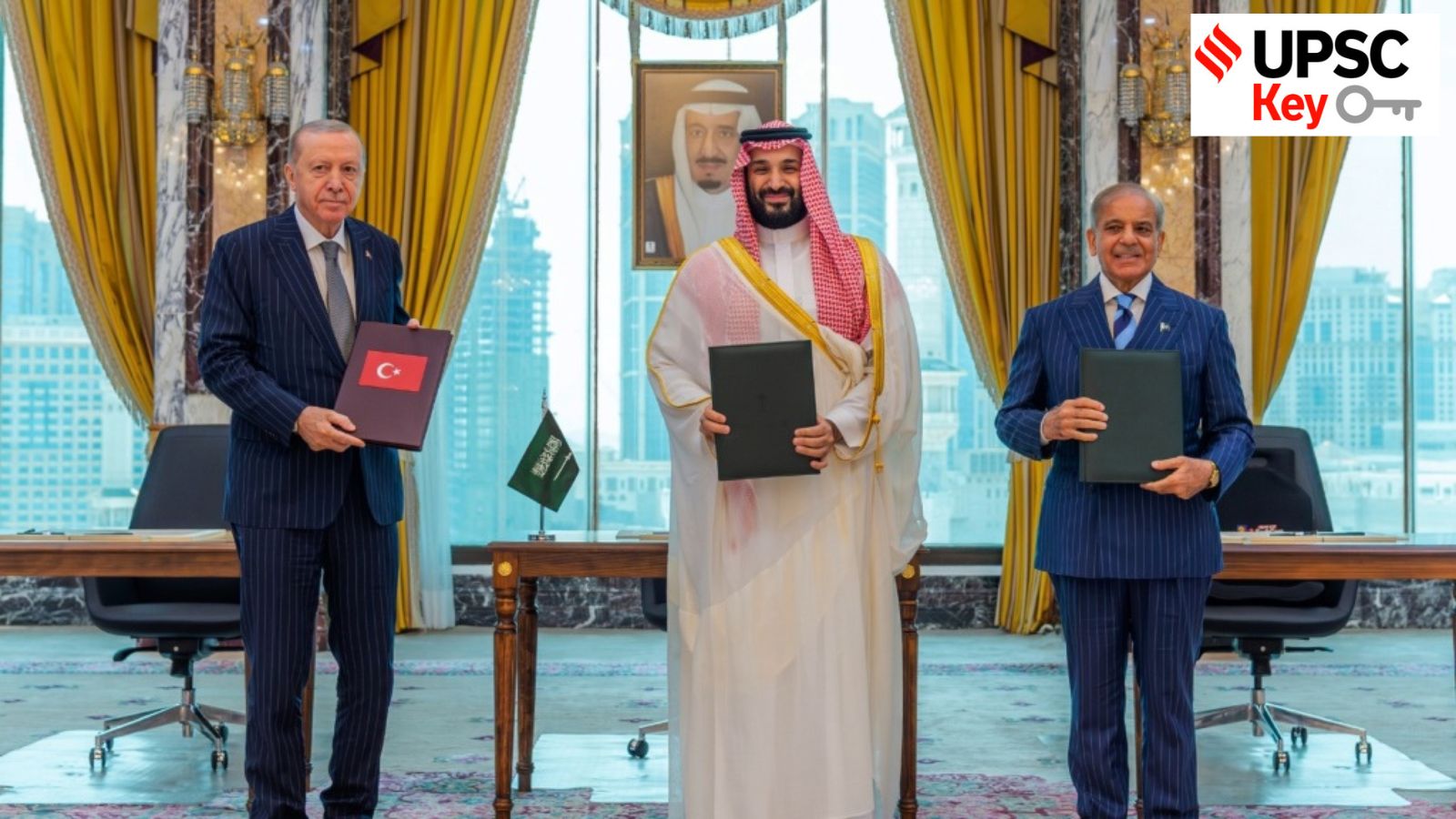
The leaders of three countries — Saudi Arabia, Turkey, and Pakistan — met in Mecca and signed a special promise called the Mecca Joint Defence Agreement.
This agreement says that if an enemy attacks one of these countries, the other two will treat it like an attack on all three of them.
That idea is called collective defence, and it is similar to the promise NATO member countries make to one another.
The three countries are all mostly Muslim nations that want to feel safer together in a region with a lot of tension.
Recently, a conflict involving Iran worried the region and disrupted ships passing through the Strait of Hormuz.
Saudi Arabia is one of the world's biggest oil sellers, and Turkey has a large military and is part of NATO.
Pakistan is the only Muslim-majority country in the world that has nuclear weapons.
The leaders spent almost a year negotiating the agreement, which was first reported by Reuters in January, before signing it.
Their goal is to strengthen collective deterrence, which means scaring off anyone who might think about attacking them.
However, the agreement does not clearly state that the countries must automatically send their armies if one of them is attacked.

Saudi Arabia, Turkey and Pakistan signed the Mecca Joint Defence Agreement on Friday, creating a new trilateral security framework — the first mutual-defence arrangement among the three Sunni Muslim-majority nations.
Under the pact, an armed attack on any one of the three countries will be regarded as an attack on them all, resembling NATO's collective defence principle without spelling out automatic military obligations.
The agreement was signed in Mecca by Saudi Crown Prince Mohammed bin Salman, Turkish President Recep Tayyip Erdogan and Pakistani Prime Minister Shehbaz Sharif.
It follows nearly a year of negotiations, first reported by Reuters in January, amid escalating West Asia tensions triggered by the Iran conflict that exposed Gulf security vulnerabilities and disrupted shipping through the Strait of Hormuz.
The partners bring complementary strengths: Saudi Arabia's oil wealth, Turkey's NATO military and growing defence industry, and Pakistan's status as the only nuclear-armed Muslim-majority country.
- Who
- Saudi Crown Prince Mohammed bin Salman, Turkish President Recep Tayyip Erdogan and Pakistani Prime Minister Shehbaz Sharif, on behalf of Saudi Arabia, Turkey and Pakistan
- What
- Signed the Mecca Joint Defence Agreement, a trilateral pact under which an armed attack on one country is treated as an attack on all three
- Where
- Mecca, Saudi Arabia
- When
- Friday, August 7, 2026, after nearly a year of negotiations
- Why
- To strengthen collective deterrence against aggression amid escalating tensions in West Asia triggered by the Iran conflict
Backers of the defence pact
Regional watchers and neighbouring states
Regional security purpose
Backers of the defence pact
The pact is intended to strengthen collective deterrence against any act of aggression, bringing together the complementary military, economic and strategic strengths of Saudi Arabia, Turkey and Pakistan.
Regional watchers and neighbouring states
The agreement raises fresh questions about the region's evolving security architecture, including how closer Turkey–Pakistan defence cooperation could affect the security environment of other countries such as India.
Impact on India's interests
Backers of the defence pact
India has strategic interests in maintaining balanced relations with Saudi Arabia, Turkey, Iran and the Gulf countries as part of its Act West Asia policy.
Regional watchers and neighbouring states
Closer Turkey–Pakistan defence cooperation and Pakistan's military and strategic engagement with West Asian countries could impact India's security environment.
Key facts
- Agreement
- Mecca Joint Defence Agreement
- Signatories
- Saudi Arabia, Turkey, Pakistan
- Signing location
- Mecca
- Signed by
- Mohammed bin Salman, Recep Tayyip Erdogan, Shehbaz Sharif
- Core provision
- Armed attack on one signatory treated as an attack on all three
- Negotiation period
- Nearly a year; first reported by Reuters in January
- Background tensions
- Iran conflict exposed Gulf security vulnerabilities; shipping disrupted through Strait of Hormuz
- Prior pact
- Pakistan and Saudi Arabia signed a bilateral mutual-defence agreement last year
Quotes
Shivkumar Kalyanaraman
Chief Executive Officer of the Anusandhan National Research Foundation (ANRF)
“There are no immediate plans to further strengthen the process… The governance structure of the RDI Fund is such that there is an Executive Council...”
 indianexpress.com
Sources
Related news

UPSC Key Tracks Talking Cars, Glaciers, Treaties And Growth
UPSC Key Highlights Defence, Disasters, Economy and Governance
UPSC Weekly Current Affairs: Environment, Diplomacy, Defence and Economy
UPSC Weekly Quiz: 10 Current Affairs Questions for Prelims 2027
UPSC Key Covers SCO, Electoral Rolls, Economy, Defence and Climate

Saudi Arabia Says Iranian Tanker Attack Killed Two Sailors
U.S.-Iran Exchange Escalates Across Middle East, Markets Slide
Trump Aides Seek Quiet Iran War Before Midterm Elections
US Warns Middle East Travelers Amid Escalating Iran-Linked Tensions

Indian Stocks Slide as Oil, Conflict and Yields Rise