1 hr ago
India’s Space Journey Enters a Commercial, Human-Spaceflight Era
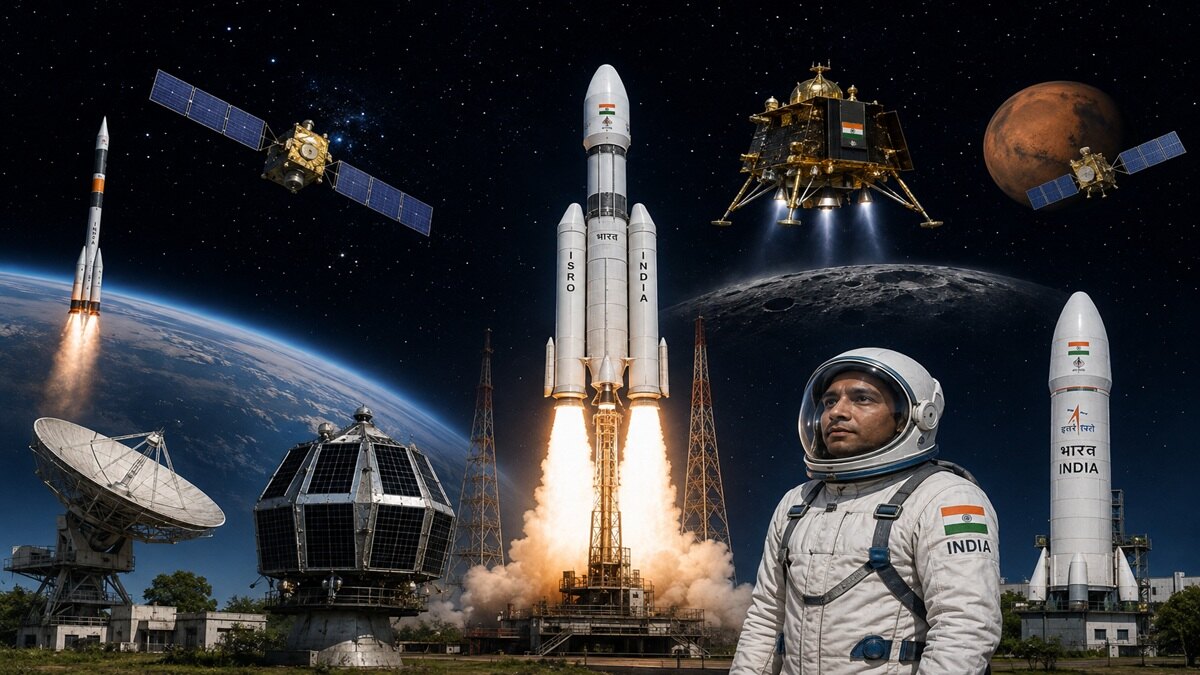
India started its organised space programme in 1962 with a small research committee.
It later created ISRO to build rockets, satellites and useful space technology.
India’s first home-developed satellite, Aryabhata, was launched in 1975.
The PSLV rocket helped India launch its own and other countries’ satellites.
India then sent missions to the Moon and Mars.
Chandrayaan-3 successfully landed near the Moon’s south-polar region in 2023.
India is now working on Gaganyaan, which aims to send astronauts into space using Indian systems.
New rules are also encouraging private companies and foreign investors to join the space industry.

India’s organised space programme began with INCOSPAR in 1962 and evolved into ISRO in 1969.
Aryabhata, launched in 1975, marked India’s entry into the satellite era and was its first indigenously developed satellite.
PSLV established India as a reliable, cost-competitive launch provider and supported missions including Chandrayaan-1 and Aditya-L1.
Chandrayaan-1, Mangalyaan and Chandrayaan-3 demonstrated India’s growing capabilities in lunar and Martian exploration.
Gaganyaan, policy reforms and foreign-investment changes are intended to expand human spaceflight and private-sector participation.
- Who
- India, ISRO, government space institutions, private companies and international investors.
- What
- India has developed an end-to-end space programme and is moving toward human spaceflight, deeper exploration and a larger commercial sector.
- Where
- India’s space programme operates through Indian space and launch facilities, with some missions and satellites launched from abroad or serving international customers.
- When
- The programme began in 1962; major milestones include Aryabhata in 1975, PSLV’s successful operation from 1994, Mangalyaan’s launch in 2013, and Chandrayaan-3’s landing in 2023.
- Why
- The programme was developed for scientific research, national applications such as communications and forecasting, strategic capability, exploration and expanding commercial opportunities.
Key facts
- Programme origins
- The Indian National Committee for Space Research was formed in 1962 and became ISRO in 1969.
- First satellite
- Aryabhata, India’s first indigenously developed satellite, was launched in 1975 from the Soviet Union.
- Key launch vehicle
- PSLV became a reliable, cost-competitive workhorse after a successful 1994 mission.
- Planetary milestones
- Chandrayaan-1 detected water molecules on the Moon, Mangalyaan entered Mars orbit in 2014, and Chandrayaan-3 landed near the lunar south pole in 2023.
- Human spaceflight
- Gaganyaan aims to demonstrate India’s ability to send astronauts into space using indigenous systems.
- Foreign investment
- Automatic foreign investment limits include 74% for satellite manufacturing and operations, 49% for launch vehicles and spaceports, and 100% for satellite components and subsystems.
- Startup investment
- IN-SPACe facilitated approximately $150 million in investment in Indian space startups during calendar year 2025.
Sources
Related news
India’s Space Economy Targets $45 Billion by 2030

India’s Space Sector Expands With 440 Startups After Reforms
ISRO Targets Gaganyaan Uncrewed Launch Within Four Months

India’s Space Economy Projected to Reach $40–45 Billion

India Marks Space Sector Growth With 548 Satellites in Orbit
Strategic funding may propel India's space economy to $100 billion

Lunar South Pole May Preserve Earth Microbes, Study Finds
From Mangalyaan to Chandrayaan-3: India's Rise as a Space Power

Mumbai's Nehru Science Centre Hosts AI Prompt Art 2026 Exhibition