3 days ago
Supreme Court Upholds Increment for Regularised Daily-Wage Workers
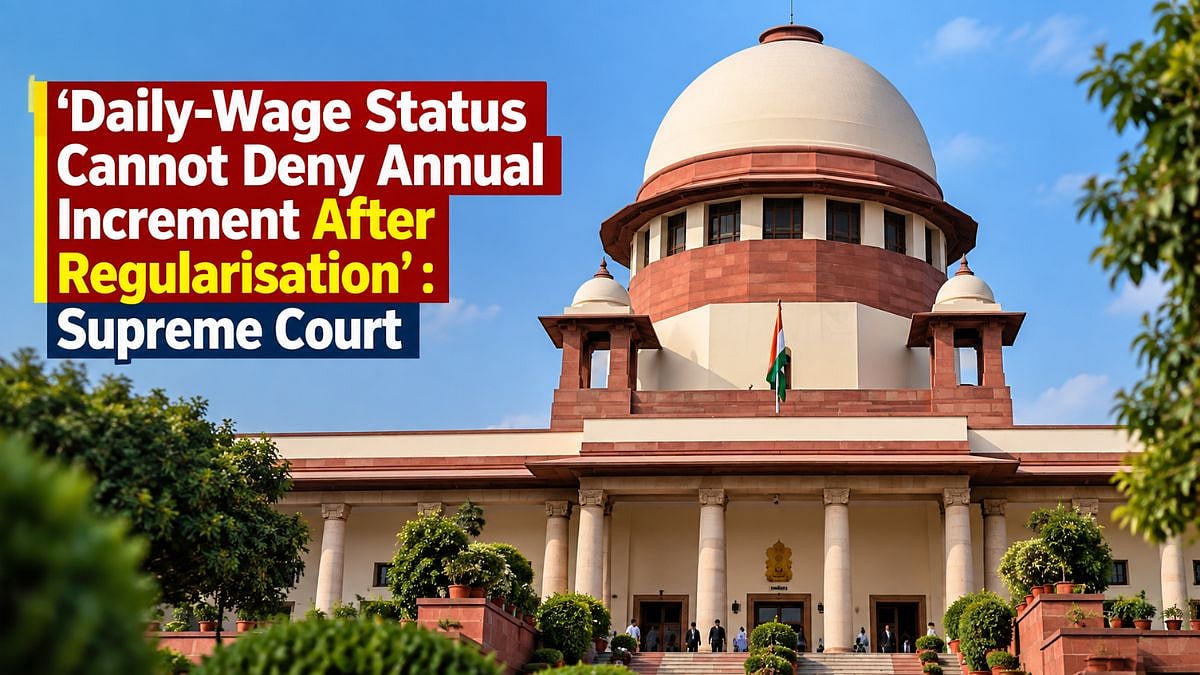
Some workers in Gujarat began their jobs as daily-wage workers.
After completing the required service, they were treated as permanent employees and received regular pay and retirement benefits.
They retired on June 30, just before an annual pay increase was due on July 1.
The Gujarat government argued that their original daily-wage status meant they could not receive that increase.
The Supreme Court disagreed because the workers had later been regularised.
It said the increase must be included when calculating their pension, subject to limits set in an earlier ruling.
Since they filed their case in 2022, the enhanced pension covers the three years before they filed.
The authorities must pay within 30 days or owe 6% interest for delay.

The Supreme Court ruled that Gujarat workers regularised after daily-wage service could not be denied an annual increment solely because of their original employment status.
The workers had served in the Gujarat Irrigation Department for more than 30 years and retired on June 30 in different years.
Their increment fell due on July 1, the day after retirement, and the court relied on earlier rulings recognizing this entitlement for pension purposes.
Because the workers filed their case in 2022, their enhanced pension is subject to a three-year retrospective limit under modified directions in M. Siddaraj.
Authorities must calculate and pay the amounts within 30 days; late payment will carry 6% interest from the date of default.
- Who
- Retired skilled workers from the Gujarat Irrigation Department, and the Gujarat government.
- What
- The Supreme Court upheld the workers’ entitlement to an annual increment and pension calculated with that increment, subject to limits on retrospective payment.
- Where
- Gujarat, India; the appeal was decided by the Supreme Court of India.
- When
- The ruling was reported on October 6, 2026; the workers filed their case in 2022.
- Why
- The workers had been regularised under the Gujarat government’s 1988 resolution, so their original daily-wage status alone could not disqualify them from the increment.
Workers’ claim
Gujarat government’s argument
Eligibility for the increment
Workers’ claim
The workers said the increment due after their June 30 retirement should be considered in calculating their pension, consistent with the Supreme Court’s earlier rulings.
Gujarat government’s argument
The state argued before the Gujarat High Court Division Bench that the workers could not claim the benefit because they had originally been appointed as daily wagers.
Effect of regularisation
Workers’ claim
The workers had been treated as permanent employees under the 1988 resolution and received regular pay scales and retirement benefits.
Gujarat government’s argument
The state relied on their original daily-wage status to oppose the increment; the Supreme Court rejected that basis once they had been regularised.
Key facts
- Regularisation resolution
- Gujarat government resolution dated October 17, 1988
- Service threshold
- The resolution covered daily-wage skilled workers who completed 10 years of service.
- Increment date
- The annual increment fell due on July 1, after the workers retired on June 30.
- Prior rulings relied on
- Director (Administration and Human Resources), KPTCL v. C.P. Mundinamani and Union of India and another v. M. Siddaraj
- Retrospective pension period
- Enhanced pension including one increment is payable for the three years before the month the workers filed their 2022 petition.
- Payment deadline
- Authorities must calculate and release the amounts within 30 days.
- Late-payment interest
- 6% from the date of default if the deadline is missed.
Quotes
Supreme Court
The court's statement on applying the modified pension-benefit direction to the appellants.
“As it is an admitted fact that the appellants filed their writ petition in the year 2022 itself, they would be covered by the modified clause (d), which provided that enhanced pension, by including one increment, would be payable for the period of 3 years prior to the month in which the writ petition was filed”
 freepressjournal.in
Sources
Related news
High Court Orders Haryana Board to Regularise Daily-Wage Worker

Supreme Court Raises Rajasthan Worker’s Compensation After Long Legal Battle

Allahabad High Court Orders Pension After Nearly 30 Years

Bombay High Court Upholds Law Officer’s Pension Service Claim

Madras High Court Upholds Cancellation of Retiree’s ST Certificate
J&K High Court Rejects Government Jobs in Exchange for Land
Bhopal Police Plan Extra Navratri Patrols Across 38 Station Areas

BJP intensifies Uttar Pradesh preparations for 2027 polls amid controversy

Supreme Court Slams UP Police Over Unknown Suspect FIR
Supreme Court Questions UP Police Investigation, Demands Officer's Personal Appearance