1 hr ago
How Modi-Era Policies Reshaped India’s Digital Economy
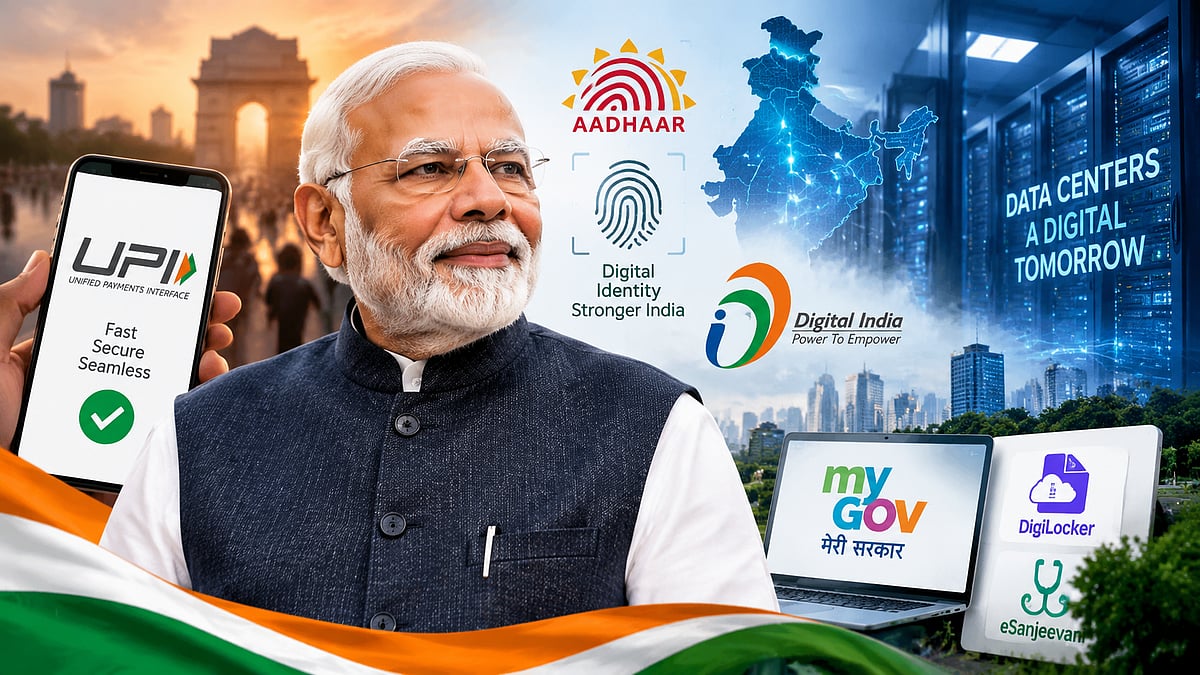
Prime Minister Narendra Modi’s government has spent years moving many Indian services onto computers and mobile phones.
Digital India helped expand online banking, welfare payments and government documents.
UPI made it easier for people to send money using phones.
The government also says more villages now have internet connections and that technology has helped health care and education.
However, some people cannot use these services because of poor internet, expensive devices, power problems or difficulty with digital tools.
Researchers have also raised concerns about fraud and the protection of personal information.
India is building more electronics factories, semiconductor plants and artificial-intelligence data centres.
Supporters see this as economic progress, while critics say the benefits, jobs and local value created may be smaller than official claims suggest.

Digital India initiatives such as JAM, UPI, DigiLocker and UMANG have expanded digital payments, welfare transfers and online public services.
The government cites wider connectivity, telemedicine, digital education and more than 150,000 recognised startups as major achievements.
Researchers warn that authentication failures, weak rural infrastructure, limited digital skills and data-protection gaps still exclude many citizens.
Make in India has increased electronics and mobile-phone production, though analysts say domestic component and design capabilities remain limited.
India is pursuing semiconductor projects and large AI data centres, but questions remain about jobs, environmental pressures, land disputes and implementation.
- Who
- Prime Minister Narendra Modi’s government, along with researchers, economists, technology companies and state officials.
- What
- A review of India’s digital, economic and technology changes under Modi’s leadership, including digital services, payments, manufacturing, semiconductors and data centres.
- Where
- Across India, including rural areas, six states involved in semiconductor projects, and Visakhapatnam and surrounding coastal areas of Andhra Pradesh.
- When
- The transformation is described over the decade since Digital India was launched in 2015; the semiconductor figures and some investments are cited for 2026.
- Why
- To digitise governance and the economy, expand financial access, strengthen domestic technology and manufacturing, and support artificial-intelligence infrastructure.
Government and industry case
Researchers’ and analysts’ concerns
Digital inclusion
Government and industry case
Digital payments, welfare transfers, optical fibre and online services have expanded access, reduced paperwork and helped bring citizens into formal systems.
Researchers’ and analysts’ concerns
Authentication failures, connectivity problems, expensive devices, unreliable electricity and limited digital skills can prevent eligible people from using those systems.
Economic transformation
Government and industry case
Startup growth, electronics manufacturing, semiconductor investment and AI infrastructure are presented as evidence of stronger domestic technology capabilities.
Researchers’ and analysts’ concerns
Startup recognition does not establish survival or economic output, and electronics growth may rely heavily on assembly rather than domestic components and design.
Scale of new infrastructure
Government and industry case
Large semiconductor and data-centre investments could strengthen India’s AI, manufacturing and international connectivity ambitions.
Researchers’ and analysts’ concerns
Hyperscale data centres may create relatively few permanent jobs, while proposed projects raise questions about power, water, environmental planning and unresolved land disputes.
Key facts
- Digital India launch
- The Digital India programme was launched in 2015.
- JAM accounts
- Government materials cite more than 50 crore bank accounts linked through Jan Dhan, Aadhaar and mobile numbers.
- UPI expansion
- UPI is expanding to markets including the United Arab Emirates, Singapore, France, Mauritius and Sri Lanka.
- Connectivity
- The government cites more than 42 lakh kilometres of optical fibre laid to villages.
- Startup ecosystem
- The government says India has more than 150,000 recognised startups.
- Semiconductor mission
- Officials cite 12 approved semiconductor units backed by roughly $20 billion in committed investment, with three already producing chips.
- Vizag data centres
- Google has committed close to $15 billion to a proposed 1-gigawatt data-centre campus in the Visakhapatnam region.
Sources
Related news

UPI at Ten: India’s Payment Rail Enters Next Decade

Modi Marks UPI’s Decade as India’s Digital Payments Turning Point

India’s UPI Revolution Pushes Digital Payments Toward Cashlessness

Naidu Hails UPI’s Transformative Impact on India’s Payments

UPI’s Decade Transforms India’s Digital Economy Toward 2047

UPI Turns India’s Payment Experiment Into Global Infrastructure

Railways Commissions 150 Gati Shakti Cargo Terminals Nationwide

Cabinet Raises EPFO Wage Ceiling, Expanding Social Security Coverage
Government Raises PF Wage Ceiling to Rs 25,000

Meta Agrees to Share Child Abuse Data Directly with India