3 hrs ago
India Advances Artificial Sun Effort With New Gyrotron

Fusion tries to join tiny hydrogen pieces together to release energy, much like the Sun does.
Earth does not have the Sun’s enormous gravity, so scientists must heat hydrogen fuel to extremely high temperatures.
The fuel becomes a hot gas called plasma.
India has added a powerful microwave device to its SST-1 machine to heat this plasma.
India also operates ADITYA-U and contributes important equipment to the international ITER project.
China’s EAST has kept very hot plasma running for longer periods than India’s current experiments.
Other countries use machines such as KSTAR, JT-60SA and NIF to test different ways of making fusion work.
Scientists still need to solve problems involving reactor materials, plasma stability and fuel supplies.
Fusion experiments have made progress, but practical commercial fusion power has not yet been demonstrated.

India commissioned an 82.6 GHz, 400-kilowatt gyrotron for the SST-1 tokamak in Gandhinagar.
The system uses microwave heating to help produce and sustain plasma above 100 million degrees Celsius.
India’s SST-1 and ADITYA-U support domestic fusion research, while planned SST-2 aims toward a demonstration reactor.
India supplies 9% of ITER’s in-kind hardware contributions and has delivered components including the cryostat and shielding.
China’s EAST leads in long-pulse tokamak performance, while KSTAR, JT-60SA, JET and the United States’ NIF pursue other fusion milestones.
- Who
- The Institute for Plasma Research, India’s Department of Atomic Energy and international fusion programmes including ITER, EAST, KSTAR, JT-60SA and NIF.
- What
- India commissioned an 82.6 GHz, 400-kilowatt gyrotron to improve plasma heating in the SST-1 tokamak and compared its programme with major global fusion facilities.
- Where
- The new system was integrated at the Institute for Plasma Research in Gandhinagar, Gujarat, India; ITER is located in Cadarache, France.
- When
- The gyrotron was commissioned recently; the article also describes milestones achieved through late 2023 and subsequent fusion programmes.
- Why
- The upgrade is intended to improve India’s ability to create, heat and sustain ultra-hot plasma as part of long-term fusion-energy research.
India’s Development Path
Global Benchmarks
Scale and performance
India’s Development Path
India is expanding capabilities through the smaller SST-1 and ADITYA-U facilities, with the new gyrotron supporting longer and more stable plasma experiments.
Global Benchmarks
Facilities such as China’s EAST and Japan’s JT-60SA are larger or have achieved longer-duration or higher-performance operating milestones.
National development strategy
India’s Development Path
India combines domestic experiments, planned SST-2 development and industrial participation with its ITER partnership to build technological self-reliance.
Global Benchmarks
China is pursuing a rapid national roadmap toward CFETR, while the United States also combines national laboratories with private fusion ventures.
Fusion method
India’s Development Path
India’s programme is centered on magnetic-confinement tokamaks and technologies such as gyrotron heating.
Global Benchmarks
The global field also includes alternative approaches, including the National Ignition Facility’s laser-based inertial-confinement fusion and private high-field tokamaks.
Key facts
- New heating system
- An 82.6 GHz, 400-kilowatt gyrotron connected to SST-1 through a 20-metre transmission line.
- Target plasma conditions
- Temperatures exceeding 100 million degrees Celsius are needed for terrestrial fusion experiments.
- SST-1
- India’s steady-state superconducting tokamak has a major radius of 1.1 metres and is designed for long-pulse research.
- ITER contribution
- India is responsible for 9% of ITER’s physical, in-kind hardware contributions.
- EAST milestone
- China’s EAST sustained a high-confinement plasma pulse for 1,056 seconds, according to the article.
- KSTAR milestone
- South Korea’s KSTAR sustained 100-million-degree plasma ion temperatures for 48 seconds.
- NIF approach
- The United States’ National Ignition Facility uses 192 lasers for inertial-confinement fusion and has reported energy gain above 4.
Sources
Related news
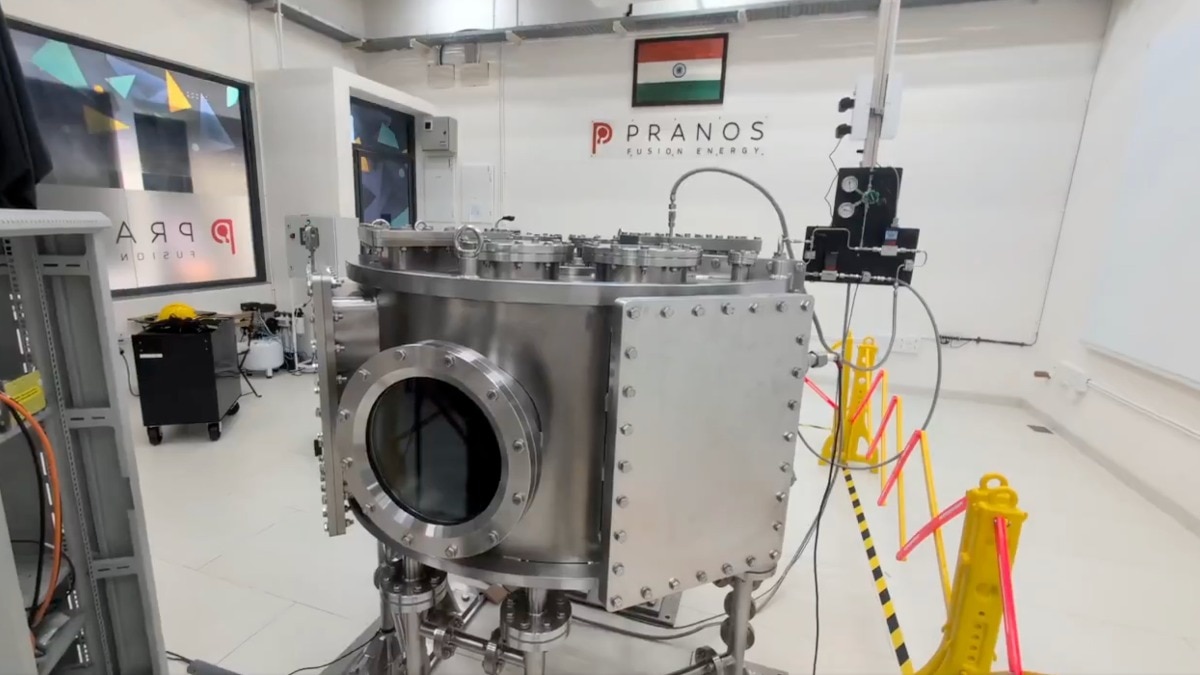
India's Private Pragya Tokamak Opens A New Fusion Frontier
China completes giant 582-tonne magnet for 'artificial sun' fusion
UPSC Mains Practice: Nuclear Power and Railways Net-Zero Themes
Indian Nuclear Expansion Puts Specialized Pump Stocks In Focus
India’s 57-Year-Old Tarapur Reactor Prepares for More Years

Fusion Finance targets 10% of disbursements from individual loans
China Completes Largest Fusion Magnet, Aiming for 2030 Power

Fusion Finance Reports Q1 Loss, Faces Challenges