1 year ago
ISRO-IIT Guwahati Team Uncovers X-ray Flickers from Distant Black Hole
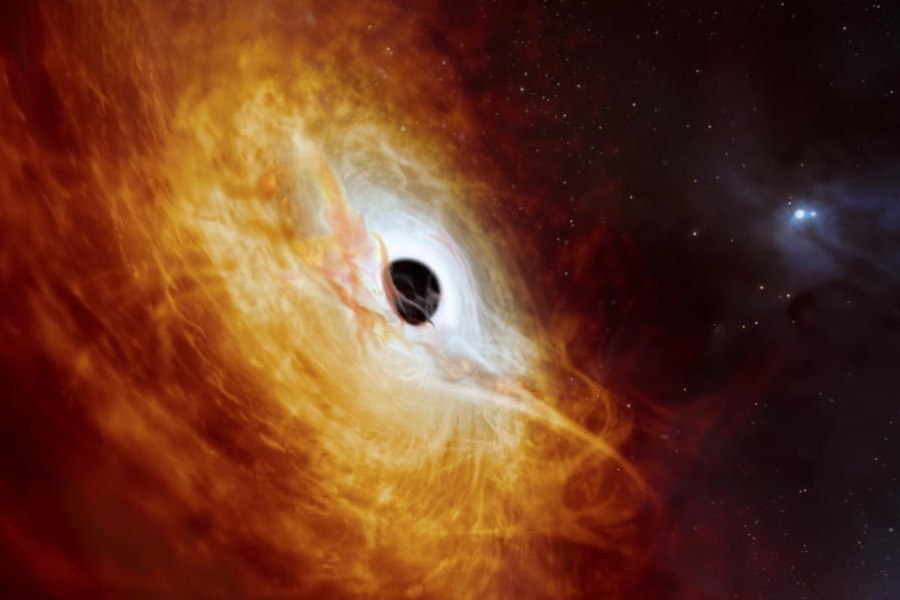
Imagine a giant vacuum cleaner in space called a black hole.
Scientists from India, using a special space telescope called AstroSat, saw the black hole flashing with X-rays.
These flashes changed, sometimes bright, sometimes dim.
The bright flashes have quick bursts of light, like a fast strobe.
The scientists found that the area around the black hole changes shape and temperature as it sucks in gas.
This helps scientists understand how these giant space objects work and how they affect the universe around them.

Researchers discovered a unique X-ray signal pattern from a black hole.
The black hole, GRS 1915+105, is located 28,000 light-years away.
AstroSat observed the object's X-ray brightness varying between bright and dim phases.
Rapid X-ray flickers, repeating 70 times per second, occurred during bright phases.
The findings offer insight into black hole dynamics and their influence on galaxies.
- Who
- Researchers from ISRO, IIT Guwahati, and Haifa University collaborated on the study.
- What
- Researchers detected a unique X-ray signal pattern from a black hole.
- Where
- The black hole is located approximately 28,000 light-years from Earth.
- When
- The findings were published in the Monthly Notices of the Royal Astronomical Society.
- Why
- The study aims to understand black hole dynamics, energy release, and influence on galaxies.
Key facts
- Research Institutions
- ISRO, IIT Guwahati, Haifa University
- Black Hole
- GRS 1915+105
- Black Hole Distance
- Approximately 28,000 light-years
- Observation Method
- AstroSat space observatory
- X-ray Flickering Speed
- 70 times per second (70 Hz)
Quotes
the researchers
unspecified
“This study reshapes our understanding of black hole dynamics and the extreme environments they create.”
 thestatesman.com
“It also opens up new avenues for probing how black holes grow and influence their cosmic neighbourhoods over billions of years.”
thestatesman.com
Dr Anuj Nandi
of ISRO’s U. R. Rao Satellite Centre
“This is the first time we have direct evidence linking such rapid flickering to changes in the corona—the hot plasma surrounding the black hole.”
thestatesman.com
Prof Santabrata Das
of IIT Guwahati
“This shows the corona is not a static structure but a dynamic one that changes with the inflow of gas spiralling into the black hole.”
thestatesman.com
Sources

Related news

Assam Proposes Scholarships for 100 IIT Guwahati Students

Humanoid Robots Near Borders Raise Questions About Human Control
IIT Guwahati Develops Low-Cost Reactor for Arsenic, Fluoride Removal

India’s Smart Cancer Drug RK-251 Targets Tumor Cells

Indian Researchers Develop AI and Targeted Cancer Treatment Tools