

1 hr ago
Experts Urge India to Build Tailored AI Safety Framework

Experts say India should make AI safety rules that fit the country rather than copy another country’s plan.
India has many languages, and AI is often used to build practical applications.
Some experts want legal rules for serious risks, while others worry that too many rules could make it harder for new companies to compete.
Some suggest combining required rules with voluntary safety practices.
They say AI should be tested and checked by independent experts.
They also want governments, businesses, researchers, workers, and users involved in making the rules.
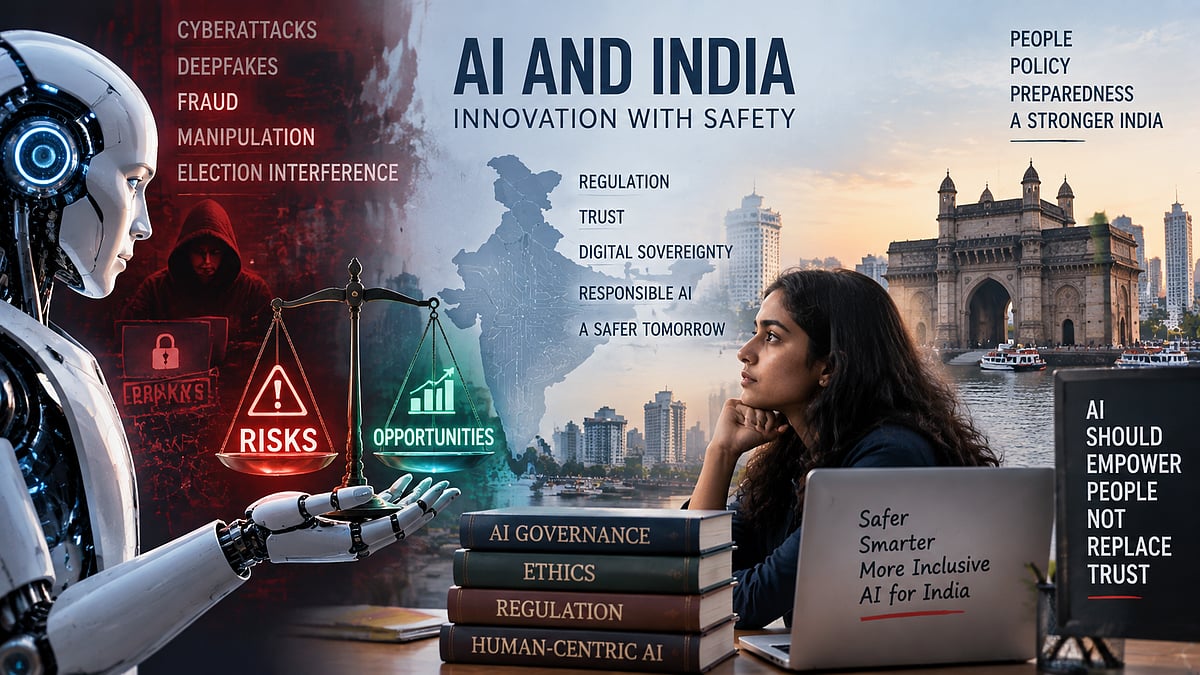
Important concerns include fake videos, scams, cyberattacks, and harm to essential services.
The Indian government has said it is considering whether new laws are needed.

Industry experts say India should develop AI safety rules suited to its languages, scale, and application-focused ecosystem instead of copying the US voluntary pact.
The White House Accord on Super Intelligence was signed September 29 by Donald Trump and executives from six major technology companies.
Experts disagree on regulation: some favor binding or hybrid rules, while Gnani.ai CEO Ganesh Gopalan supports self-regulation to avoid stifling competition.
Suggested safeguards include testing, independent audits, incident reporting, accountability, and rules for high-risk uses.
Experts cite risks including deepfakes, cyberattacks, electoral interference, privacy breaches, and attacks on critical infrastructure.
- Who
- Indian industry experts, the Indian government, and companies that signed the White House Accord on Super Intelligence.
- What
- Experts called for India to create an AI safety framework tailored to its circumstances and debated whether it should rely on voluntary measures, binding rules, or both.
- Where
- India; the comparison is with a US-led voluntary pact.
- When
- The discussion followed the signing of the White House Accord on September 29; the report was datelined October 4.
- Why
- Experts say India’s languages, scale, application-led AI ecosystem, and risks such as deepfakes and cyberattacks require a framework suited to its needs.
Supporters of binding or hybrid rules
Supporters of voluntary self-regulation
How AI safety should be enforced
Supporters of binding or hybrid rules
Srikanth Velamakanni and Amit Khanna say voluntary measures alone leave gaps; they call for binding requirements alongside voluntary practices. Soumen Mandal supports mandatory rules for higher-risk uses and voluntary standards in fast-moving areas.
Supporters of voluntary self-regulation
Ganesh Gopalan says voluntary self-regulation is important because the technology is new, and mandatory rules could stifle competition or favor some companies.
Balancing safety and innovation
Supporters of binding or hybrid rules
Supporters of stronger rules argue that technically capable oversight can improve safety and public trust without necessarily stopping innovation.
Supporters of voluntary self-regulation
Gopalan argues India needs more frontier AI companies and that mandatory regulation could hinder competition.
Key facts
- White House accord date
- September 29
- Companies named as accord signatories
- Google, OpenAI, Anthropic, Meta, Nvidia, and xAI
- Accord measures
- Internal model controls, oversight teams, independent external audits, board oversight, and regular meetings on safety standards
- Proposed safeguards
- Pre-deployment testing, independent audits, serious-incident reporting, and named responsibility for AI risks
- Regulatory approaches discussed
- Voluntary self-regulation, binding rules, and hybrid approaches
- Risks highlighted
- Deepfakes, fraud, privacy breaches, cyberattacks, electoral interference, and attacks on critical infrastructure
- Government position
- Officials have said existing laws may be insufficient and that additional AI regulation or a new legal framework may be needed.
Quotes
Srikanth Velamakanni
Nasscom chairman and Fractal Group CEO
“As models become more capable and agentic, we are giving them greater access to systems and greater autonomy to make decisions. AI safety must be strengthened considerably and must stay ahead of capability to prevent catastrophic risks.”
 deccanchronicle.com
“Voluntary self-regulation is key given the technology is new. Having mandatory regulation can stifle competition and lead to concerns about a few companies getting preferential treatment.”
deccanchronicle.com
 livemint.com
 rediff.com
Sources


Related news

Why Frontier AI Development Needs Stronger Government Safeguards
India Faces AI Agent Risks as Safety Debate Accelerates

India Rejects AI Pause, Emphasizes People-Centric Development and Safety
Global AI Governance Splits as Nations Debate Voluntary Safeguards

Sitharaman Seeks Stronger AI Safeguards Without Stifling Innovation
AI Governance Needs Laws, Not Voluntary Slowdown Promises
Mother Praises Railway Staff for Preparing Oats for Toddler

SRFTI Students Seek Safeguards Ahead of Hindu Jagran Rally

Sikkim MP Urges Priority for Two Proposed Railway Links

Vande Bharat Crosses Chenab, Anji Bridges at 100 km/h
