

1 hr ago
NIT Rourkela Patents Hybrid System To Extend EV Battery Life
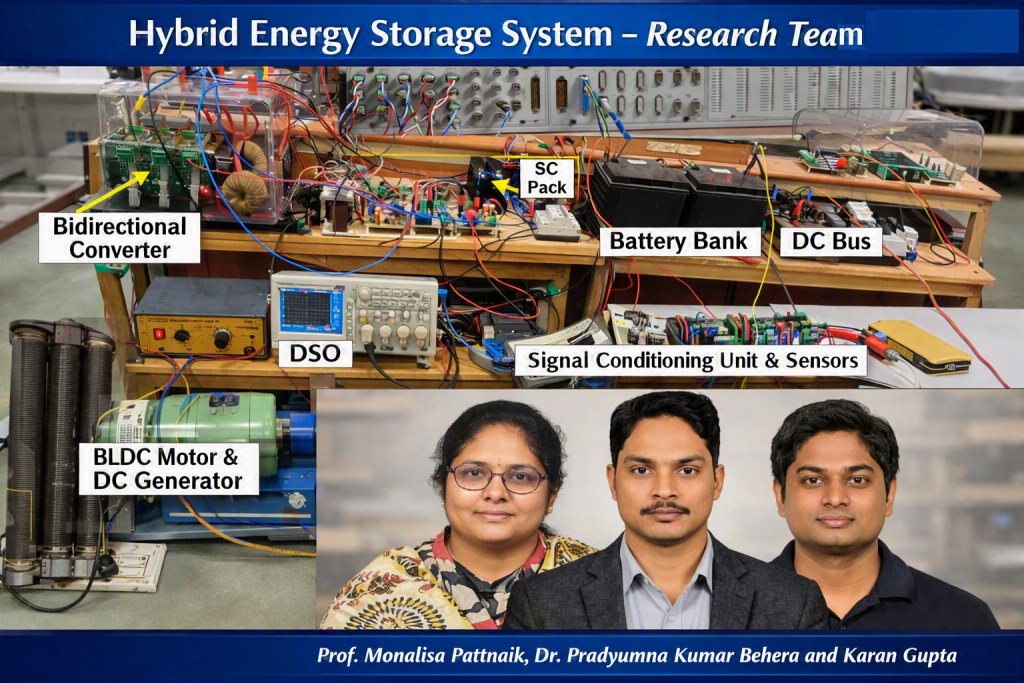
Researchers at NIT Rourkela created a new way to help electric-vehicle batteries last longer.
The system combines a normal battery with a supercapacitor.
The battery provides energy for longer trips.
The supercapacitor quickly supplies or absorbs energy when the vehicle accelerates or brakes.
This helps protect the battery from sudden bursts of electricity.
The design uses fewer major parts than some other battery-supercapacitor systems.
Tests showed stable operation and smoother changes in battery current.
It is designed for smaller electric vehicles and could also be used in some industrial and renewable-energy systems.

NIT Rourkela researchers developed and patented a hybrid battery-supercapacitor energy-storage system for electric vehicles.
The system uses one converter, an inductor and a single control system to manage power flow.
The supercapacitor handles sudden power demands during acceleration, braking and regenerative braking, reducing battery stress.
Tests showed stable 48-volt operation, smoother battery-current changes and efficient handling of power fluctuations.
The technology targets 24V-60V EVs, including scooters, motorcycles, e-rickshaws and utility vehicles, and is open to industry collaboration.
- Who
- Researchers Prof. Monalisa Pattnaik, Dr Pradyumna Kumar Behera and Mr Karan Gupta at the National Institute of Technology Rourkela.
- What
- They developed and patented a hybrid energy-storage system combining a conventional battery with a high-power-density supercapacitor.
- Where
- The research was conducted at the National Institute of Technology Rourkela in Rourkela, Odisha.
- When
- The patent application was filed on January 12, 2026.
- Why
- The system is intended to reduce battery stress from rapid power fluctuations, improving EV efficiency and battery lifespan.
Key facts
- Patent application
- Application No. 202631003328
- Patent filing date
- January 12, 2026
- Core technology
- Battery-supercapacitor hybrid energy storage
- Main components
- One converter, one inductor and a single control system
- Test performance
- Stable 48-volt operation with smoother battery-current changes
- Target voltage range
- 24V-60V DC
- Potential vehicles
- Electric scooters, motorcycles, e-rickshaws, cargo tricycles and campus or industrial utility vehicles
- Collaboration sought
- EV manufacturers, powertrain integrators, fleet operators and EV retrofit start-ups
Quotes
Prof. Monalisa Pattnaik
Associate Professor in the Department of Electrical Engineering at NIT Rourkela and member of the research team
“Our architecture contains three main components—one converter to connect both battery and supercapacitor to the vehicle’s electrical system, an inductor that is placed in the electrical path, and a single control system to handle the power flow.”
 deccanchronicle.com
Sources
Related news

MiniMines Cleantech Secures Patent for Hybrid Hydrometallurgy Technology
IIT Delhi Alumna Develops Battery-Powered Cold-Chain Refrigeration System
Ather Konarc Debuts With 200-Kilometre Range, Ten-Year Battery Warranty

SolarYaan Launches Hybrid Inverters, Storage Portfolio For India’s Energy Independence

NITK 1981 batch gifts electric buggies on Foundation Day

Denmark Delegation Discusses Future Power Grid Development in Amaravati

Four-Year-Old Elena Mishra Becomes Youngest FIDE-Rated Female Player

Puri Jagannath Temple Reports Rs 1,912 Crore Deposits

Odisha OTET 2026 Results Announced, Scorecards Available Online Now

Mineral Tax Reform Pits National Economic Integration Against State Revenues
