1 hr ago
Francis Halzen Wins 2026 Nobel Prize for Neutrino Research
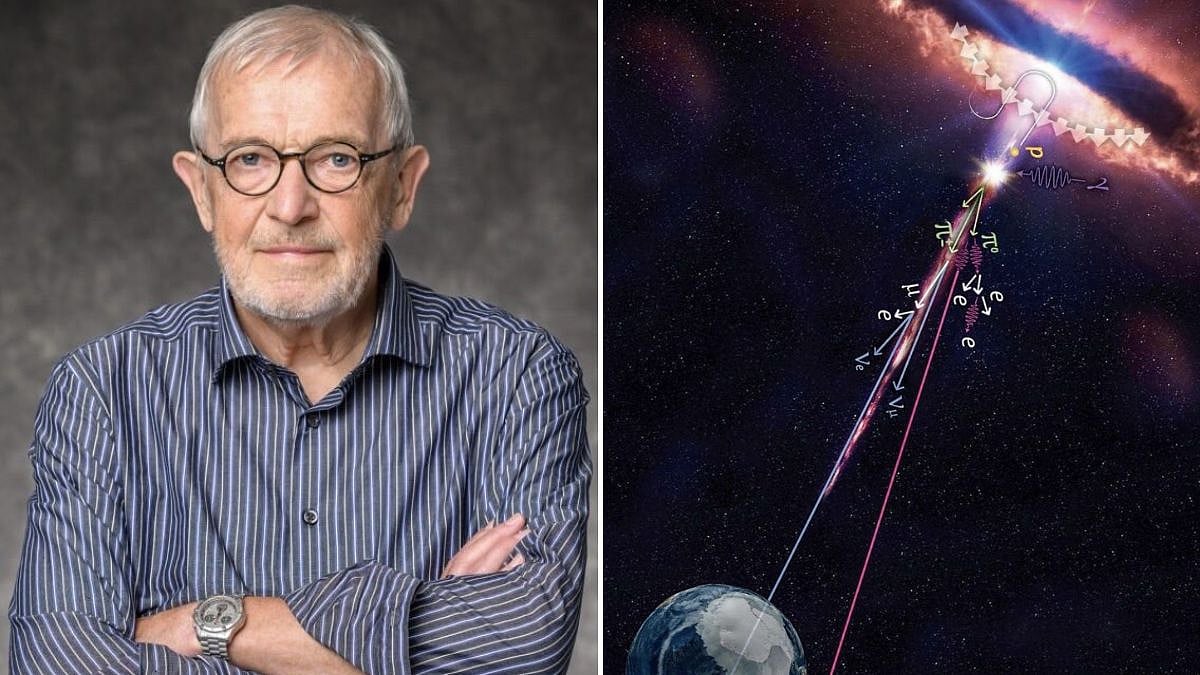
Francis Halzen is a physicist who studies neutrinos, tiny particles that are very hard to detect.
Trillions of them pass through people every second, usually without interacting with anything.
In the 1980s, Halzen began thinking about using ice at the South Pole to find them.
That idea helped lead to the IceCube observatory in Antarctica.
It looks for flashes of light or other signs created when a neutrino rarely hits another particle.
These detections can give scientists clues about events far away in space.
Halzen led an international team that helped build and run the observatory.
He won the 2026 Nobel Prize in Physics for his work.
He said he was surprised when he received the news by phone in Italy.

Belgian-born physicist Francis Halzen won the 2026 Nobel Prize in Physics for work on high-energy neutrinos and the IceCube Neutrino Observatory.
Halzen began exploring ways to detect neutrinos at the South Pole in the 1980s.
IceCube uses Antarctic ice to detect light and charged particles produced by rare neutrino interactions.
The University of Wisconsin-Madison is the observatory’s lead institution, and Halzen led its international research and engineering team.
Halzen said the Nobel Committee’s call, which came while he was in Italy, was a surprise.
- Who
- Francis Halzen, a Belgian-born particle physicist affiliated with the University of Wisconsin-Madison.
- What
- He won the 2026 Nobel Prize in Physics for pioneering work on high-energy neutrinos and the IceCube Neutrino Observatory.
- Where
- The observatory is at the South Pole in Antarctica; Halzen was in Italy when he received the call.
- When
- The Nobel Committee called Halzen on Tuesday; the article identifies the award as the 2026 Nobel Prize.
- Why
- His work helped create a way to detect high-energy neutrinos and use them to study distant cosmic events.
Key facts
- Award
- 2026 Nobel Prize in Physics
- Award recipient
- Francis Halzen
- Field of study
- High-energy neutrinos
- Observatory
- IceCube Neutrino Observatory
- Location
- South Pole, Antarctica
- Early exploration
- Halzen began exploring South Pole neutrino detection in the 1980s.
- Lead institution
- University of Wisconsin-Madison
Quotes
Mark Pearce
Chair of the Nobel Committee for Physics
“Francis Halzen has led an international team of researchers and engineers who have provided us with a fantastic instrument. His tenacity and scientific vision has paved the way for a new kind of astronomy.”
 freepressjournal.in
Eva Olsson
Representative of the Royal Swedish Academy of Sciences
“The messengers bring information from the cosmos. They open the door to distant galaxies and tell us about the processes of exploding stars.”
freepressjournal.in
Francis Halzen
Particle physicist and 2026 Nobel Prize in Physics laureate
“It was a great surprise and I obviously didn't expect it.”
freepressjournal.in
Sources
Related news

Francis Halzen Wins 2026 Physics Nobel for IceCube Neutrino Discovery

India Sports, Science and Diplomacy Lead October 7 Headlines

Trump, Carney and ISS in 2026 Nobel Peace Prize Speculation

CERN Experiment Recreates Cosmic Ray Collisions in Earth’s Atmosphere
International Space Station Emerges as Surprise Nobel Peace Prize Contender

Three Scientists Win 2026 Nobel Medicine Prize for Optogenetics

Gut Bacterial Molecule Linked to Alzheimer’s-Related Brain Changes

AI Helps Solve 25-Year-Old Wireless Communication Problem, Professor Says

UAE Indian Passport Services: No Premium Queues, 30-Minute Target