1 week ago
Maharashtra’s 2026 Cooperative Rules Aim to Cut Housing Litigation

Maharashtra has many housing societies where people live together and make shared decisions.
Sometimes members argue about maintenance, parking, elections, redevelopment or who owns a home after someone dies.
These disagreements can take years to resolve.
New cooperative rules for 2026 are intended to improve how societies are managed.
The article says the rules should also include faster deadlines and online systems for tracking cases.
It recommends trying mediation before sending suitable disputes to court.
Members should be able to see important records, such as meeting minutes and accounts, digitally.
Redevelopment projects should follow clear and transparent steps.
The reforms will be successful only if they make societies more accountable and help ordinary disputes get resolved faster.

Maharashtra has about 1.27 lakh cooperative housing societies, including 33,200 in Mumbai, serving millions of families.
The 2026 Maharashtra Cooperative Societies Rules establish a legal framework focused on modern cooperative governance.
The article calls for time limits, mediation, digital case tracking and published statistics to address delayed dispute resolution.
Clearer jurisdiction guidance and stronger digital recordkeeping could reduce confusion and improve member access to information.
Redevelopment, nominations, audits, parking, electric-vehicle charging, pets and digital meetings require more detailed safeguards.
- Who
- Maharashtra’s cooperative housing societies, their members and the authorities handling cooperative disputes.
- What
- The 2026 Maharashtra Cooperative Societies Rules introduce a governance framework, while the article proposes additional measures to reduce litigation and speed up justice.
- Where
- Maharashtra, including approximately 33,200 cooperative housing societies in Mumbai.
- When
- The reforms are associated with the 2026 Maharashtra Cooperative Societies Rules.
- Why
- To improve transparency and accountability and reduce lengthy disputes involving housing-society management, redevelopment and member rights.
Reform Potential
Implementation Concerns
Effect of the 2026 rules
Reform Potential
The rules provide an important legal foundation and emphasize modern governance for Maharashtra’s cooperative housing societies.
Implementation Concerns
New provisions alone may not reduce litigation unless authorities add timelines, improve accountability and measure whether cases are resolved faster.
Dispute resolution
Reform Potential
Mandatory mediation or conciliation, digital case management and priority for older cases could make routine disputes quicker and easier to follow.
Implementation Concerns
Members still face uncertainty over whether matters belong before the registrar, cooperative court, civil court or another authority, creating possible delays and expense.
Housing-society governance
Reform Potential
Digital records, clearer nomination rules, stronger audit follow-up and transparent redevelopment procedures could improve member protection.
Implementation Concerns
The article argues that model bye-laws need more detailed safeguards covering records, succession, developer selection, disclosures, transit rent, guarantees and project monitoring.
Key facts
- Cooperative societies in Maharashtra
- About 1.27 lakh
- Cooperative societies in Mumbai
- About 33,200
- Main concern
- Delayed resolution of housing-society disputes
- Proposed case reforms
- Timelines, mediation or conciliation, online case tracking and public statistics
- Records recommended for digital access
- Notices, agendas, minutes, resolutions, accounts, audit reports and membership records
- Major dispute area
- Redevelopment
- Additional emerging disputes
- Parking, electric-vehicle charging, pets, tenants, common areas, home offices and digital meetings
Sources
Related news
Bombay High Court Rejects Split Legal Challenges to Redevelopment

Eight Green Acres Committee Members Disqualified Over Non-Disclosure of Records

Maharashtra Clears Path For Deemed Conveyance Of Housing Societies

Advocates Welcome Supreme Court Rebuke Over Consumer Fora Delays
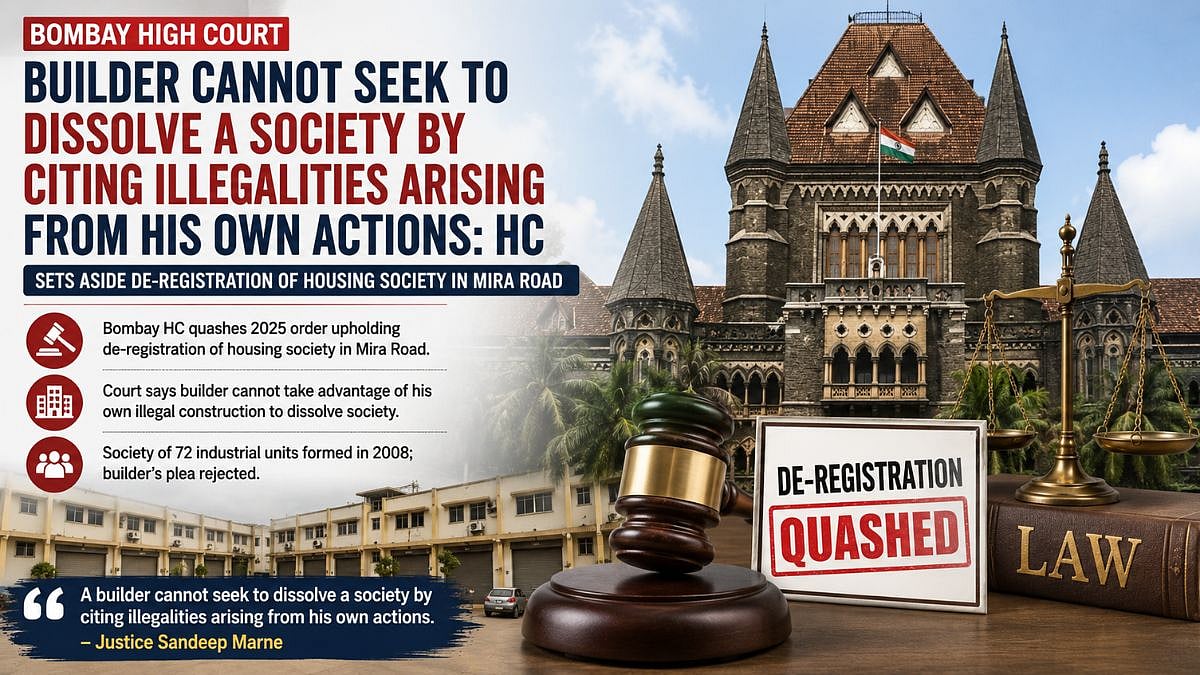
Bombay HC Sets Aside Mira Road Housing Society De-Registration
Mumbai Trains Election Officials Amid Statewide Electoral Roll Revision

Bombay Gymkhana Squash Finals Set After Junior Semifinals
NMMC Launches Navi Mumbai Drive to Protect Existing Trees
Maharashtra Ministers Seek End to Jarange Patil’s Maratha Quota Fast
Bhiwandi JCB Operator Assault Spurs Warehouse Work Dispute Investigation