

1 day ago
Hubris Cannot Rewrite Nature’s Laws as Financial Excesses Grow

The article says that people and countries cannot ignore the limits of nature forever.
Money, armies and institutions all need real things such as energy, food and resources.
The author believes financial markets can sometimes become too optimistic and disconnected from reality.
When governments and organizations keep spending more than they produce, their problems can grow.
History shows that powerful empires may weaken when leaders become wasteful and stop adapting.
The article also says shared purpose and trust help societies use fewer resources and remain stable.
It compares today’s debt and expensive markets with a bill that eventually has to be paid.
The main message is that human confidence cannot change the basic laws of nature.

The article argues that societies weaken when financial valuations and elite power detach from physical reality.
It links climate change, wars, energy, food, water and rare minerals to the material foundations of political and economic power.
János Kornai’s hard-budget-constraint concept is presented as a warning against repeatedly supporting inefficient institutions.
Historical thinkers are cited as describing imperial decline through overextension, bureaucracy, weakened cohesion and economic exhaustion.
The author warns that high debt, financial engineering and concentrated asset valuations could produce systemic instability.
- Who
- The author, drawing on Charles Dickens, János Kornai, Helen Thompson, Ray Dalio and several historical thinkers.
- What
- An argument that financial excess, debt, imperial overextension and weakened social cohesion are colliding with physical limits.
- Where
- Across the global economic and geopolitical system, with references to the Ukraine war and major historical civilizations.
- When
- In the present global period, described as an era of heat waves, wars, high asset valuations and elevated interest rates.
- Why
- The author argues that economic and political systems ultimately depend on finite energy, resources, productive output, trust and social cohesion.
Material Limits and Fiscal Discipline
Financial Flexibility and Human Agency
How much can markets and governments stretch?
Material Limits and Fiscal Discipline
The article argues that debt, bailouts and inflated asset valuations eventually encounter hard limits imposed by real output, energy and resources.
Financial Flexibility and Human Agency
The article acknowledges that human agency can change social systems and that perceptions and valuations are not governed in exactly the same way as physical systems.
What drives imperial decline?
Material Limits and Fiscal Discipline
The author emphasizes overextension, bureaucracy, elite self-interest, weakened cohesion and a hollowed-out economic base.
Financial Flexibility and Human Agency
The article’s historical comparisons leave room for the view that societies can survive by adapting, experimenting, adjusting and responding pragmatically to crises.
Key facts
- Core argument
- Human institutions and markets may become detached from physical reality, but they cannot escape material limits.
- Thermodynamics
- The article summarizes energy conservation, increasing entropy and the impossibility of reaching absolute zero.
- Budget discipline
- János Kornai’s hard-budget constraint is described as a discipline that forces inefficient firms to fail rather than depend indefinitely on bailouts.
- Historical pattern
- The article says empires often rise through adaptation and shared purpose before declining through luxury, bureaucracy, overextension and economic exhaustion.
- Current warning
- The author says governments are accumulating debt faster than real output and that financial engineering is outpacing productive engineering.
- Resource foundations
- Energy, food, water, fossil fuels and rare minerals are presented as foundations of political, military and economic power.
- Market risk
- Concentrated and highly valued markets are described as fragile, with a potential bursting carrying systemic implications.
Quotes

Charles Dickens
English novelist whose work is quoted in the article to illustrate the consequences of living within or beyond one’s means.
“Annual income twenty pounds, annual expenditure nineteen nineteen and six, result happiness. Annual income twenty pounds, annual expenditure twenty pounds ought and six, result misery.”
 thestatesman.com
Sources
Related news
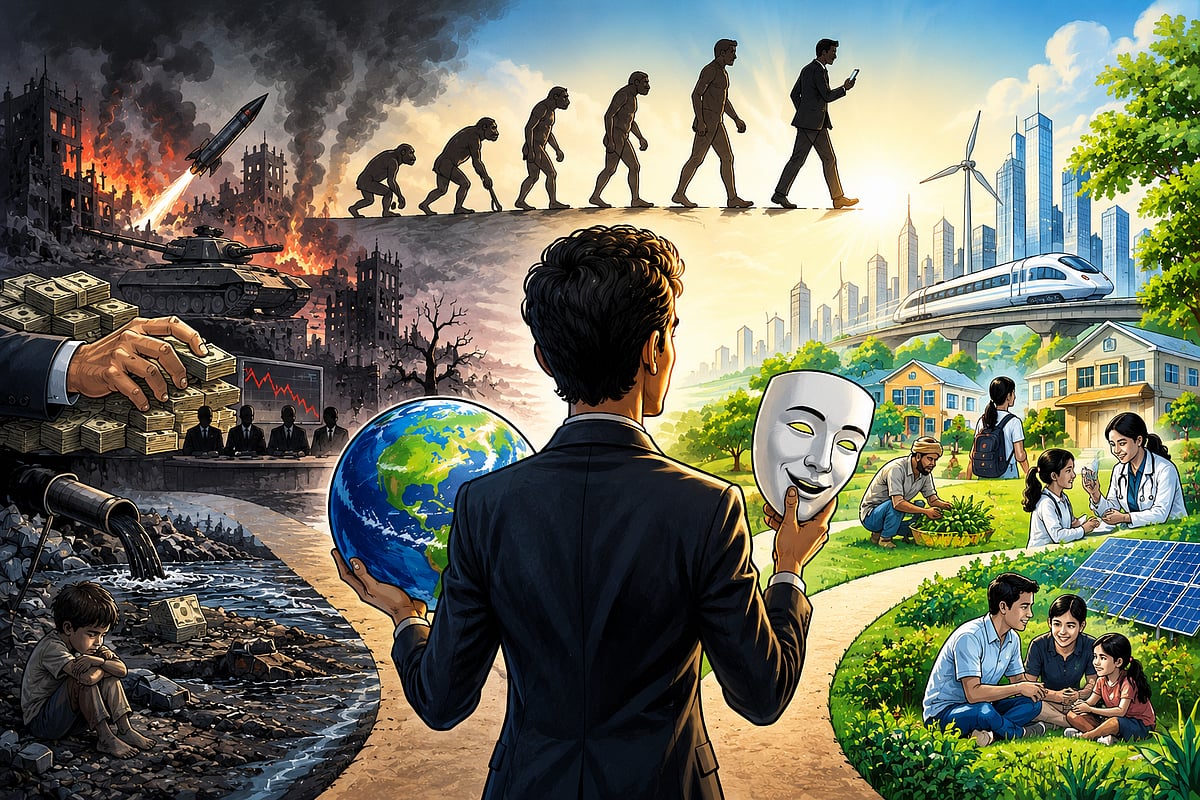
Humanity’s Economic Progress Still Lags Behind Its Wisdom
War and Debt Raise Questions About America’s Imperial Future

Modi and Trump Face the Challenge of Wounded Power

Book Explores Civilisational Forces Behind Bharat’s Economic Rise

Sridhar Vembu Says Profit-Driven Economics Creates a Dystopian World

UPSC Mains 2026 Checklist: 15 Ethics Topics Aspirants Shouldn't Miss

Evergrande Collapse Highlights Short-Selling Risks, Andrew Left Says
