1 day ago
Madhya Pradesh Leads India in Forest Diversion Over Decade
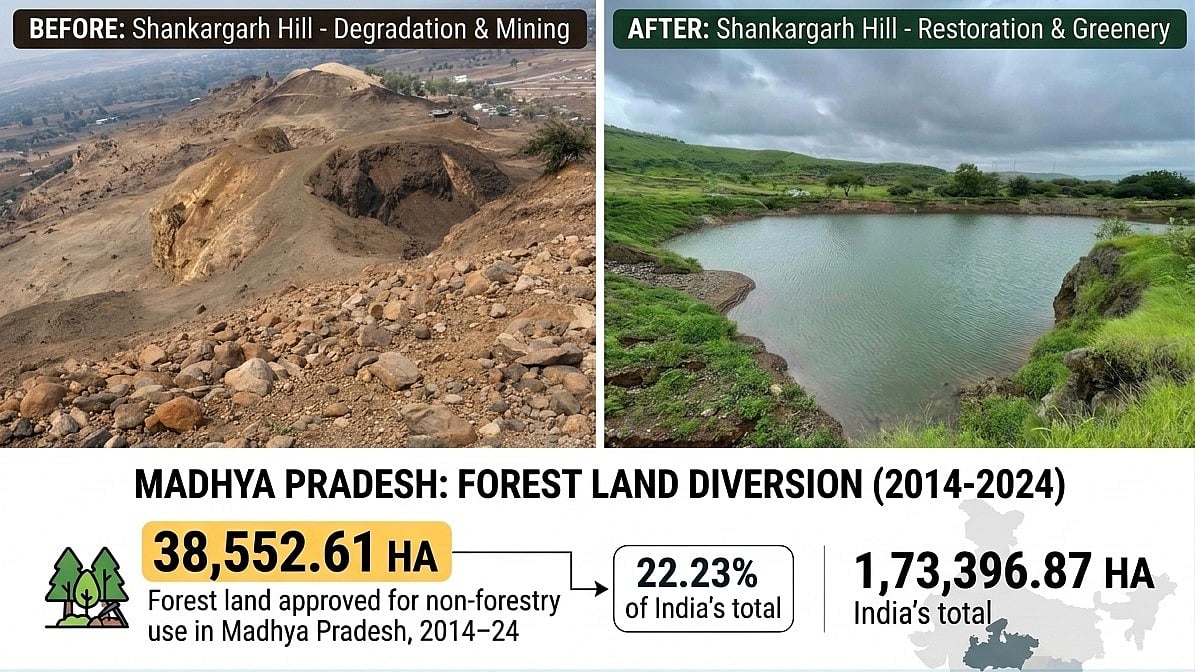
Madhya Pradesh approved more forest land for non-forest projects than any other Indian state over the last decade.
The approvals covered roads, mines, dams, power projects and other developments.
They totaled about 38,553 hectares in Madhya Pradesh.
This was more than one-fifth of all forest land approved for diversion across India.
Approval does not always mean that trees are cut immediately because projects may be built in stages.
Some projects pass through areas used by tigers and other animals to travel between protected forests.
Mining and quarrying can permanently change hills, land and water systems.
Planting trees somewhere else can help, but it cannot quickly replace an old forest and its wildlife habitat.

Madhya Pradesh approved the diversion of 38,552.61 hectares of forest land from 2014–15 to 2023–24.
The state accounted for 22.23% of India’s 173,396.87 hectares approved for non-forestry development.
Odisha ranked second with 24,458.89 hectares, followed by Telangana with 11,422.47 hectares.
Tiger corridors including Kanha-Pench and Bandhavgarh-Sanjay may be affected by roads, railways and other linear projects.
Mining, quarrying and other development have raised concerns about landscape damage, wildlife movement and the limits of compensatory afforestation.
- Who
- Madhya Pradesh recorded the largest forest diversion, according to data submitted by the Ministry of Environment, Forest and Climate Change to Parliament.
- What
- A total of 38,552.61 hectares of forest land in Madhya Pradesh was approved for non-forestry development.
- Where
- The reported projects were in Madhya Pradesh, including the Kanha-Pench and Bandhavgarh-Sanjay corridors, Dewas, Sanawadiya and Kathotian hill near Indore.
- When
- The approvals covered the period from 2014–15 to 2023–24; a stone-mining clearance in Sanawadiya was also recorded in May 2024.
- Why
- The land was approved for non-forestry development, including mining, irrigation, roads, power infrastructure, defense and public infrastructure.
Development Approvals
Forest Conservation Concerns
Use of forest land
Development Approvals
Forest diversion approvals support non-forestry development such as mining, irrigation, roads, power transmission and public infrastructure.
Forest Conservation Concerns
The article notes that diverted forests support wildlife and local ecosystems, and that compensatory plantations cannot quickly replace an old forest.
Linear projects and wildlife
Development Approvals
Roads, railways and corridor-widening projects are included among the approved development activities.
Forest Conservation Concerns
The National Tiger Conservation Authority identifies the Kanha-Pench and Bandhavgarh-Sanjay corridors as important movement routes for tigers, leopards, dholes and gaurs.
Mining and quarrying
Development Approvals
Mining and mineral extraction account for approximately 38% of Madhya Pradesh’s reported diversion by sector.
Forest Conservation Concerns
The article describes severe landscape damage at Shankargarh Hills and reports that quarrying near Indore degraded local hydrology and topography.
Key facts
- Madhya Pradesh diversion
- 38,552.61 hectares from 2014–15 to 2023–24
- National total
- 173,396.87 hectares approved across India
- Madhya Pradesh share
- 22.23% of the national total
- Second-highest state
- Odisha, with 24,458.89 hectares
- Third-highest state
- Telangana, with 11,422.47 hectares
- Largest sectoral share in Madhya Pradesh
- Mining and mineral extraction, approximately 38%
- Sanawadiya quarrying growth
- Expanded from 6.47 lakh square feet in 2000 to 10.07 lakh square feet in 2015
Quotes
Rakesh Modi
Deputy ranger discussing efforts to address illegal mining at Shankargarh Hills in Dewas
“We had to dig holes, clear rocks, fight against the difficult terrain over years, and win over three major illegal mining operations.”
 freepressjournal.in
Sources
Related news

NGT Gives Bhopal Three Months To Clear Forest Encroachments
Maharashtra approves forest land diversion for two Adani Group projects

Cat-22 in Madhya Pradesh: 50 humans killed, 45 tigers dead
Most Power Lines in Kawal Tiger Reserve, Corridor Forests Illegal
Illegal Sand Mining Drains Kawal Tiger Reserve Water, Threatens Wildlife

Supreme Court Orders Elephant Corridor Survey as Ramesh Flags Destruction
Kukshi Seeks Drought Status After 205 Mm Rainfall Deficit

Five Dead, 30 Injured in Madhya Pradesh Bus-Truck Collision

Three Killed, Several Injured in Rewa Bus Collision
Suspected Hyena Attack in Mandsaur Kills Six Goats

Rahul Gandhi’s Indore Student Outreach Postponed Amid Venue Dispute