

2 weeks ago
AI Enters IVF Labs as Decision-Support, Not Embryologist Replacement
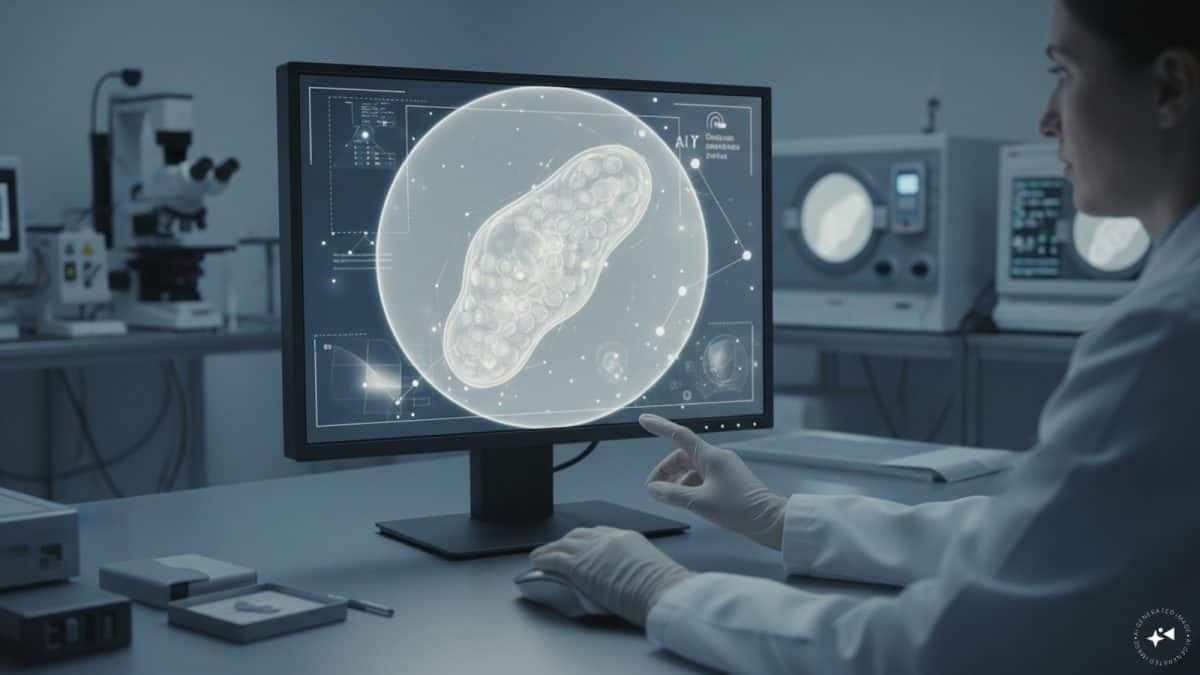
Some doctors who help people have babies are testing a new helper: a computer program that looks at pictures of tiny embryos.
It can spot things that are hard for human eyes to see.
The computer is like a magnifying glass and a second opinion, not the boss.
The people making the final decision are still the embryologists, the scientists who study embryos.
One big study tested the computer in 14 baby-making clinics.
It found that about the same number of pregnancies happened whether or not the computer helped pick the embryo.
So the computer did not make pregnancy more likely.
Scientists say the computer can still be useful because it is very consistent and fast.
It can grade embryos the same way every time, which humans sometimes do differently.
But having a fancier laboratory does not mean a baby is guaranteed.

Artificial intelligence is entering IVF laboratories to analyse embryo images, time-lapse videos, and development patterns as a decision-support tool.
ASRM's 2026 committee opinion describes AI as a potentially valuable adjunct but says its clinical usefulness requires rigorous validation.
A Nature Medicine trial across 14 clinics in Australia and Europe reported pregnancy rates of 46.5% with AI-assisted selection versus 48.2% with conventional assessment, failing to show non-inferiority.
Randomised trials have not shown AI-assisted embryo selection improves pregnancy outcomes over standard morphology-based assessment.
Experts say AI and automation will augment, not replace, embryologists, with human judgement staying central; automation is also being studied for ICSI and sperm selection.
- Who
- Embryologists, IVF patients, researchers, and organisations such as the American Society for Reproductive Medicine (ASRM)
- What
- Artificial intelligence is being used to analyse embryo images and development patterns in IVF labs as a decision-support tool, though it has not been proven to improve pregnancy outcomes
- Where
- IVF laboratories, including 14 clinics in Australia and Europe involved in a multicentre randomised trial
- When
- Ongoing developments, including a 2026 ASRM committee opinion and a 2025 systematic review
- Why
- To make embryo assessment more consistent, efficient, and standardised, while experts maintain that embryologists' professional judgement remains essential
Supporters of AI in IVF
Skeptics and cautious clinicians
AI effectiveness in embryo selection
Supporters of AI in IVF
AI can make embryo assessment more consistent and efficient, and a 2025 systematic review found promising diagnostic performance for predicting implantation.
Skeptics and cautious clinicians
Randomised trials have not shown AI improves pregnancy outcomes; the Nature Medicine trial could not demonstrate non-inferiority (46.5% vs 48.2% pregnancy rates).
Role of AI and automation in IVF labs
Supporters of AI in IVF
AI and robotics can handle embryo grading, laboratory logistics, witnessing, and even procedures like intracytoplasmic sperm injection, reducing repetitive work.
Skeptics and cautious clinicians
Full replacement of embryologists is unlikely because labs need quality control, troubleshooting, interpretation, accountability, and decisions an automated system may lack context for.
Key facts
- AI's role in IVF
- Decision-support tool that analyses embryo images and development; not a replacement for embryologists or a guarantee of pregnancy
- ASRM position
- 2026 committee opinion: potentially valuable adjunct; clinical usefulness requires rigorous validation
- Nature Medicine trial
- Randomised trial across 14 IVF clinics in Australia and Europe involving 1,066 patients
- Clinical pregnancy rates
- 46.5% with AI-assisted selection vs 48.2% with conventional assessment; non-inferiority not demonstrated
- Consistency benefit
- AI can apply the same analytical framework repeatedly; one trial found reduced time to evaluate blastocysts
- 2025 systematic review
- AI-based embryo assessment showed promising diagnostic performance for predicting implantation, but not proof of better outcomes
- Automation exploration
- AI explored for embryo grading, laboratory logistics, and storage; automation investigated for intracytoplasmic sperm injection and sperm selection
- Expert view
- Dr. Nidhi Sehrawat: AI adds another perspective while keeping professional judgement at the centre of the process
Quotes
Dr. Nidhi Sehrawet
Embryologist and expert in obstetrics and gynaecology
“"Embryo selection is a complex process that involves far more than analysing an image or generating a score. AI can serve as an additional layer of information, offering another perspective while keeping professional judgement at the centre of the process."”
 firstpost.com
“"The future of IVF is therefore unlikely to be about humans versus machines. Instead, it will be about combining the analytical capabilities of technology with the expertise and judgement of trained embryologists."”
firstpost.com
Sources
Related news

AIIMS Bhopal Opens New IVF and Fertility Centre

Samarth IVF Opens AI-Enabled Headquarters in Chhatrapati Sambhajinagar
Gujarat Couples Challenge IVF Age Cutoff Amid Advanced-Pregnancy Risks

RBI Deputy Governor Says AI Needs Human Judgment In Banking

Assam’s First IVF-Born Lakhimi Calf Signals Breed Conservation

Ikea cuts European prices as cost pressures weaken demand

Europe's Bond Selloff Deepens as Middle East Tensions Lift Oil

China’s Rapid Car Development Faces Growing Safety Scrutiny

CNG Prices Rise Rs 2 per Kilogram in Pune

China Challenges US Leadership in Escalating Global AI Contest
