

1 hr ago
Modi Balances Rivalries at a Restrained BRICS Summit
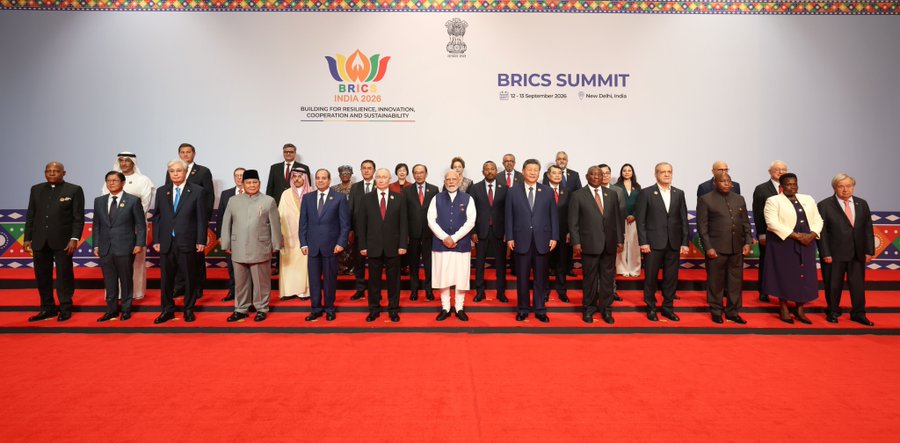
India hosted a meeting called the BRICS Summit.
Many countries with different friendships and disagreements attended.
Prime Minister Narendra Modi acted as a quiet and careful host.
He did not make the event mainly about himself or India.
The countries criticized Israel’s violence in Gaza and supported South Africa’s legal action against Israel.
They did not mention the Russia-Ukraine war in their joint statement.
India also had to manage relationships with Iran, Saudi Arabia, the United Arab Emirates, and China.
The summit showed that India wanted to help countries work together even when they disagree.
Modi focused on peace, trade, and safer sea travel.

India hosted the 18th BRICS Summit in New Delhi while holding the rotating presidency.
Prime Minister Narendra Modi adopted a subdued, factual tone rather than emphasizing personal or national grandeur.
The summit declaration condemned violence by Israel in Gaza and supported South Africa’s case against Israel at the International Criminal Court.
The Russia-Ukraine war was omitted, while the declaration mentioned the Pahalgam terror attack.
India balanced competing interests involving Iran, Saudi Arabia, the United Arab Emirates, China, and other BRICS members.
- Who
- India, Prime Minister Narendra Modi, and leaders of BRICS member countries, including Iran, Saudi Arabia, the United Arab Emirates, China, Egypt, Ethiopia, and South Africa.
- What
- The 18th BRICS Summit, where members discussed cooperation, peace, trade, Gaza, maritime safety, and the grouping’s future implementation structure.
- Where
- New Delhi, India.
- When
- During the 18th BRICS Summit; the articles do not provide a specific date.
- Why
- India sought to manage disagreements among BRICS members and demonstrate a constructive role in the grouping during heightened conflict in West Asia.
Accommodation and Multilateral Balance
National and Strategic Alignment
Position on Israel and Gaza
Accommodation and Multilateral Balance
India accommodated the broader BRICS position by supporting condemnation of Israel’s violence in Gaza and South Africa’s action at the International Criminal Court.
National and Strategic Alignment
The article says this was difficult for Modi and the pro-Israel lobby in the Indian government, suggesting a preference for closer alignment with Israel.
Approach to the Russia-Ukraine War
Accommodation and Multilateral Balance
The omission allowed BRICS members to avoid making the summit revolve around a conflict the article describes as European.
National and Strategic Alignment
The article does not report a competing statement at the summit, but the omission contrasts with the group’s explicit attention to West Asian violence.
Summit leadership style
Accommodation and Multilateral Balance
A restrained, quiet-host approach helped India accommodate rival countries and keep the focus on BRICS rather than on Modi or India.
National and Strategic Alignment
The article contrasts this with Modi’s earlier personalized diplomacy, national-cultural promotion, and more prominent public style.
Key facts
- Summit
- 18th BRICS Summit
- Host
- India, with New Delhi as the venue
- Indian leader
- Prime Minister Narendra Modi
- West Asia position
- The declaration condemned Israel over violence in Gaza.
- International legal action
- The summit supported South Africa’s move against Israel in the International Criminal Court.
- Russia-Ukraine war
- The conflict was omitted from the joint declaration.
- Proposed reform
- Modi suggested a permanent implementation structure because the BRICS presidency rotates annually.
Sources
Related news
India’s BRICS Summit Wins Consensus Amid Global Divisions

BRICS Summit Delivers Declaration and Modi-Xi Confidence-Building Meeting
BRICS Summit Reaches Consensus Amid Global Tensions
Rajnath Singh Hails India’s Conclusion of 18th BRICS Summit

BRICS Summit Tests India’s Balancing Act and Global Influence

India's BRICS Summit Tests Diplomatic Reach Amid Global Uncertainty

ICC Leaders Warn Isolation Campaign Threatens Global Legal Order

US Probes Iran-Reported Airstrike That Hit Wedding Gathering
Sahel Juntas Face Rising Violence Despite Joint Anti-Jihadist Force

Iran vows resistance, challenges legality of US attack