

2 weeks ago
AI Could Shift Mathematics From Proving Toward Imaginative Discovery
The article discusses how artificial intelligence might change mathematics.
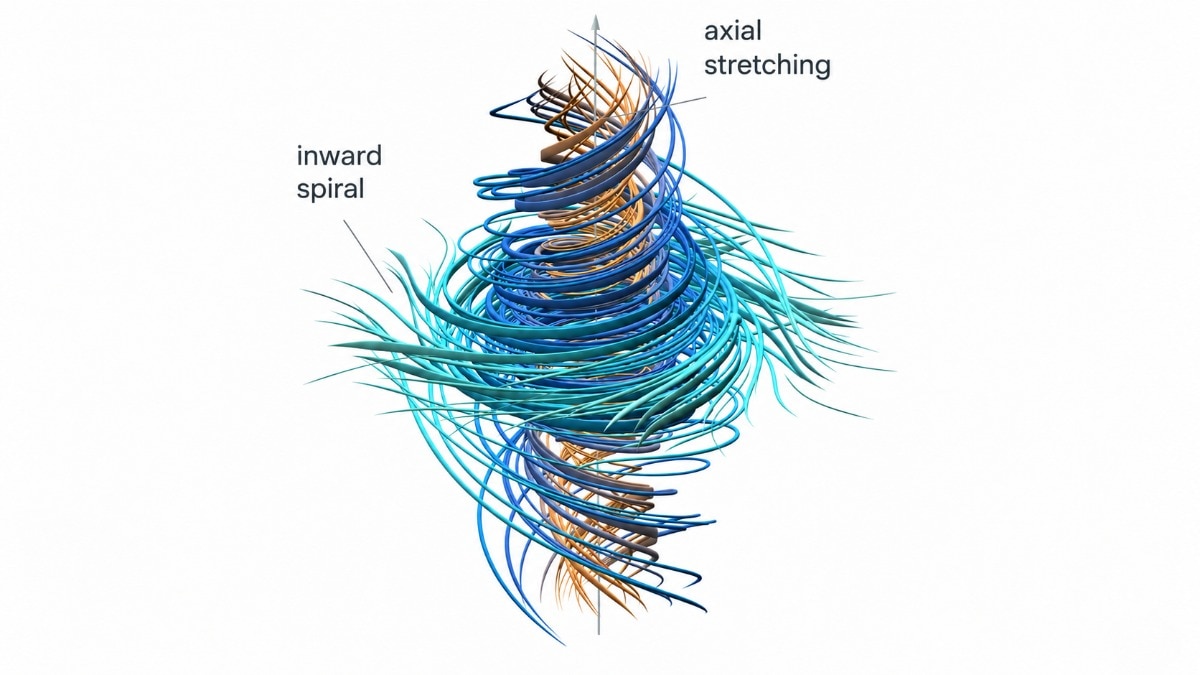
OpenAI said that thousands of AI agents helped solve a difficult question about the Navier–Stokes equations.
These equations describe how some liquids move.
The reported result says that the equations can produce singularities, which are places where the mathematics becomes especially difficult.
Mathematicians traditionally show that ideas are correct by writing proofs.
The author thinks AI may become better at creating some proofs than people are.
This could make mathematics less focused on checking every detail by hand.
Humans might then spend more time imagining new ideas and asking interesting questions.
The article compares this future to treating mathematics more like a creative art or a form of play.

OpenAI claimed on September 8 that 10,000 AI agents solved a long-standing Navier–Stokes problem in 88 hours.
The reported result says the Navier–Stokes equations can develop singularities, though the article presents this as an OpenAI claim.
A second team of human mathematicians reportedly used AI technology while working on the problem.
The author argues that AI may eventually become better than humans at developing mathematical proofs.
Rather than ending mathematics, AI could free mathematicians to focus more on speculation, intuition, aesthetics and creative questions.
- Who
- OpenAI, AI agents, and human mathematicians using AI technology.
- What
- A reported solution to a long-standing question about whether three-dimensional fluid motion described by the Navier–Stokes equations can develop singularities, and the possible effect of AI on mathematics.
- Where
- The article does not identify a specific location for the reported work.
- When
- September 8; the article does not specify a year.
- Why
- The reported result raises questions about whether AI will change mathematical proof-writing and allow humans to focus more on creative mathematical ideas.
AI as a Threat to Human Mathematics
AI as a Tool for Creative Mathematics
The future role of mathematicians
AI as a Threat to Human Mathematics
If AI becomes better at developing proofs, humans may lose the central skill that has traditionally defined professional mathematics.
AI as a Tool for Creative Mathematics
Outsourcing difficult proof development could let humans concentrate on asking questions, forming conjectures and finding broad ideas.
How mathematics should be understood
AI as a Threat to Human Mathematics
Heavy reliance on AI could encourage people to treat mathematics as something to watch or receive from a machine rather than something to practice themselves.
AI as a Tool for Creative Mathematics
AI could help move mathematics beyond its current emphasis on rigorous but often unwieldy proofs and make room for intuition, aesthetics and play.
AI and human achievement
AI as a Threat to Human Mathematics
Because mathematical results affect later work, AI-generated solutions cannot be isolated from human mathematics in the way separate chess games can be.
AI as a Tool for Creative Mathematics
The article argues that AI-assisted proof development may be one of the best developments for mathematics because it can help researchers navigate increasingly complex problems.
Key facts
- Reported claim
- OpenAI said it had solved a long-standing Navier–Stokes problem.
- AI involvement
- OpenAI reportedly used 10,000 AI agents.
- Reported duration
- The task took 88 hours, according to the article.
- Mathematical subject
- The Navier–Stokes equations describe the behavior of a class of liquids.
- Reported finding
- The two teams reportedly showed that the equations can exhibit singularities.
- Human contribution
- A separate team of human mathematicians reportedly used AI technology.
- Author’s argument
- AI could shift mathematics from proof development toward speculation, intuition and creative discovery.
Quotes
OpenAI
The artificial intelligence research organization discussing its reported Navier-Stokes result.
“The question of whether smooth three-dimensional fluid motion can break down has remained unresolved for roughly 90 years”
 scroll.in
Bernard Suits
A philosopher whose definition of play is cited in the essay.
“playing a game is the voluntary attempt to overcome unnecessary obstacles.”
scroll.in
Sources
Related news

OpenAI Navier-Stokes Proof Claim Faces Questions From Mathematicians
OpenAI Claims Navier-Stokes Breakthrough After 88-Hour AI Effort
OpenAI Navier-Stokes Claim Raises Questions About AI Research
Indian Scientist’s 2017 Paper Cited in OpenAI Math Claim

OpenAI Says AI Agents Solved Decades-Old Maths Problem
