2 weeks ago
Nuclear Weapons Could Deflect Dangerous Asteroids, New Simulations Suggest
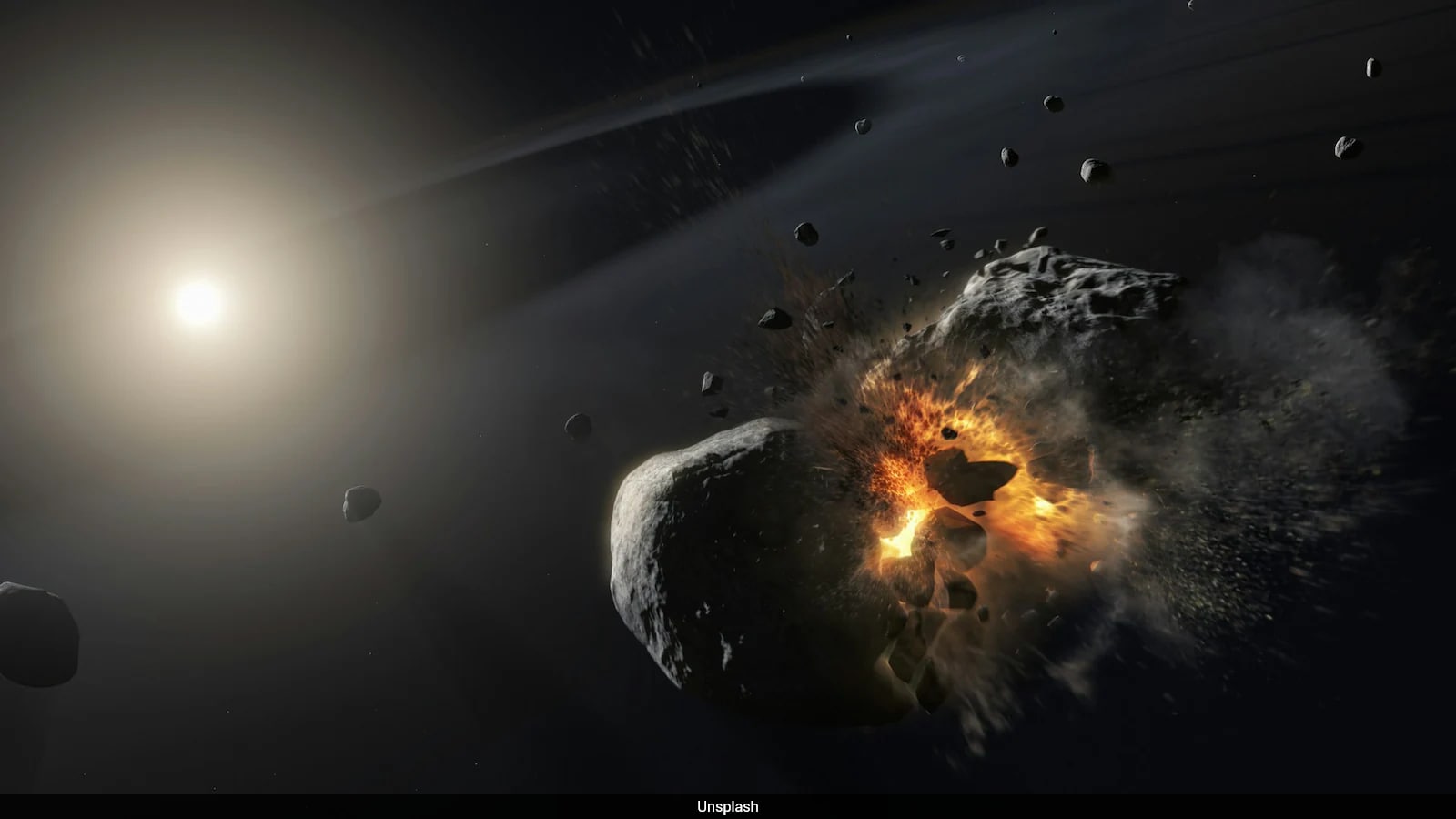
Scientists wondered if a nuclear bomb could save Earth from a giant space rock.
A big asteroid could destroy a whole city, so we need ways to stop it.
Some asteroids are very dark and hard to see coming.
If we found one too late, a nuclear bomb might be our last hope.
Scientists used supercomputers to test this idea.
They pretended a nuclear bomb exploded near a make-believe asteroid.
The bomb's X-rays would heat the rock so much that parts of it would fly away.
That could push the asteroid off course or break it into pieces.
The tests showed the asteroid would be badly damaged in most cases.
But scientists still are not sure if the pieces would be small enough to be safe.

Scientists at Lawrence Livermore National Laboratory simulated a 1-megaton nuclear explosion against a 160-metre-wide asteroid.
The weapon would not need to hit the asteroid; X-rays from a nearby blast could vaporize surface material and change its trajectory.
In a 10-metre blast simulation, 98.2% of the asteroid's material was badly damaged and about 97% moved faster than escape velocity.
A blast 25 metres away caused more widespread damage at one stage, damaging 92.6% of the asteroid after 68 milliseconds.
Simulations covered only up to 145 milliseconds, so researchers cannot confirm whether fragments would remain a threat to Earth.
- Who
- Scientists led by astrophysicist Isaiah Santistevan at Lawrence Livermore National Laboratory
- What
- Computer simulations testing whether a 1-megaton nuclear weapon could disrupt a 160-metre-wide asteroid
- Where
- Lawrence Livermore National Laboratory, United States
- When
- Publication date not specified; the findings appear in The Planetary Science Journal
- Why
- To assess nuclear disruption as a last-resort option for planetary defense if an asteroid is discovered too late for other methods
Key facts
- Lead researcher
- Isaiah Santistevan
- Institution
- Lawrence Livermore National Laboratory
- Simulated weapon
- 1-megaton nuclear weapon
- Simulated asteroid
- 160-metre-wide asteroid modeled on Bennu
- Explosion distances tested
- 10 metres and 25 metres from the surface
- X-ray energy share
- 70-80% of nuclear explosion energy
- Simulation coverage
- Up to 145 milliseconds; took 59 days on 1,680 processors
- Publication
- The Planetary Science Journal
Quotes
Isaiah Santistevan
Lead astrophysicist at Lawrence Livermore National Laboratory
“"Based on the extent of damage, the directionality of the material motion, and the [velocity change] that we impart on these asteroids, we suggest that disruption is highly likely for two of the three scenarios."”
 NDTV
NDTV
Research team
Authors of the study
“"Simulations such as these help to further inform the viability of nuclear mitigation options for planetary defense and support emergency response planning."”
NDTV
Sources
Related news

SpaceX Falcon 9 Upper Stage Likely Crashes Into the Moon

Fire, Explosion Rock KNDS Ammunition Plant Near Rome
IAEA to remove Syrian nuclear material under US-brokered deal

SpaceX Falcon 9 rocket stage believed to crash into Moon
Europa's Ice May Transport Life-Supporting Chemicals to Ocean