

8 months ago
Giant 'spider' on Europa's Manannán crater hints at water
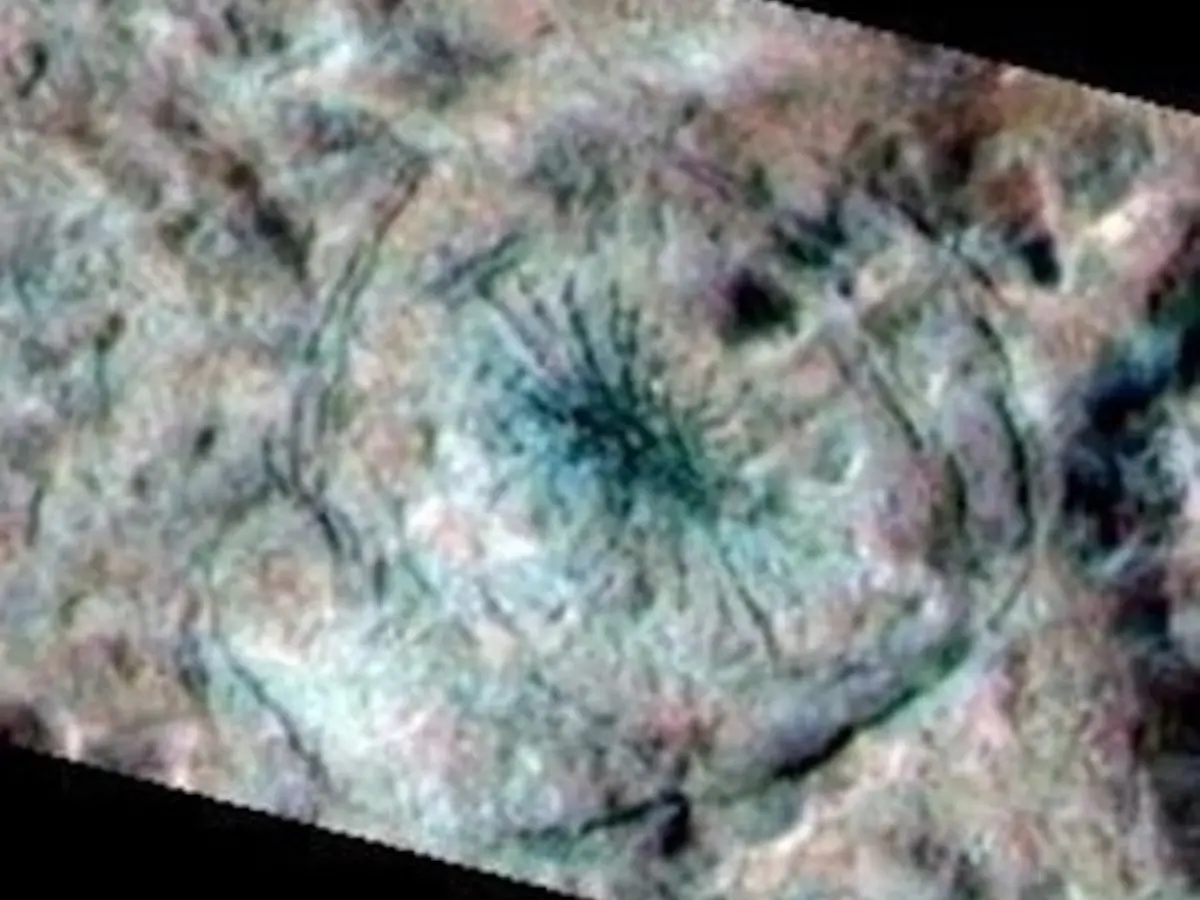
Scientists found a big spider-like shape in a crater on Europa, one of Jupiter's moons.
This crater is called Manannán and is very large, about 21-23 kilometers wide.
The spider-like shape, nicknamed Damhán Alla, was likely formed when salty water erupted to the surface after a big impact.
This is different from similar shapes found on Mars and Earth.
On Mars, they are made by carbon dioxide gas, and on Earth, they form on frozen lakes.
The scientists did experiments to see how this could happen and found that even in very cold conditions, similar patterns can form.
This discovery helps us learn more about what Europa was like a long time ago.

Scientists discovered a spider-like feature in Europa's Manannán crater, formed by the eruption of briny water.
The Manannán crater is one of the largest on Europa, with a diameter of 21-23 kilometers.
The spider-like feature, nicknamed Damhán Alla, is located at the center of the crater.
Previous studies revealed ice and hydrated water minerals concentrated around the crater.
Researchers recreated the process in a lab using Europa ice simulants and liquid nitrogen.
- Who
- Scientists from the Planetary Science Institute, University of Central Florida, NASA’s Jet Propulsion Laboratory (JPL), and other institutions
- What
- Discovery of a spider-like feature in Europa's Manannán crater, possibly formed by the eruption of briny water
- Where
- Europa, Jupiter's moon
- When
- Study published on December 2, 2025
- Why
- To understand the subsurface properties and brine composition at the time of the impact
Key facts
- Location
- Europa, Jupiter's moon
- Crater Name
- Manannán
- Crater Diameter
- 21-23 kilometers
- Spider Nickname
- Damhán Alla
- Study Publication
- The Planetary Science Journal
- Study Date
- December 2, 2025
- Research Institutions
- Planetary Science Institute, University of Central Florida, NASA’s Jet Propulsion Laboratory (JPL)
Quotes
Elodie Lesage
Co-author of the study and researcher at the Planetary Science Institute
“This spider-like feature might have formed through the eruption of melted brines following the Manannán impact.”
 wionews.com
“This would mean that it can inform us on subsurface properties and brine composition at the time of the impact.”
wionews.com
Lauren McKeown
Planetary geomorphologist at the University of Central Florida and lead author of the study
“We flowed water through these simulants under different temperatures and found that similar star-like patterns formed even under extremely cold temperatures.”
wionews.com