1 hr ago
Magnetic Pole Reversal Uncertain, Unlikely to Cause Mass Extinction
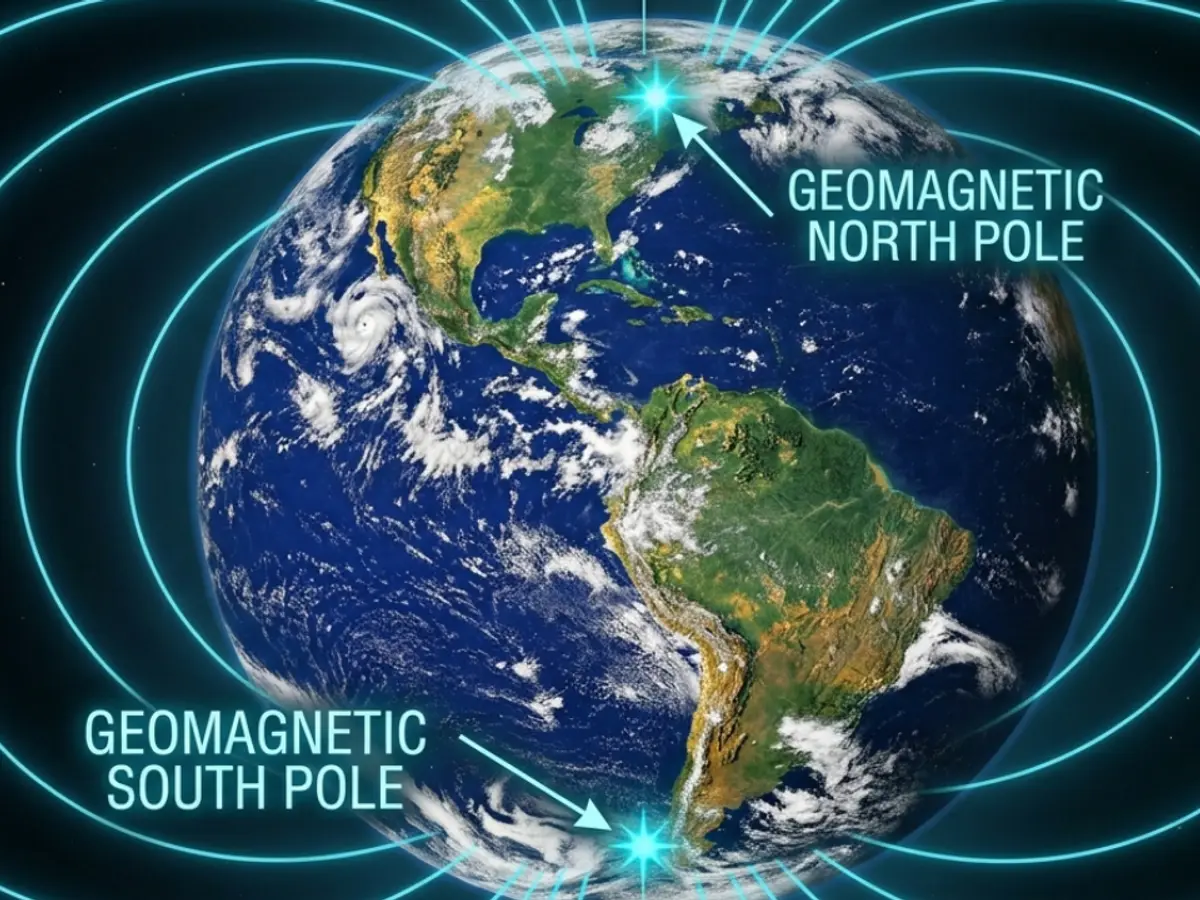
Earth has a magnetic shield that helps protect it from space radiation.
Sometimes the magnetic north and south poles swap places.
Scientists say this change would happen very slowly, over thousands of years.
Earth’s magnetic field has weakened somewhat, and Magnetic North is moving.
These changes might be early signs, but scientists cannot tell whether a reversal has begun.
Some researchers think extra radiation could affect clouds and climate.
However, the National Aeronautics and Space Administration says past reversals did not cause mass extinctions.
A weak magnetic field could still create problems for satellites, GPS, airplanes, communications, and power systems.
Scientists also cannot predict when the next reversal will happen.

Earth’s magnetic field has weakened by about 9% over the past 150–200 years.
Magnetic North has moved from northern Canada toward Siberia at roughly 50–60 kilometers per year.
A reversal would take about 2,000–10,000 years rather than happening suddenly.
The National Aeronautics and Space Administration says past reversals did not cause mass extinctions.
A weakened field could increase risks to satellites, GPS, aviation, communications, and power grids.
- Who
- Earth, scientists studying geomagnetic reversals, and the National Aeronautics and Space Administration.
- What
- Researchers are assessing whether a possible future magnetic pole reversal could affect climate, radiation exposure, technology, or extinction risk.
- Where
- Changes include Magnetic North moving from northern Canada toward Siberia and a weak-field region over South America and the southern Atlantic Ocean.
- When
- The latest completed reversal occurred about 780,000 years ago; reversals generally take 2,000–10,000 years to complete.
- Why
- A weakened magnetic field could allow more solar and cosmic radiation to reach Earth’s atmosphere and potentially disrupt technological systems, although its relationship to climate and extinction remains uncertain.
Potential Climate and Radiation Risks
Mainstream Scientific Assessment
Climate effects
Potential Climate and Radiation Risks
Some researchers argue that increased atmospheric ionisation during a weakened magnetic field could alter cloud cover, aerosols, condensation, and climate processes.
Mainstream Scientific Assessment
The available account says the climate effects remain uncertain and does not establish that magnetic reversals cause major climate change.
Mass extinction risk
Potential Climate and Radiation Risks
A weaker field could allow more solar-particle and cosmic radiation to reach the upper atmosphere, creating a possible biological risk during the transition.
Mainstream Scientific Assessment
NASA reports that past geomagnetic reversals did not trigger mass extinctions or cataclysmic physical disasters, and fossil records show no correlation with extinction events.
Whether reversal is imminent
Potential Climate and Radiation Risks
The field’s weakening, Magnetic North’s movement, and the South Atlantic weak-field region could be viewed as possible indications of an ongoing reversal.
Mainstream Scientific Assessment
Scientists cannot predict the next reversal, and it is unclear whether these observations indicate that a reversal has begun or is overdue.
Key facts
- Recent field change
- Earth’s magnetic field has weakened by about 9% over the past 150–200 years.
- Magnetic North movement
- Magnetic North has moved toward Siberia from northern Canada at about 50–60 kilometers per year in recent decades.
- Last reversal
- The Brunhes–Matuyama reversal was completed approximately 780,000 years ago.
- Reversal duration
- A full reversal could take roughly 2,000–10,000 years.
- Historical frequency
- Magnetic reversals have occurred roughly every 200,000–300,000 years, though timing is irregular.
- Extinction evidence
- NASA says fossil records show no correlation between past magnetic reversals and mass extinctions.
- Potential disruptions
- A weakened field could affect power grids, satellite communications, aviation networks, and GPS systems.
Sources
Related news

Musk Warns Climate Action Alone May Not Save Humanity
Pangea Ultima Could Make Most Land Uninhabitable for Mammals
Future Supercontinent Could Make Earth Uninhabitable for Humans
UNEP Warns Irreversible Climate Damage as 1.5°C Nears

Nepal Tragedy Highlights Climate Change’s Growing Warning Signs
Study Finds Past Polluter Emissions Will Shape Climate for Centuries

Gershkovich Describes Alleged FSB Sting Behind His 2023 Arrest

Bear Attacks Kill 14 Across Siberia as Abaza Faces Siege

How Polish Refugees Found Shelter in India's Little Poland

Rare Sharp-Tailed Sandpiper Spotted at Najafgarh in Fifth Indian Record