

4 days ago
India’s Families Shrink as Fertility Falls Below Replacement
Indian families are having fewer children than they did in the past.
In 1993, more than one in four mothers had five or more children; by 2021, fewer than one in ten did.
Families with one or two children became much more common.
India’s fertility rate also fell below the level needed to replace the population over time.
The article says education, healthcare, urbanisation, rising incomes and changing hopes may all help explain the change.
Smaller families may give parents more resources to spend on each child.
They may also give women more opportunities beyond pregnancy and childcare.
But if fertility stays low for a long time, India could have more older people and fewer working-age people to support them.

The share of mothers with five or more children fell from 27% in 1993 to 8% in 2021.
Mothers with one or two children rose from 38% of the total in 1993 to 60% in 2021.
Two-child families became the largest group, increasing from 21% in 1993 to 39% in 2021.
India’s total fertility rate declined from 5.2 in 1971 to 1.9 in 2023, below the roughly 2.1 replacement-level benchmark.
The article links smaller families to social and economic changes, while noting potential future challenges from an ageing population and a smaller workforce.
- Who
- Indian mothers and families, as described in National Family Health Survey data and Sample Registration System figures.
- What
- The article describes a shift toward smaller families and a decline in India’s fertility rate.
- Where
- India.
- When
- The family-size comparison covers 1993 to 2021; the fertility-rate comparison covers 1971 to 2023.
- Why
- The article associates the shift with rising incomes, education and healthcare access, urbanisation, and changing aspirations.
Potential benefits
Potential challenges
Household investment and opportunity
Potential benefits
Fewer children may allow families to devote more resources to each child’s education, nutrition and healthcare. Lower fertility may also create more opportunities for women’s education and workforce participation.
Potential challenges
The article notes that these potential gains do not remove the wider effects of sustained low fertility, including pressure from an ageing population.
Population and economic pressures
Potential benefits
Slower population growth may ease long-term pressure on land, water, food and infrastructure.
Potential challenges
If fertility remains low, a growing elderly population and fewer working-age people could place greater demands on pensions, healthcare and elder care, and affect economic growth unless productivity rises.
Key facts
- Mothers with five or more children
- 27% in 1993; 8% in 2021
- Mothers with one or two children
- 38% in 1993; 60% in 2021
- Mothers with two children
- 21% in 1993; 39% in 2021
- Mothers with one child
- 17% in 1993; 21% in 2021
- Mothers with four children
- 15% in 1993; 10% in 2021
- Mothers with three children
- 20% in 1993; 22% in 2021
- India's total fertility rate
- 5.2 in 1971; 1.9 in 2023, compared with a roughly 2.1 replacement-level benchmark
Sources
Related news
India’s Falling Births Challenge Legacy Population-Control Policies
UPSC GS1 Practice Explores Demography and Thirukkural’s Significance

EAC-PM Urges India to End Sterilisation Incentives

Births Plunge Across Major Economies, Data Shows Uneven Demographic Decline

India’s Rising Household Incomes Could Reshape Wealth Pyramid by FY31
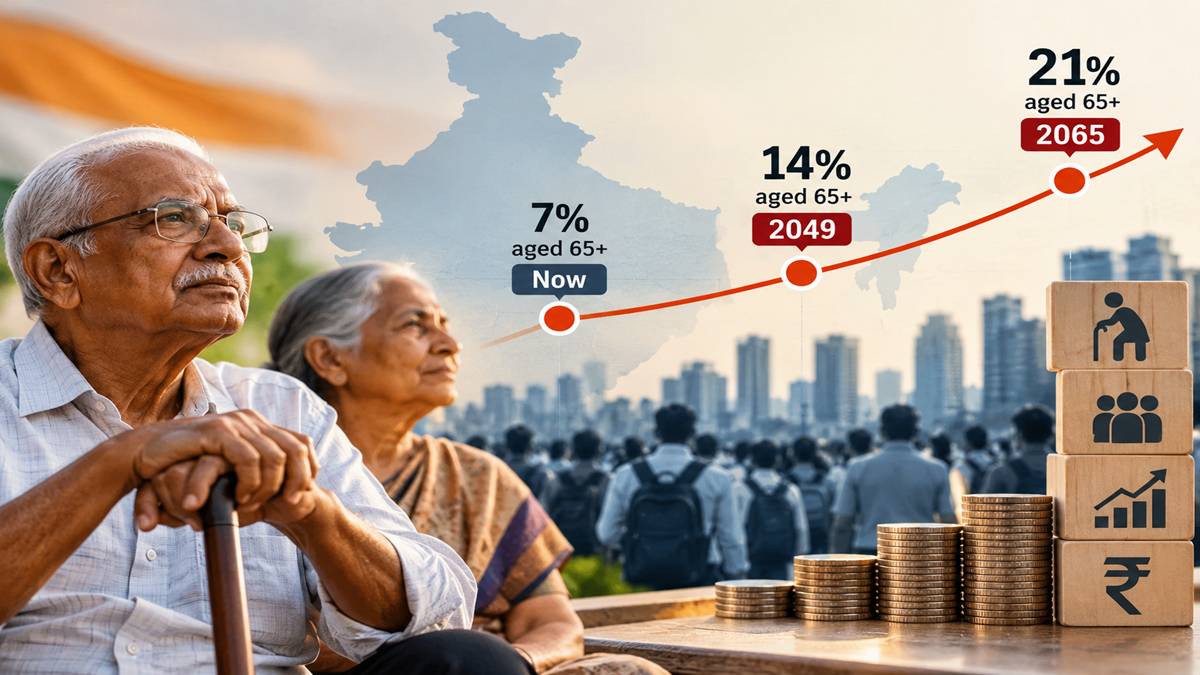
India Faces Rapid Aging Before Becoming a High-Income Economy
Experts Examine Possible Air Pollution Links to Gynaecological Cancer

Why More Indians Under 35 Are Considering Bariatric Surgery
Odisha Urged to Restore Double-Fortified Salt in School Meals

Supreme Court Commutes Death Sentence, Clarifies Rarest Of Rare Doctrine
