3 weeks ago
Global food system better prepared for 'super' El Nino
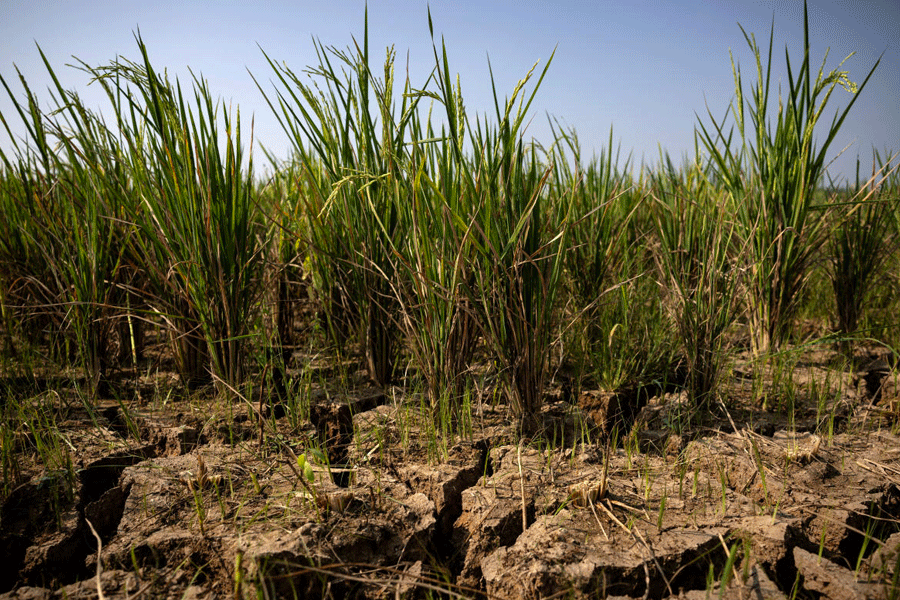
El Nino is a big weather pattern over the ocean that can make some parts of the world very dry and other parts very rainy.
This year, a very strong El Nino, called a 'super' El Nino, is happening.
It has already made it harder to grow food in places like India, Australia, Indonesia and Thailand.
In the past, big El Ninos caused food shortages because farms could not grow enough food.
Now, the world is much better prepared.
Farmers have special seeds that can grow well even when it is dry, and better ways to water their fields.
Countries have stored up lots of extra wheat, rice and other food.
Big farming countries like Brazil and Russia can now sell more food to the rest of the world.
So even though dry weather is coming, there should be enough food for everyone.
Some things, like wars that make farm supplies expensive, could still cause problems, so experts are watching carefully.

Near-record grain inventories, drought-tolerant seeds, improved irrigation and better weather forecasting are poised to cushion much of the fallout from this year's 'super' El Nino.
World farm production has outpaced consumption and population growth since the 1980s, according to the UN Food and Agriculture Organization and analysts.
El Nino has disrupted crop planting across large parts of Asia, including India, Southeast Asia and Australia, and is expected to intensify in the fourth quarter and early next year.
Brazil has become the world's biggest soybean supplier with exports up more than 13-fold since 1997/98, while Russia's wheat shipments jumped to 48 million tons last year.
Wars in the Middle East and Black Sea region, including the Strait of Hormuz blockade and higher fertiliser prices, temper some of the optimism over global food supplies.
- Who
- The UN Food and Agriculture Organization, analysts and farmers in major crop-producing countries including India, China, Brazil, Russia, Australia, Indonesia and Thailand.
- What
- The global food system is more resilient to this year's 'super' El Nino thanks to record farm stocks, better crop science, technology and new export powerhouses, though dry conditions have disrupted planting across Asia.
- Where
- Across large parts of Asia, including India, Southeast Asia and Australia, with the El Nino weather phenomenon driven by warming ocean surface temperatures in the eastern and central Pacific.
- When
- This year, with El Nino expected to intensify in the fourth quarter and early next year.
- Why
- Improved yields, near-record inventories, drought-tolerant crop varieties and new exporters such as Brazil and Russia are cushioning the impact of El Nino dryness on global food supplies and prices.
Preparedness view
Risk view
Severity of El Nino impact
Preparedness view
Improved preparedness, including better irrigation management and crop science, means disruptions are much less severe than in previous decades, according to Andrew Whitelaw of Episode 3.
Risk view
The El Nino is expected to be one of the strongest on record and 'the big impact of dryness has yet to come,' according to meteorologist Chris Hyde of SkyFi.
Risks to global food production
Preparedness view
Near-record inventories, drought-tolerant seeds and new export powerhouses like Brazil and Russia are poised to cushion much of the fallout from the El Nino.
Risk view
Wars in the Middle East and the Black Sea region and higher fertiliser prices temper optimism, with FAO chief economist Maximo Torero citing reduced use of agricultural inputs caused by the Strait of Hormuz crisis.
Key facts
- El Nino outlook
- Expected to be one of the strongest on record, intensifying in the fourth quarter and early next year
- India's share of global rice exports
- 40%
- Global wheat stocks held by China
- Nearly half
- Palm oil share of global edible oil exports
- About 60%
- Brazil soybean export growth
- More than 13-fold since 1997/98; world's biggest soybean supplier
- Russia wheat shipments
- 48 million tons last year, up from roughly 1 million tons in 1997/98
- Strait of Hormuz
- Carried about a fifth of global crude oil and LNG before being blockaded during the Iran war that began in February
- Past severe El Nino episodes
- 1997-98 and 2015-16 events slashed crop production, fuelling food shortages, inflation and sapping economic growth
Quotes
Andrew Whitelaw
Head of Australian agricultural consultancy Episode 3
“Expectations are that it will be one of the strongest on record, or the strongest the world has ever seen, and that means the big impact of dryness has yet to come”
 telegraphindia.com
“Even during drought conditions, better irrigation management and crop science mean we can still produce marketable yields”
telegraphindia.com
Sources
Related news
India's weak monsoon may add to global food inflation
El Niño and Fertiliser Risks Threaten India’s 2027 Food Outlook
UN Warns Strong El Niño Could Push Millions into Hunger
El Niño fears not over despite July monsoon revival

Latin America's super El Niño to impact top food-exporting region
Global food prices hit three-year high as supply fears build

US-Iran Strikes Escalate as Tehran Warns of New Strategy

Trump Warns of Fresh Iran Strike After Heavy Attack

Trump Says US Could Attack Iran Again at Will

U.S. Treasury Yields Ease as Jobs Data Misses Expectations

Iran Seizes Fuel-Smuggling Vessel in Gulf, Arrests 11 Crew