4 days ago
India’s High-Speed Rail Threatens Aviation’s Domestic Golden Age
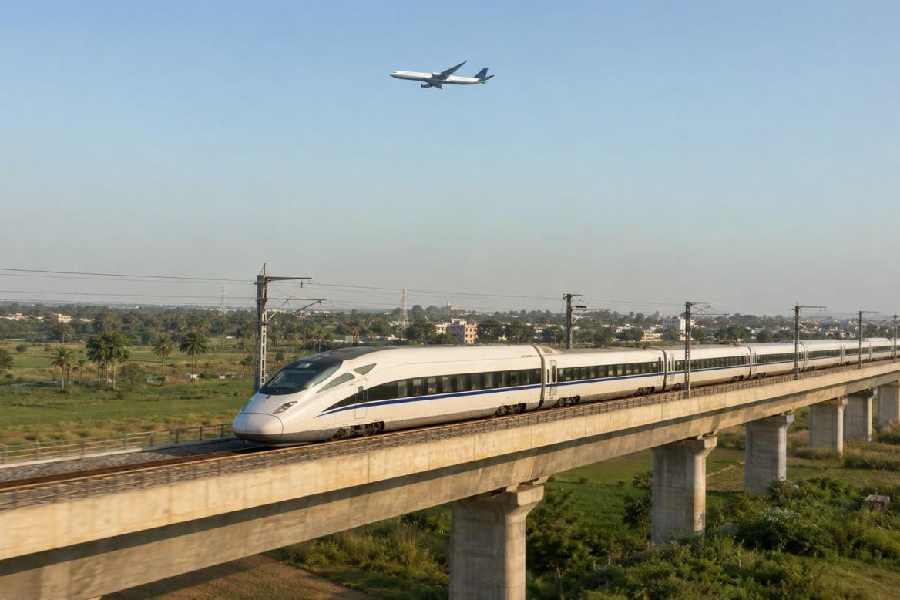
India is building very fast trains that could compete with airplanes.
The first service is expected to open in August 2027 on part of the Mumbai-Ahmedabad route.
Some trips could become as quick as flights, without needing to travel to an airport.
This may reduce the number of people flying between nearby cities.
Airlines in other countries have lost passengers when fast trains opened on similar routes.
Indian airlines are already growing, but they have also been losing money.
Airlines may respond by focusing more on international journeys, which trains cannot serve.
The change will probably take years and depends on construction, land acquisition, and ticket prices.

India’s 2026-27 budget announced seven high-speed rail corridors spanning nearly 4,000 kilometres.
The first bullet train is expected to begin partial operations between Surat and Bilimora in August 2027.
Proposed travel times include 48 minutes from Mumbai to Pune and 78 minutes from Bengaluru to Chennai.
Indian airlines carried more than 165 million passengers in FY2025 but recorded losses of nearly Rs 5,289.73 crore.
International evidence suggests high-speed rail can sharply reduce airline demand on competing routes lasting roughly two to three hours.
- Who
- The Indian railways ministry, led by Ashwini Vaishnaw, airlines, investors, and travellers are central to the development.
- What
- India is planning seven high-speed rail corridors that could take passengers away from domestic airline routes.
- Where
- The planned network includes western, southern, and northern corridors linking cities such as Mumbai, Ahmedabad, Pune, Hyderabad, Bengaluru, Chennai, Delhi, Varanasi, and Siliguri.
- When
- The Union budget announced the corridors for 2026-27, and the first bullet-train service is expected to begin partially in August 2027.
- Why
- High-speed rail is expected to provide fast, city-centred travel on 300-800 kilometre routes while reshaping regional economic connections.
High-Speed Rail Expansion
Airline Adaptation and Caution
Effect on domestic routes
High-Speed Rail Expansion
High-speed rail is likely to dominate competing short- and medium-distance routes, especially journeys that can be completed by train in roughly two to three hours.
Airline Adaptation and Caution
Airlines may lose capacity on competing routes but can redirect aircraft toward international markets such as Mumbai-Dubai and Delhi-London.
Economic impact
High-Speed Rail Expansion
Connected cities could form integrated economic zones, create secondary economic nodes, and support industrial clusters along the corridors.
Airline Adaptation and Caution
These benefits are not guaranteed and depend on infrastructure execution, land acquisition, and whether ticket prices remain accessible to middle-income travellers.
Timing of the shift
High-Speed Rail Expansion
Global examples indicate that rail can substantially reduce or even eliminate air service on directly competing routes.
Airline Adaptation and Caution
The railways minister’s prediction may be directionally correct but chronologically optimistic; India’s modal shift is expected to take years rather than months.
Key facts
- Planned corridors
- Seven high-speed rail corridors
- Total planned length
- Nearly 4,000 kilometres
- Estimated cost
- Rs 16 lakh crore
- First expected operation
- Partial Mumbai-Ahmedabad service between Surat and Bilimora in August 2027
- FY2025 airline passengers
- More than 165 million
- FY2025 airline losses
- Nearly Rs 5,289.73 crore
- Proposed travel time
- Mumbai to Pune in 48 minutes
Sources
Related news
Proposed Bullet Train Could Cut Delhi-Patna Travel Time

India’s Indigenous Bullet Train Project Nears First Launch
Indian Railways Plans Four-Tracking Seven High-Density Corridors Nationwide
Indian Railways Plans Four-Laning of 11,000-Km High-Density Network

Noida Airport Faces Slow Growth, Losses and Tough Competition

India Aims Electric Air Taxi Test Flights by 2028

India's New Smartphone Scheme Faces Consumer Product Test
Vaishnaw Explains India’s Journey From Sand to Semiconductor Chips

Adityanath Accuses Previous Governments of Hiding Encephalitis Deaths
Upgraded Nepalganj Road-Bahraich Rail Section Inaugurated in Uttar Pradesh