1 hr ago
GDP Growth Debate Shows Why One Number Misleads
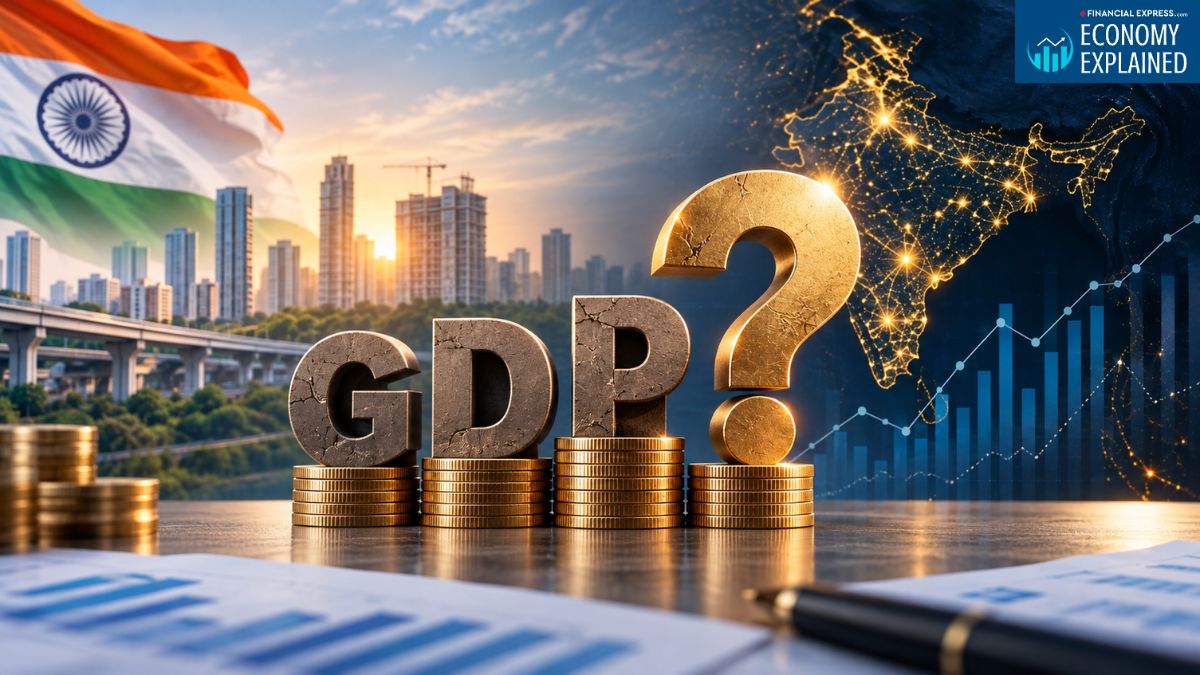
The government reported that the economy grew 7.8% in the first quarter of the fiscal year.
Some critics believe the number is much lower after looking at the data differently.
The author jokingly makes another estimate that reaches almost 10%.
He does this by adding together past GDP revisions, night-time light data and growth in poorer states.
The joke shows how easy it is to create different numbers when methods are mixed.
GDP measures economic activity, but it does not measure whether people are happy or struggling.
It also cannot fully show problems such as poor roads, expensive food or shortages of teachers and toilets.
GDP is still useful for seeing the economy’s general direction.
The author argues that people should question GDP carefully instead of treating it as either perfect or fake.

Official data put real GDP growth in the fiscal year’s first quarter at 7.8%.
Former Finance Secretary Subhash Chandra Garg recalculated nominal growth at 2.6% and real growth at zero.
The article’s deliberately stacked adjustments produce a satirical estimate approaching 10%.
Past revisions, night-time luminosity and faster growth in poorer states are cited as reasons to question the headline figure.
The author says GDP remains useful, but cannot measure happiness, living standards, governance or economic fairness.
- Who
- India’s official statistical system, former Finance Secretary Subhash Chandra Garg, opposition leaders, economists and the article’s author.
- What
- A debate over whether first-quarter real GDP growth was 7.8%, zero, or close to 10% under different calculations.
- Where
- India, with examples involving Bihar, Chhattisgarh, Uttar Pradesh and Odisha.
- When
- The debate concerns the first quarter of the current fiscal year; the article also cites historical data from FY15–FY25 and 1992–2019.
- Why
- Different methods, revisions and alternative indicators can produce different growth estimates, while GDP does not measure many aspects of people’s lived experience.
GDP Critics
GDP Defenders and Cautious Analysts
Accuracy of the 7.8% figure
GDP Critics
Subhash Chandra Garg and some economists argue that alternative calculations imply much weaker growth, including zero real growth.
GDP Defenders and Cautious Analysts
The official figure reports 7.8% real growth, and the author says GDP remains a useful measure even though it has limitations.
Use of alternative indicators
GDP Critics
Critics can use nominal growth, revised calculations and other data to argue that the headline number does not reflect economic reality.
GDP Defenders and Cautious Analysts
The author’s near-10% estimate is intentionally satirical, showing that stacking unrelated adjustments onto GDP can produce an apparently precise but misleading result.
What GDP says about people’s lives
GDP Critics
A strong GDP number may coexist with unaffordable goods, poor infrastructure, inadequate public services and people struggling financially.
GDP Defenders and Cautious Analysts
GDP is not designed to measure happiness or governance, but it remains an accessible indicator of the economy’s broad direction.
Key facts
- Official real GDP growth
- 7.8% in the first quarter of the fiscal year
- Subhash Chandra Garg’s calculation
- Nominal GDP growth of 2.6% and real growth of zero
- Historical GDP revisions
- Growth rates were revised upward 28 out of 44 times, with an average revision of 1.05 percentage points
- Q1 revision pattern
- Q1 growth was revised upward in 7 of 11 years from FY15 to FY25; the average upward revision from FY22 to FY25 was 1.06 percentage points
- Night-time luminosity
- The article cites an RBI study finding annual luminosity growth of 7.1% from 1992 to 2017, 0.6 percentage points above official real GDP growth
- Bihar luminosity
- Light intensity increased 220% between 2012 and 2019
- International examples
- The article says rebasing lifted Ghana’s and Nigeria’s real GDP by roughly 60% and 89%, while Ireland’s real GDP rose 26% in 2015
Sources
Related news
India’s GDP Growth Debate Extends Beyond Conflicting Statistics
MoSPI Defends India’s 7.8% GDP Growth Estimate

GDP Base Revision Debate Should Not Obscure India’s Growth
India’s Strong GDP Growth Faces Questions Over Official Data

Mishra Defends India’s 7.8% GDP Growth Against Critics
SBI Defends 7.8% GDP Growth Amid Data Doubts

IMF Welcomes India’s 7.8% Q1 FY27 Growth Amid Data Debate
UPSC Key Covers BRICS, Ladakh, Marital Rape, GDP Debate

Centre Defends GST Growth Figures Amid Base Comparison Dispute
India’s GDP Debate Intensifies as Calls for Data Transparency Grow