

5 hrs ago
Mishra Rejects Claims India’s GDP Growth Was Only 2.6%
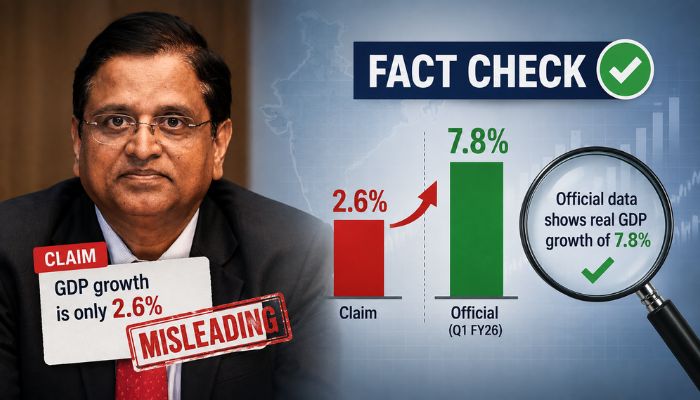
India reported that its economy grew 7.8% in the June quarter.
Some people, including former finance secretary Subhash Garg, said growth may have been only 2.6%.
Garg connected his argument to a change in the reported size of the economy.
Neelkanth Mishra strongly disagreed with that interpretation.
He said India began using a better GDP calculation method in February 2026.
He also said the change to the GDP base was known in March.
Mishra pointed to strong vehicle sales, tax collections, lending and construction as evidence that economic activity was strong.
However, he said weak wage growth shows that the economy still has some unused capacity.

India’s June-quarter GDP growth was reported at 7.8%, while some claims put actual growth at 2.6%.
Former finance secretary Subhash Garg linked the 2.6% claim to a revision in nominal GDP from ₹86 lakh crore to ₹80 lakh crore.
Neelkanth Mishra called the claim “ill-educated,” “egregiously wrong” and “obviously wrong.”
Mishra said the GDP series introduced in February 2026 improved methodology, data quality and real-output estimates.
Vehicle sales, tax collections, credit growth and construction indicators were cited as signs of firm economic activity, though weak real wages indicate remaining slack.
- Who
- Neelkanth Mishra defended the 7.8% estimate, while former finance secretary Subhash Garg was identified as making the 2.6% argument.
- What
- A dispute over whether India’s June-quarter GDP growth was 7.8% or effectively 2.6% after accounting for changes to the GDP series and base.
- Where
- India; Mishra made his comments on X.
- When
- The dispute followed the June 2026 quarter’s GDP release; Mishra’s comments were posted on September 3, 2026, and referred to a series introduced in February 2026.
- Why
- The disagreement concerns revisions to nominal GDP, the GDP base and methodology used to estimate real economic growth.
The 2.6% Growth Interpretation
Mishra’s Defense of 7.8% Growth
Effect of the GDP revision
The 2.6% Growth Interpretation
Subhash Garg argued that nominal GDP was revised from ₹86 lakh crore to ₹80 lakh crore and that, without the revision, growth would have been 2.6%.
Mishra’s Defense of 7.8% Growth
Neelkanth Mishra said the conclusion was obviously and egregiously wrong, arguing that the revised series gave more credible estimates of real output.
GDP methodology
The 2.6% Growth Interpretation
Critics argued that using the original June 2025 base rather than the revised series would materially lower growth in the June 2026 quarter.
Mishra’s Defense of 7.8% Growth
Mishra said the February 2026 series cleaned up the data and significantly improved methodology, including the treatment of deflators; he added that the downward base revision was known in March.
Evidence of economic momentum
The 2.6% Growth Interpretation
The criticism focused on whether statistical revisions made the headline growth rate appear stronger than underlying activity.
Mishra’s Defense of 7.8% Growth
Mishra pointed to vehicle dispatches, tax collections, recovering credit growth and robust construction indicators as evidence of strong activity, while acknowledging weak real-wage growth and continuing economic slack.
Key facts
- Reported GDP growth
- 7.8% year-on-year in the June quarter
- Contested growth figure
- 2.6%, according to the claim criticized by Mishra
- Nominal GDP revision
- From ₹86 lakh crore to ₹80 lakh crore, according to Subhash Garg’s argument
- New GDP series
- Introduced in February 2026 with revised data and methodology
- Vehicle activity
- Passenger-vehicle dispatches rose 35% year-on-year in August, two-wheelers grew by more than 20%, and commercial vehicles by more than 40%
- Morgan Stanley forecast
- FY27 GDP growth forecast raised to 7.3% from 6.7%
- Remaining weakness
- Mishra said weak real-wage growth indicates that economic slack remains
Quotes
Neelkanth Mishra
World Bank Executive Director and Axis Bank Chief Economist
“As expected, with the fiscal headwinds fading and monetary headwinds (falling credit growth till 1HFY26) becoming tailwinds (credit growth accelerating), GDP growth is surprising on the upside, and should help push up consensus trend-growth estimates to 7 per cent-plus. That is, with a neutral fiscal and monetary policy, the economy should still register 7.5 per cent growth.”
 m.rediff.com
 financialexpress.com
“there is still slack in the economy, as seen in weak real-wage growth. It may take several quarters of above-trend growth for that slack to tighten and to bring back sticky inflation pressures.”
financialexpress.com
Sources
Related news

Government Defends India’s 7.8% Q1 GDP Growth Amid Debate
Centre Rejects 2.6% GDP Claim, Defends 7.8% Growth
Government Rejects 2.6% Claim, Defends India’s 7.8% GDP Growth

Sanyal Defends India’s 7.8% GDP Growth Amid Opposition Questions
SBI Defends 7.8% GDP Growth Amid Data Doubts
India’s 7.8% GDP Growth Sparks Methodology Debate Over Q1 Estimates

SpaceX Plans Texas Foundry to Ease AI Power Bottleneck
India's Strong Q1 GDP Raises FY27 Growth and Rate-Hike Expectations
HDFC Bank Shares Rise as CEO Selection Process Advances

Morgan Advanced Materials Exits Foseco India With Rs 678-Crore Sale
