9 hrs ago
India’s GDP Growth Debate Extends Beyond Conflicting Statistics
The government says India’s economy grew by 7.8% in the first quarter of the fiscal year.
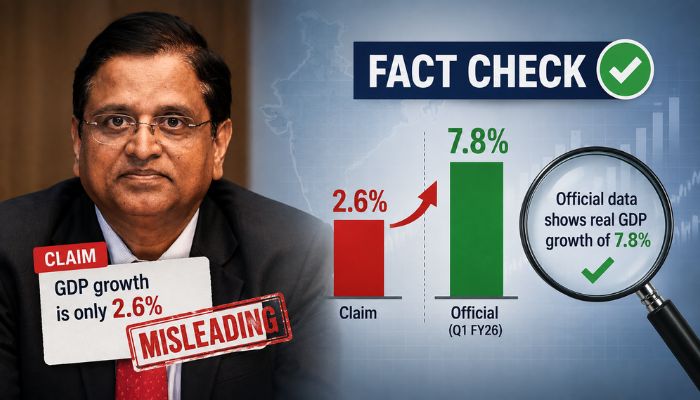
Subhash Chandra Garg says the economy grew by only 2.6%.
These numbers are very different, so economists are debating how growth should be measured.
Officials say newer calculations use more surveys, tax records and company information.
Critics say the government needs to explain its methods more openly.
Another concern is that strong GDP growth may not create enough good jobs.
Millions of young people enter India’s workforce every year.
The debate is therefore about both the accuracy of the number and whether growth improves people’s lives.

The government reported 7.8% GDP growth in the first quarter of this fiscal year.
Former finance secretary Subhash Chandra Garg argued that growth was only 2.6%.
Former chief economic adviser Arvind Subramanian previously said post-2011 growth may have been overstated.
The dispute has highlighted concerns about transparency, methodology and the credibility of official economic data.
The central issue is whether growth is broad-based and generating stable, productive employment.
- Who
- The Indian government, former finance secretary Subhash Chandra Garg, former chief economic adviser Arvind Subramanian, Neelkanth Mishra and Gaurav Vallabh are central to the debate.
- What
- They are disputing whether GDP grew by 7.8% or 2.6% in the first quarter of the fiscal year.
- Where
- The debate concerns India’s national economic accounts.
- When
- The government released its 7.8% figure early this week; Subramanian’s related critique was published in June 2019.
- Why
- The disagreement reflects questions about GDP methodology, data transparency, employment creation and whether growth is producing broad prosperity.
Official estimate
Alternative estimate and concerns
First-quarter growth
Official estimate
The government reported that GDP grew by 7.8% in the first quarter of the fiscal year.
Alternative estimate and concerns
Subhash Chandra Garg said growth was only 2.6%, creating a major dispute over the scale of expansion.
GDP methodology
Official estimate
Gaurav Vallabh said revised estimates reflect changes in economic coverage and use surveys, GST records, company data and government records, not merely price changes.
Alternative estimate and concerns
Critics argue that limited transparency makes it difficult for the public to assess the credibility of the figures.
Meaning of growth
Official estimate
Supporters of the official figure emphasize the reported pace of economic expansion.
Alternative estimate and concerns
Critics say the more important test is whether growth is broad-based and creates adequate, productive livelihoods.
Key facts
- Official growth estimate
- 7.8% in the first quarter of the fiscal year.
- Alternative estimate
- Subhash Chandra Garg said growth was 2.6%.
- Earlier criticism
- Arvind Subramanian said growth had been overstated by about 2.5 percentage points per year after 2011.
- Earlier reported growth
- Subramanian said reported average growth from 2011 to 2016 was 6.9%, while actual growth may have been 3.5% to 5.5%.
- Methodological changes
- The revised approach incorporated new surveys, GST records, improved company data, government records and broader economic coverage.
- Main concern
- High headline GDP growth may not translate into sufficient stable, reasonably paid and productive jobs.
Quotes

Arvind Subramanian
Former chief economic adviser who published a 2019 research paper challenging official growth estimates.
“Instead of reported average growth of 6.9 per cent between 2011 and 2016, actual growth was more likely to have been between 3.5 per cent and 5.5 per cent. Cumulatively, over five years, the level of GDP might have been overstated by about 9-21 per cent”
 thehansindia.com

Laurence J. Peter
American academic whose quotation is cited in the article’s discussion of transparency.
“Statistics are like a bikini. What they reveal is suggestive, but what they conceal is vital.”
thehansindia.com
Sources
Related news
India’s Strong GDP Growth Faces Questions Over Official Data
Goyal Defends India’s 7.8% GDP Growth Amid Data Debate

Government Defends India’s 7.8% Q1 GDP Growth Amid Debate

Mishra Defends India’s 7.8% GDP Growth Against Critics
Congress Challenges 7.8% GDP Growth as Revisions Draw Scrutiny
Government Rejects 2.6% Claim, Defends India’s 7.8% GDP Growth

Malviya Challenges Garg’s Reversal on India’s New GDP Series

Rijiju Shares Huang’s India Tech Praise Amid GDP Dispute
Old BJP Letter Questions Garg’s Economic Policy Approach