

Science & Tech · Science & Environment · 6 hrs ago
Roman Villa Excavations Near Wrexham Reveal Earlier Activity and Later Changes
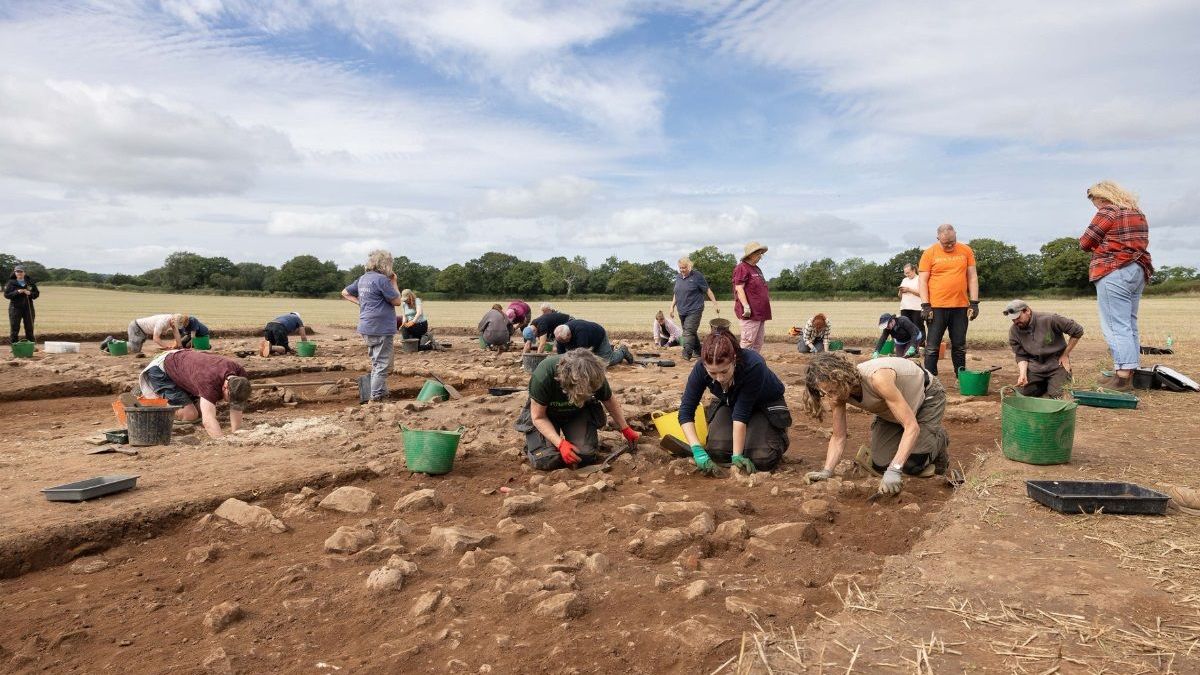
Archaeologists have uncovered a Roman villa complex near Rossett, close to Wrexham in northern Wales.
The site came to attention in 2019, when a local metal detectorist found a lead ingot bearing the name of a Roman governor.
Later excavations revealed Roman buildings and a medieval structure built partly with material taken from the Roman remains.
A complete quern stone, used to process grain, was found beneath the villa’s foundations, suggesting people were active there before the villa was built.
The villa appears to have been altered over time, and one part may have served as a bathhouse.
Intact floors, underfloor heating, painted wall plaster and imported pottery suggest its residents had wealth and links to wider Roman trade.
The discoveries add to evidence that Roman influence in this part of Britain was more extensive than previously thought, and further excavation seasons are revealing more about the area’s history.

Archaeologists excavating a Roman villa complex near Rossett, Wales, have found evidence that activity at the site began before the villa was built.
A complete quern stone was found in a layer beneath the villa’s foundation.
Excavations also indicate that the villa was built in phases and that its rooms changed uses over time.
The team found a building with intact floors and remains of a hypocaust heating system.
The finds add to evidence of Roman wealth and wider connections in the region.
- Who
- Archaeologists working at the site, including a team led by the University of Chester and DigVentures.
- What
- Excavations revealed a quern stone beneath the villa’s foundation and evidence of changes to the villa over time.
- When
- The quern stone and other findings were announced following a recent excavation; the sources do not give its date.
- Where
- Near Rossett, close to Wrexham in northern Wales.
- Why
- The findings help researchers investigate earlier human activity and how communities adapted in this part of Roman Britain.
This story does not have two clearly opposing sides.
Local metal detectorist Rob Jones found a 139-pound lead ingot in a field near Wrexham.
Subsequent investigations uncovered coins, ceramics and a Roman villa complex.
Archaeologists found a quern stone beneath the villa’s foundation and reported evidence of phased construction and changing uses.
- Quern stone
- Complete stone used for processing grain, found below the villa’s foundation
- Lead ingot
- 139 pounds; inscribed with the name of Marcus Trebellius Maximus
- Villa structures
- Two Roman structures have been uncovered, including a corridor villa
- Heating
- Remains of a hypocaust system were found in a building with intact floors
- Other finds
- Pottery, coins, animal bones and painted wall plaster
What people are saying
Finds like the quern stone allow us to look beyond the villa itself and begin exploring the much longer history of human activity in this landscape
a star find this year
Rather than representing a single moment in time, the archaeology is revealing a villa complex that evolved over generations, reflecting changing needs, ambitions and lifestyles
The quality of the buildings and artifacts reinforces the growing evidence that Roman influence in this region was more extensive than previously understood
Sources
Related news

Jonathan the tortoise’s gene switches may offer clues to long life

South Korea forecast to turn colder and windier on Wednesday

Forecast puts possible global warming by 2100 at up to 5.7°C
Fire ant nest found at freight centre in Sydney’s inner west
Medieval teeth show lead mining spread in England by the 7th century

Review finds broader evidence of human-caused climate change

Chinook salmon return to habitat opened by removal of four Klamath River dams

Mostly stable, summer-like weather forecast across Spain on Tuesday
El Niño drives record Pacific hurricane strength and longevity
Fossil study suggests animal life may be 200 million years older

Vienna team demonstrates a self-stabilizing thorium nuclear clock
