Science & Tech · Science & Environment · 1 day ago
Northern lights visible as far south as Devon, Hampshire and Kent
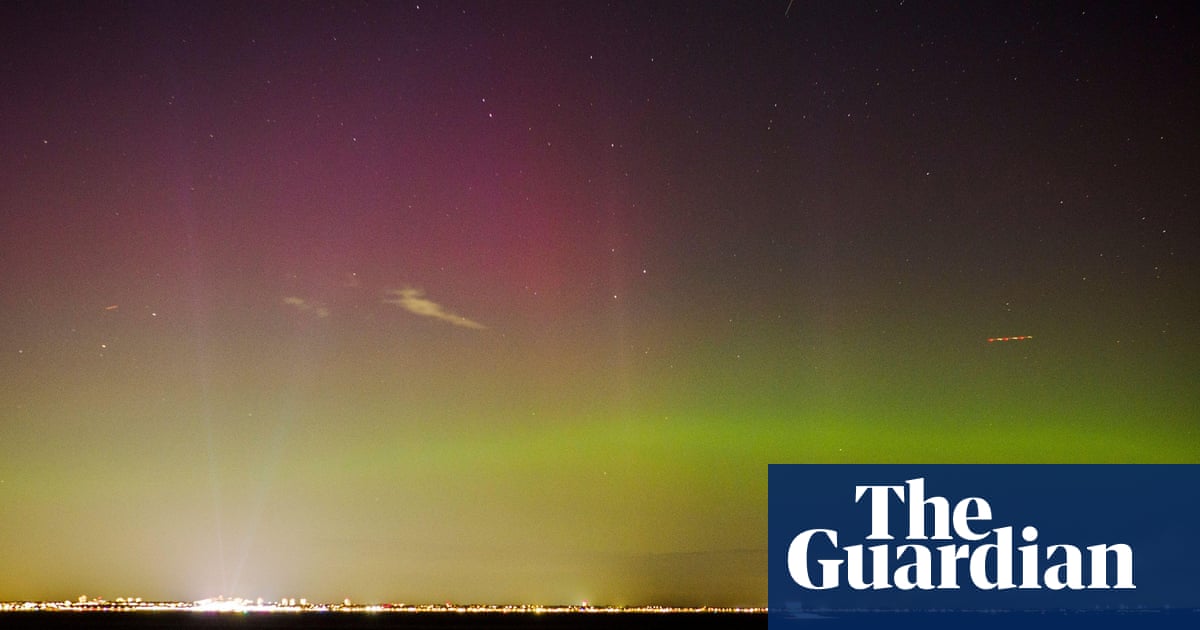
The northern lights appeared across the UK on Friday and Saturday evening, with sightings as far south as Devon, Hampshire and Kent.
The display, also called the aurora borealis, is usually seen near the Arctic Circle and in northern Scotland.
Strong solar activity sent charged particles towards Earth, where they interacted with the atmosphere and produced coloured light.
The colours depend on which gases the particles meet and how high in the atmosphere the collisions happen.
Experts have said 2026 could be a peak year for aurora viewing because the Sun is in a heightened phase of its 11-year activity cycle.
The Met Office said sightings may continue until Tuesday in clear skies, particularly across Scotland and areas at similar geomagnetic longitudes.
People hoping to see the lights are advised to look north and away from bright streetlights.

The northern lights were seen across the UK on Friday and Saturday evening, including as far south as Devon, Hampshire and Kent.
The Met Office said sightings could continue in clear skies until Tuesday.
The aurora borealis is caused by solar activity interacting with Earth’s magnetic field and upper atmosphere.
The lights are usually most visible near the Arctic Circle and northern Scotland.
Experts have said 2026 could be a peak year for aurora-spotting as the Sun remains in a heightened phase of its 11-year cycle.
- Who
- Stargazers across the UK saw the northern lights.
- What
- The aurora borealis illuminated the skies. Further sightings may be possible in clear conditions until Tuesday.
- When
- Friday and Saturday evening; sightings may continue until Tuesday.
- Where
- Across the UK, including Devon, Hampshire and Kent.
- Why
- Solar activity and geomagnetic storms caused charged particles to interact with gases in Earth’s upper atmosphere.
This story does not have two clearly opposing sides.
When these particles interact with Earth’s magnetic field – especially when the solar wind’s polarity is opposite to Earth’s – they are funnelled toward the magnetic poles.
As these energetic particles collide with gases in the upper atmosphere, they release energy in the form of light. Oxygen produces green and, at higher altitudes, rare red auroras, while nitrogen creates blue and purple hues.
The northern lights were visible across the UK, including in southern counties.
The Met Office said sightings could remain possible in clear skies.
- Southern sightings
- Devon, Hampshire and Kent
- Possible viewing period
- Until Tuesday in clear skies
- Solar wind speed
- About 1m mph, according to the Met Office
- Aurora colours
- Oxygen can produce green and red; nitrogen can produce blue and purple hues
- Solar cycle
- 11-year cycle
Sources

Related news

Study links powerful waves in Kara Gate Strait to tides

Study finds evidence of violence in Iron Age and Viking-era remains

Vienna team demonstrates a self-stabilizing thorium nuclear clock
Amazon wildfire ozone reduces surviving trees’ carbon uptake

Passive cooling could reduce Colombo homes’ reliance on fans and air conditioners

Researchers engineer lettuce to produce a meat protein
Researchers observe heavy-fermion states at an atomic-layer interface

Worm-like robot shifts its weight to cross land, climb steps and swim

Seven Indigenous sites in the US trace Native American history

Wormhole research shifts toward quantum gravity and black holes
Edmonton startup aims to make quantum equipment portable