Science & Tech · Science & Environment · 1 day ago
Light-sensitive tattoo ink can switch between colour and near invisibility

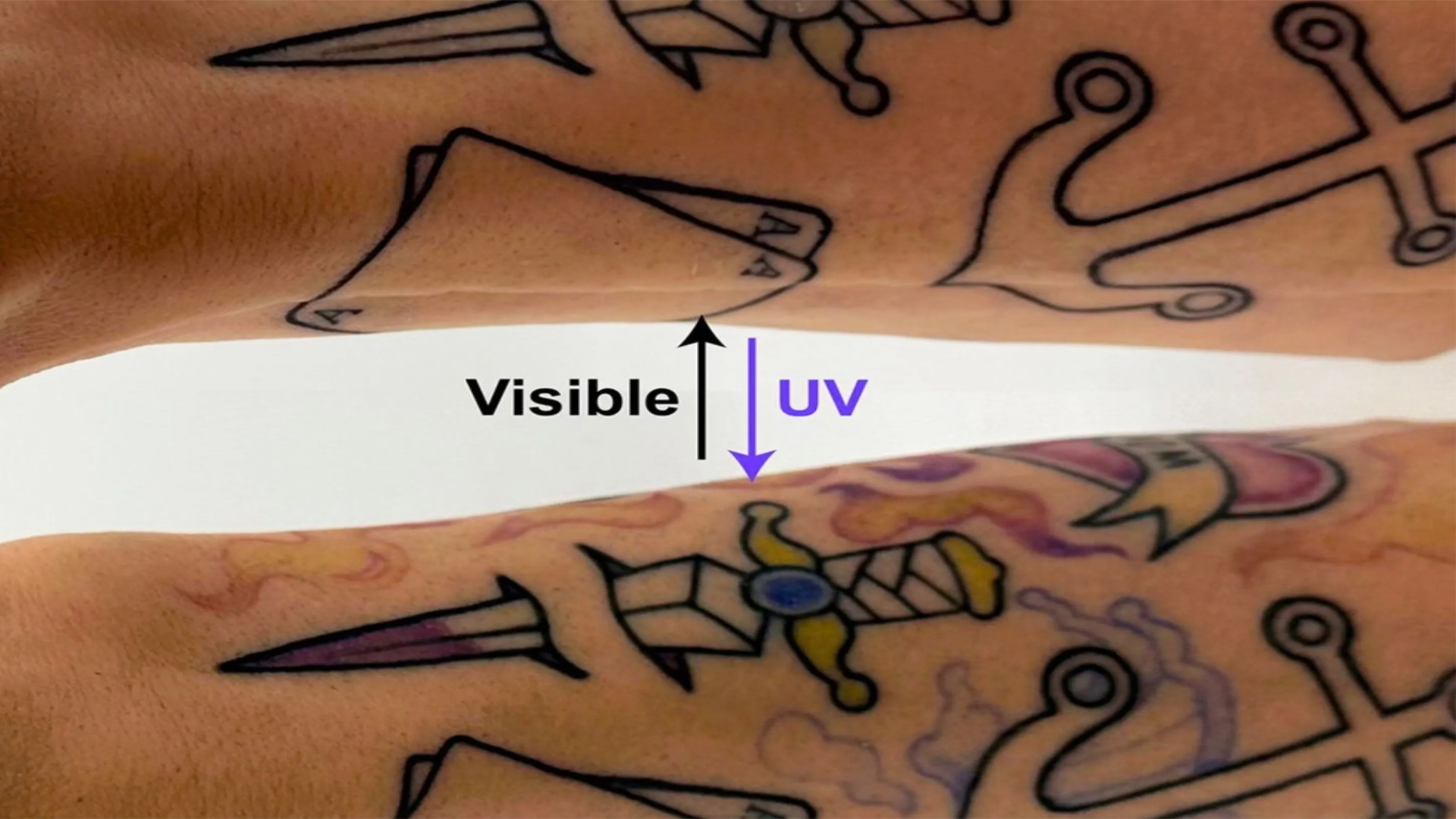
Researchers at the University of Colorado Boulder have developed PhotoTat, a tattoo ink that changes appearance when exposed to light.
Ultraviolet light makes its dyes show colour, while bright visible light can fade them back to near invisibility.
The team demonstrated designs on silicone and excised pig skin, and researcher Carson Bruns has tested the ink in a tattoo on himself.
He says it still responds to light after more than two years, but one person’s experience cannot establish that it is safe for everyone.
The ink could also be used for medical tattoos that help doctors guide radiation treatment, which can otherwise leave patients with lasting marks.
The researchers say the ink can produce 16 distinct colours and at least 300 shades, but it cannot make white or true cyan, and blue may become permanently purplish after repeated cycles.
Sunlight can activate the colours, so users would need sunscreen, and the dye’s toxicity is unknown.
Extensive safety studies are needed before the tattoos can be made available to the public.

Researchers at the University of Colorado Boulder have developed PhotoTat, a tattoo ink that can be switched between vivid colours and near invisibility using light.
Ultraviolet light activates the ink, while bright visible light can fade or erase its colour.
The researchers demonstrated designs on silicone and excised pig skin, and researcher Carson Bruns has tested the ink in a tattoo on himself for more than two years.
The ink can produce 16 distinguishable colours and at least 300 shades, but it cannot currently produce white or true cyan.
The technology could be used for body art or medical markings, but its safety for wider use has not been established.
- Who
- Researchers at the University of Colorado Boulder developed PhotoTat, with Carson Bruns as lead researcher.
- What
- They developed a light-sensitive tattoo ink that can switch between colour and near invisibility.
- When
- The articles were published on October 9 and 10, 2026.
- Where
- The research was conducted at the University of Colorado Boulder; demonstrations included silicone and excised pig skin.
- Why
- The ink could let people change or hide tattoo designs and could be used for medical markings, including marks that guide radiation therapy.
Carson Bruns and PhotoTat researchers
Signe Bedsted Clemmensen and safety concerns
Potential uses
Carson Bruns and PhotoTat researchers
Bruns says the ink could let people hide or change tattoos and could be useful for medical markings.
Signe Bedsted Clemmensen and safety concerns
Clemmensen says invisible tattoo ink is still a foreign substance in the body and may carry health concerns similar to traditional tattoo ink.
Safety
Carson Bruns and PhotoTat researchers
Bruns says the encapsulating polymer is non-toxic and has a history of use in permanent biomedical implants, while acknowledging that dye toxicity is unknown.
Signe Bedsted Clemmensen and safety concerns
Clemmensen points to concerns associated with tattoo ink; the articles say extensive safety studies are needed before PhotoTat is available to the public.
The tattoo is permanent, but its appearance is not.
ultraviolet light writes the colour in, bright visible light erases it, and the cycle can be repeated
Therefore, many of the same health considerations and concerns that apply to traditional tattoo ink are also likely to apply to invisible tattoo ink.
I get a lot of compliments on the fish scale tattoo.
Bruns had fish-scale PhotoTat ink tattooed on himself.
New Scientist reported on the light-activated tattoo ink and its potential uses and safety concerns.
Interesting Engineering reported on PhotoTat’s light-sensitive dyes, demonstrations and possible applications.
- Ink name
- PhotoTat
- Activation light
- 365-nanometre ultraviolet light
- Activation or deactivation time
- About two to three seconds of bright light
- Colours
- 16 distinguishable colours and at least 300 shades
- Demonstrations
- Silicone and excised pig skin
- Self-test
- Bruns’s tattoo continued responding to light 1.4 to 2.2 years after tattooing
Sources
Related news
Researchers map hair-like sensory cells across squid bodies
Bellbird and Seriema Among the Loudest Birds Measured
Survey finds only 83 mature cheetahs across a vast area of South Africa

British Columbia rogue wave was nearly three times taller than nearby waves
Detached sea cucumber tissue remained active for more than three years

New book examines the survival skills of 75 fierce forms of nature

Air pollution reaches ‘very poor’ levels in towns near Manaus
Young Puerto Rican parrot rescued from invasive boa
Warm, mostly sunny weather forecast across the Netherlands this week
Researchers confirm a new giant waterlily species in Colombia

Amazonas fires rise 271% in the first 10 days of October