Science & Tech · Space · 1 day ago
Total solar eclipse on 2 August 2027 could last up to 6 minutes 23 seconds
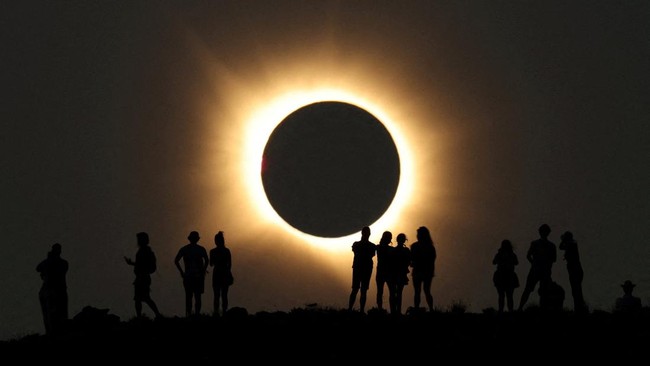
A total solar eclipse will take place on 2 August 2027, when the Moon will completely cover the Sun for people in parts of its path.
The path will cross southern Europe, North Africa and the Middle East, including Spain, Morocco, Egypt and Saudi Arabia.
The longest total phase is expected near Luxor, Egypt, where the Sun will be fully covered for up to 6 minutes 23 seconds.
That is longer than the total phases described for the 2026 eclipse and the April 2024 eclipse in North America.
A total eclipse happens when the Moon appears large enough to cover the Sun’s visible disk, briefly darkening the sky along the path.
People outside the path of totality may see a partial eclipse, with the Sun partly covered.
To protect their eyes, viewers must use approved eclipse glasses during partial phases and should not look directly at the Sun without them.

A total solar eclipse is expected on 2 August 2027, with totality lasting up to 6 minutes 23 seconds.
The path of totality is expected to cross parts of southern Europe, North Africa and the Middle East.
Luxor, Egypt, is identified as a key viewing location, while Mecca is also on the path.
The eclipse’s maximum duration is longer than the 2 minutes 18 seconds reported for the 2026 total solar eclipse and the 4 minutes 28 seconds reported for the April 2024 North American eclipse.
A total solar eclipse occurs when the Moon completely covers the Sun as seen from Earth.
- Who
- People in the eclipse’s path will be able to observe it.
- What
- A total solar eclipse, with totality lasting up to 6 minutes 23 seconds.
- When
- 2 August 2027.
- Where
- The path is expected to cross parts of southern Europe, North Africa and the Middle East, including Egypt and Saudi Arabia.
- Why
- The Moon will appear large enough to cover the Sun’s disk completely; the 2027 eclipse is described as unusually long.
This story does not have two clearly opposing sides.
A total solar eclipse is expected to cross parts of southern Europe, North Africa and the Middle East, with maximum totality of 6 minutes 23 seconds.
The next eclipse with a longer peak totality is expected to last 6 minutes 6 seconds near Florida.
- Date
- 2 August 2027
- Maximum totality
- 6 minutes 23 seconds
- Key viewing location
- Luxor, Egypt
- Path width
- Up to 258 kilometres
- Next longer peak totality
- 12 August 2045, near Florida
What people are saying
So far, Earth is the only planet we know of that experiences this type of solar eclipse.
Having a moon with the perfect size and distance to see this is truly special.
Sources
Related news
Perseverance rover sets record for driving distance on another world

SpaceX set to send solar arrays and supplies to the space station

SpaceX rocket plume creates a glowing ‘jellyfish’ in the dawn sky
NASA astronaut photographs auroras from the ISS with an iPhone

Hubble data point to a possible second-generation planet around a white dwarf

ORBES plans to send robots to the ISS and capture exterior footage

Vast engineer Brianna Clark works on technology for future space living

FAA analyst Kayla Bigham works to keep commercial spaceflight safe

Gold nanogap sensor distinguishes amino acid handedness
Halley's Comet disappointed many viewers in 1986 but advanced astronomy
New simulations suggest rare process forms Mars's giant Arsia Mons cloud